Blog ▸ Idle GPU Capacity Is a Cost Line: How to Turn It Into Revenue
GPU Infrastructure
Depreciation and power run on the calendar. The only line utilisation changes is revenue. How enterprises and labs list part of a cluster without becoming a cloud.
Idle GPU Capacity Is a Cost Line: How to Turn It Into Revenue
GPUaaS.com Team
GPU Infrastructure
October 8, 2026
No items found.
An idle H100 costs its owner roughly $30 a day in depreciation, contracted power, cooling and support whether or not a job is running on it, and listing that idle capacity for committed demand turns the same GPU into $60 to $72 a day of revenue at this month's band.
This post is for the CFO or infrastructure lead at an enterprise, lab or research institution that bought a GPU cluster, uses it in bursts, and has started to notice that the cost line does not move when the cluster does. It covers what idle capacity actually costs, why the usual fixes do not recover it, and how the demand channel works for an organisation that is not and does not want to become a cloud provider.
Key takeaways
Depreciation, contracted power, cooling, colocation and support run on the calendar. GPU utilisation does not change them
An 8-GPU H100 node costs its owner around $7,000 a month at zero utilisation. A B300 node costs $50,000 to $145,000 a year to run before depreciation
Published surveys put average enterprise GPU utilisation well under 50%, and many owned clusters sit idle between projects for weeks
Committed H100 demand pays $2.50 to $3.00 per GPU-hour on every contracted hour; B300 pays $5.00 to $6.50
Partial listings work. An enterprise can list 16 of 64 GPUs, keep the rest, and pull listed capacity back between contracts
The owner keeps the hardware, the facility, the operations and the choice of what to list. GPUaaS.com brings the buyer and holds the contract alongside both parties
◆ THE COST LINE
What a GPU costs when nobody is using it
The accounting for an owned cluster has one awkward property: almost every line is fixed. Depreciation on an H100 node bought at $300,000 runs at $8,000 a month on a three-year schedule whether the node trained a model or sat in standby. Colocation power is contracted by the kilowatt, not metered by the FLOP, and a node that draws 10 kW at load still draws most of that at idle. Cooling, rack space, support contracts, the people who run the thing: all monthly. The depreciation clock post works through the per-GPU figure and lands near $30 a day for an H100, all in.
For current-generation hardware the number is larger. A B300 node draws about 14.5 kW and costs $50,000 to $145,000 a year to run in colocation before depreciation, per the B300 node price breakdown. On a $600,000 node the depreciation adds another $200,000 a year. That is a quarter of a million dollars a year per node, and an idle node pays all of it.
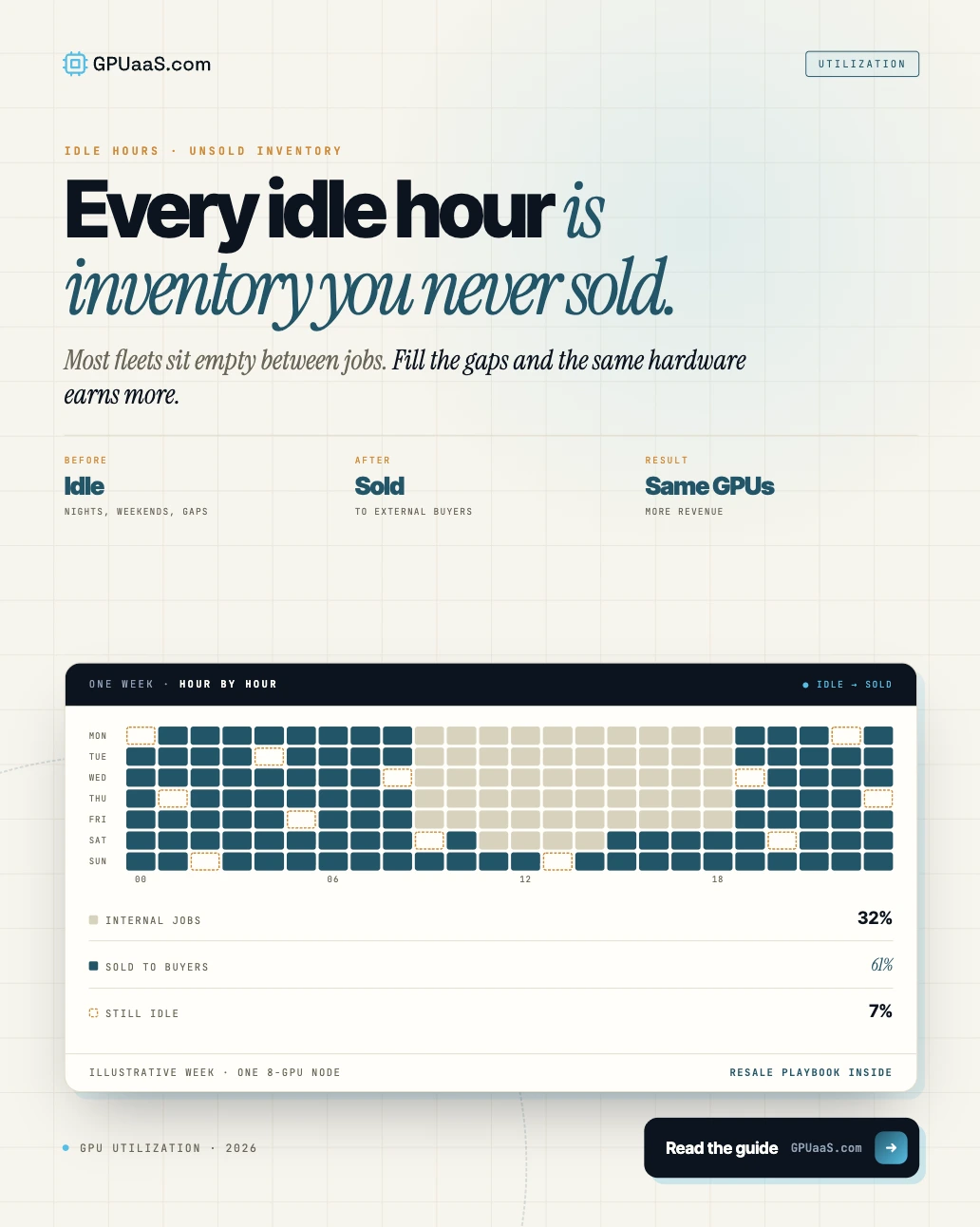
Utilisation is the only variable, and in most owned clusters it is low. Published surveys of enterprise GPU estates put average utilisation well under half, and the idle capacity problem post covers why: projects are bursty, procurement is sized for the peak, and the gaps between training runs are measured in weeks.
◆ IDLE COST AGAINST COMMITTED REVENUE, PER GPU, PER MONTH
GPU
Approx. fixed cost, idle
Committed band, Oct 2026
Revenue at 720 hours
Net swing
H100 SXM
About $900
$2.50 - $3.00
$1,800 - $2,160
$2,700 - $3,060
H200 SXM
About $1,100
$2.75 - $3.50
$1,980 - $2,520
$3,080 - $3,620
A100 80GB
About $500
$1.50 - $1.90
$1,080 - $1,370
$1,580 - $1,870
B300 SXM
About $2,600
$5.00 - $6.50
$3,600 - $4,680
$6,200 - $7,280
Illustrative. Fixed cost is depreciation plus run cost per GPU per month, derived from GPUaaS.com node cost analysis; actual figures depend on purchase price, facility and schedule. Committed bands from the GPUaaS.com October 2026 benchmark. Net swing is the difference between paying the fixed cost for nothing and earning the band on top of it. A100 80GB band is unconfirmed this month.
$0
the amount an idle GPU saves its owner against a busy one. The cost line runs on the calendar. The only thing utilisation changes is the revenue line
GPUaaS.com node cost analysis, October 2026
◆ WHY THE USUAL FIXES DO NOT WORK
Chargeback moves the cost. Scheduling fills the gaps with low-value work. Neither recovers it.
The first thing most finance teams reach for is a chargeback model, which the chargeback post covers in detail. Chargeback is useful for making internal teams feel the cost of what they request. It does not reduce the cost. It moves $7,000 a month from one cost centre to several, and the GPUs are exactly as idle afterwards.
The second is a better scheduler, which does raise utilisation, usually by filling gaps with lower-priority jobs that would not have justified the hardware on their own. That is better than idle, but it is spending a $30-a-day asset on work worth less than $30 a day, and it does nothing about the multi-week gaps between projects that no scheduler can fill from internal demand.
The third is selling the hardware, which the resale value post covers. Resale recovers some capital and ends the run cost, but it also ends the capability, and for most organisations the cluster was bought because the capability is needed some of the time. The question is what to do with the rest of the time.
◆ THE DEMAND CHANNEL
Renting out the rest of the time without becoming a cloud
The reason enterprises do not rent out idle GPUs is not that nobody wants them. It is that finding the buyer, qualifying them, pricing the capacity, writing the contract, provisioning access and billing for it is a business, and the enterprise is not in that business. The supply anchor post covers the split: the owner keeps the hardware, the facility and the operations; GPUaaS.com brings qualified committed demand, routes the request, and holds the contract alongside the owner and the buyer.
For an enterprise the mechanics that matter are the ones around control. Listing is partial: an organisation with 64 GPUs can list 16 and keep 48, and change that split between contracts. Listed capacity that is not under contract can be pulled back for internal use. The term is set per contract, so a cluster that is needed again in Q2 can be listed for a three-month term that ends in March. Nothing is installed on the nodes as a condition of listing, and the buyer gets dedicated access to the GPUs under contract, not to anything else in the facility.
The requests that arrive are committed-term asks from buyers who have already been through the demand side: a real spec, a real term, a real budget. The owner quotes inside the published band and, if accepted, provisions. The October demand snapshot covers what buyers are asking for this month, and the short version is that an idle H100 or H200 rack is competing for the most common request type on the platform.
◆ WHAT THE BOARD WILL ASK
Security, data, and whether this changes the accounting
Security comes first. A rented node is wiped between tenants and the buyer gets bare-metal or isolated access to the contracted GPUs, not a foothold in the network. Organisations with strict segmentation list capacity in a separate VLAN or a separate cage, and many already have that from the procurement that bought the cluster. Data residency works in the owner's favour: a rack in Frankfurt or Singapore with documented jurisdiction is the kind of capacity the network is shortest of, and the owner decides what to list and to whom.
On the accounting, rental income against an owned asset is revenue, and it offsets a cost line that was previously pure expense. The cost centre to revenue line post covers how enterprises have presented this internally, and the capex vs opex post covers what a board wants to see. The headline is that the depreciation does not change; what changes is that the asset earns during the months it would have earned nothing.
For inference-shaped idle capacity, there is a second route. packet.ai sells the same hardware as tokens rather than as a committed cluster, which suits capacity that is not idle in large contiguous blocks but is under-used on average. Both routes are open to the same organisation at the same time.
Turn the idle months into a revenue line.
List part of the cluster, keep the rest. One node is enough. No cost to apply or list, and you keep the hardware, the facility and the operations.
About $30 a day per H100 and considerably more per B300, covering depreciation, contracted power, cooling, colocation and support. None of those lines fall when the GPU is idle. An 8-GPU H100 node costs around $7,000 a month at zero utilisation; a B300 node runs $50,000 to $145,000 a year before depreciation.
By listing part of the cluster for committed demand through a network that brings the buyer, routes the request and holds the contract. The enterprise keeps the hardware, facility and operations, decides what to list, sets the term per contract, and pulls capacity back between contracts. Committed H100 demand pays $2.50 to $3.00 per GPU-hour on every contracted hour this month.
Yes. An organisation with 64 GPUs can list 16 and keep 48 for internal work, and change the split between contracts. The minimum listing is one 8-GPU node. Listed capacity not under contract can be returned to internal use at any time.
The buyer gets dedicated bare-metal or isolated access to the contracted GPUs only, nodes are wiped between tenants, and organisations with strict segmentation list capacity in a separate VLAN or cage. The owner decides what is listed and to whom, and documented data residency is a selling point rather than a risk.
Depreciation and run cost do not change. What changes is that rental income appears as revenue against an asset that previously only carried expense. Most enterprises present it as an offset to the infrastructure cost line rather than as a new business unit, and the contract structure keeps billing and collection off the owner's desk.
Sell it if the capability is no longer needed at all. Rent it out if the cluster is needed some of the time, because resale ends both the cost and the capability while renting keeps the capability and offsets the cost. Most organisations that bought a cluster still need it in bursts, which makes partial listing the better fit.
Last reviewed: 9 October 2026. Idle cost figures from the GPUaaS.com depreciation clock and B300 node price posts, 2026. Committed cluster bands from the GPUaaS.com October 2026 benchmark. Per-GPU monthly figures are illustrative and depend on purchase price, facility and depreciation schedule. List idle GPU capacity on GPUaaS.com.