Blog ▸ How to Sell GPU Capacity Without Building a Cloud Business
GPU Infrastructure
An idle H100 costs about $30 a day either way. What turns a rack into revenue is a buyer pipeline, and building one is a different business.
How to Sell GPU Capacity Without Building a Cloud Business
GPUaaS.com Team
GPU Infrastructure
October 1, 2026
No items found.
An idle H100 costs roughly $30 a day whether anyone rents it or not. The hardware was never the hard part.
What turns a rack into revenue is a buyer pipeline, and building one is a different business from running infrastructure.
Key points
One node is enough to list. There is no minimum fleet size
Quoting starts as soon as capacity is listed, against buyers already searching for something similar
Capacity can be listed before it lands, with a future available date
The same fleet can take short term and long term commitments, or serve inference demand
Interconnect, power density and support hours are what buyers check first
◆ THE SECOND BUSINESS
What selling capacity actually requires
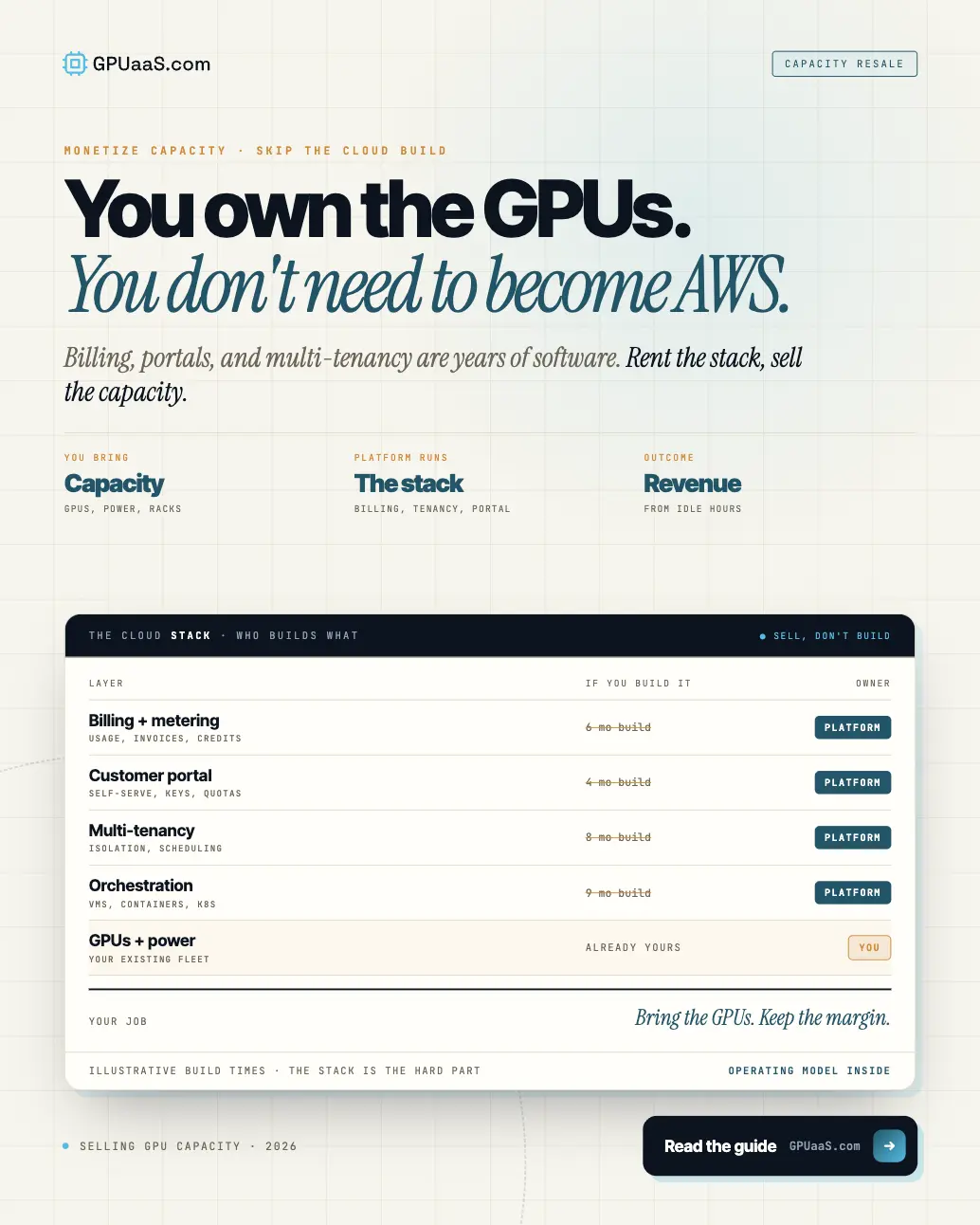
An operator with racks has already solved the difficult physical problems. Power contracted, cooling sized, hardware financed, staff trained, uptime maintained. That is a substantial business and it is already running.
Selling that capacity needs something else entirely. A pipeline of qualified buyers. People who can answer technical questions during a sales cycle. Billing that handles committed terms and overages. Support hours that match a buyer's expectations rather than your own. Contract templates, an SLA you can defend, and marketing to be found in the first place.
That is a second business with its own fixed costs, and the headcount alone usually exceeds what the idle capacity is worth. Which is why a lot of capacity simply sits.
~$30/day
the cost of a single idle H100, running whether or not a buyer is attached to it. Depreciation and power do not pause
Published utilization and idle-cost analysis, 2026
◆ NO MINIMUM FLEET
One node is enough to start
The assumption that stops most operators is scale. They have eight GPUs, or sixteen, and assume a demand channel only works for someone with a thousand.
Buyers ask for small committed clusters regularly. A sixteen-GPU request from a team fine-tuning on a deadline is a normal request, not an edge case, and small listings often fill faster than large ones because there are more requests that fit them.
Listing a single node is a valid starting point. It also costs nothing to find out whether demand exists for what you already own.
◆ QUOTING STARTS IMMEDIATELY
The requests exist before the capacity does
There is no waiting period while a listing works its way into a catalogue. From the moment capacity is listed it is quoted against buyers already searching for something similar.
Buyers are told quotes come back within a few hours, so response speed is the one thing asked in return. A provider who can answer the technical questions quickly wins deals a slower one does not.
◆ CAPACITY THAT HAS NOT LANDED YET
Listing ahead of delivery
Capacity can be listed with a future available date. Buyers planning a training run two months out commit ahead of delivery when the terms and the date are clear, and a rack that arrives with contracts already attached skips the ramp that usually follows installation.
That matters most on current-generation hardware, where lead times run long enough that the buyer and the provider are often waiting on the same delivery schedule.
◆ TWO KINDS OF DEMAND
Committed clusters or inference
The same hardware can take short term and long term commitments through GPUaaS.com, or serve inference demand through packet.ai.
The revenue profiles differ. Committed terms give predictable utilisation across a known period. Inference demand scales with usage rather than contract length, which suits capacity that is not fully booked.
◆ WHAT BUYERS CHECK
Have the answers ready
Interconnect tier is the first question on anything multi-node, and the gap between InfiniBand and Ethernet is priced differently by buyers who understand it. Power and rack density come next on current-generation hardware, since Blackwell-class racks draw more than most facilities were built for.
After that: support hours, replacement policy, uptime commitment, and where the data physically sits. Having those written down shortens every quote that follows.
The arithmetic that decides this is simple enough to do on one page. What the idle capacity costs to hold, against what a sales function would cost to build.
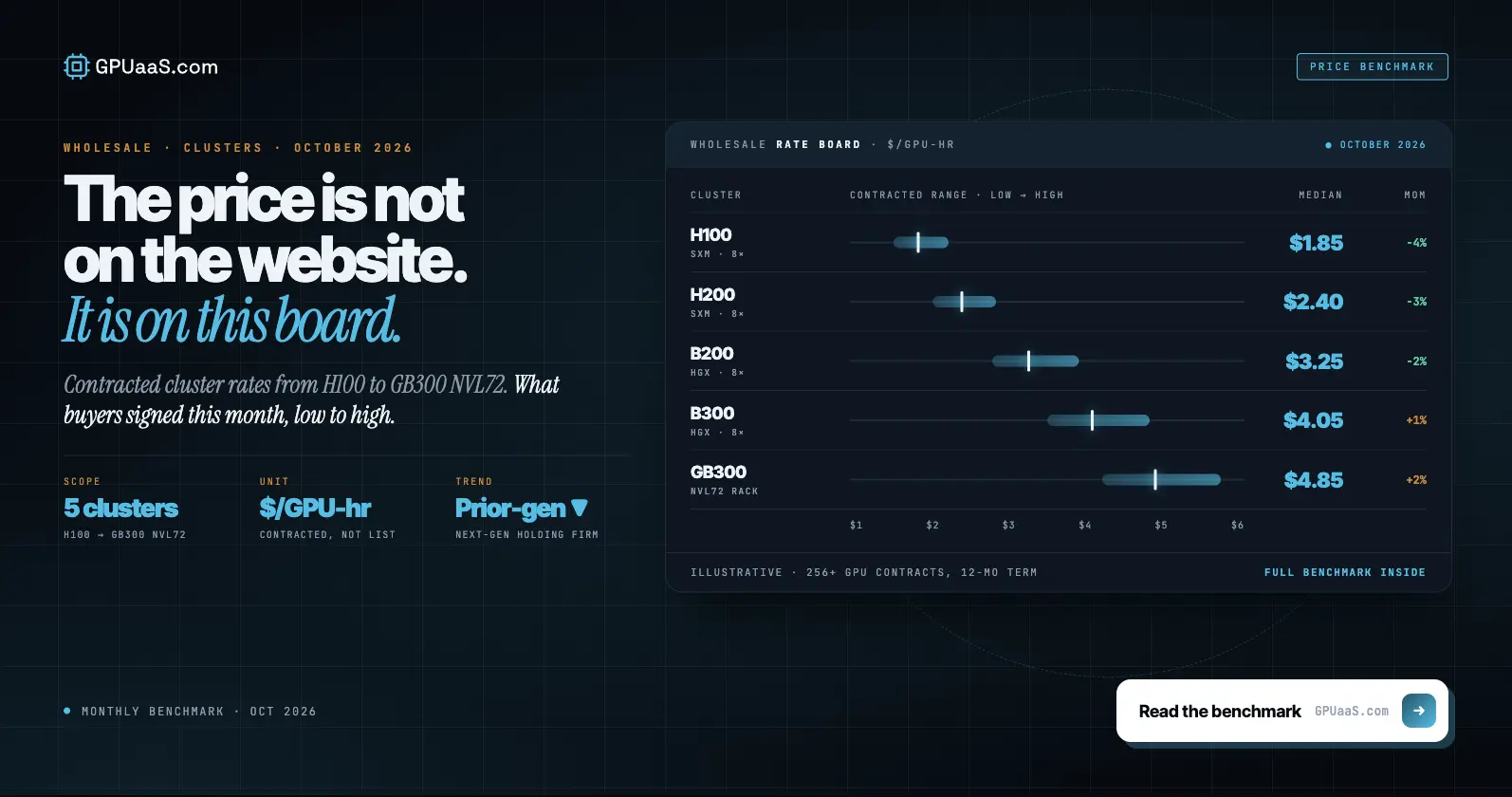
Current committed cluster bands by GPU are published in the October price benchmark, which is a reasonable place to check where your capacity would land.
List your capacity and start getting quoted.
One node is enough to start. Quoting begins as soon as your capacity is listed.
One node is enough. There is no minimum fleet size. Buyers regularly ask for small committed clusters, and small listings often fill faster because more requests fit them.
Quoting starts as soon as capacity is listed. It is matched against buyers already searching for something similar, so there is no waiting period while a listing works its way into a catalogue.
Yes. Capacity can be listed with a future available date. Buyers planning ahead commit before delivery when the terms and the date are clear, which means a rack can arrive with contracts already attached.
Interconnect tier on anything multi-node, then power and rack density on current-generation hardware. After that, support hours, replacement policy, uptime commitment and data residency. Having those written down shortens every quote.
Committed cluster demand through GPUaaS.com gives predictable utilisation across a known period, on short term or long term commitments. Inference demand through packet.ai scales with usage rather than contract length, which suits capacity that is not fully booked.
Last reviewed: 2 October 2026. Idle GPU cost figure from published utilization and idle-cost analysis, 2026. Committed cluster price bands referenced from the October 2026 benchmark. Apply to list GPU capacity on GPUaaS.com.