Blog ▸ Building a GPU Chargeback Model Teams Will Not Route Around
GPU Infrastructure
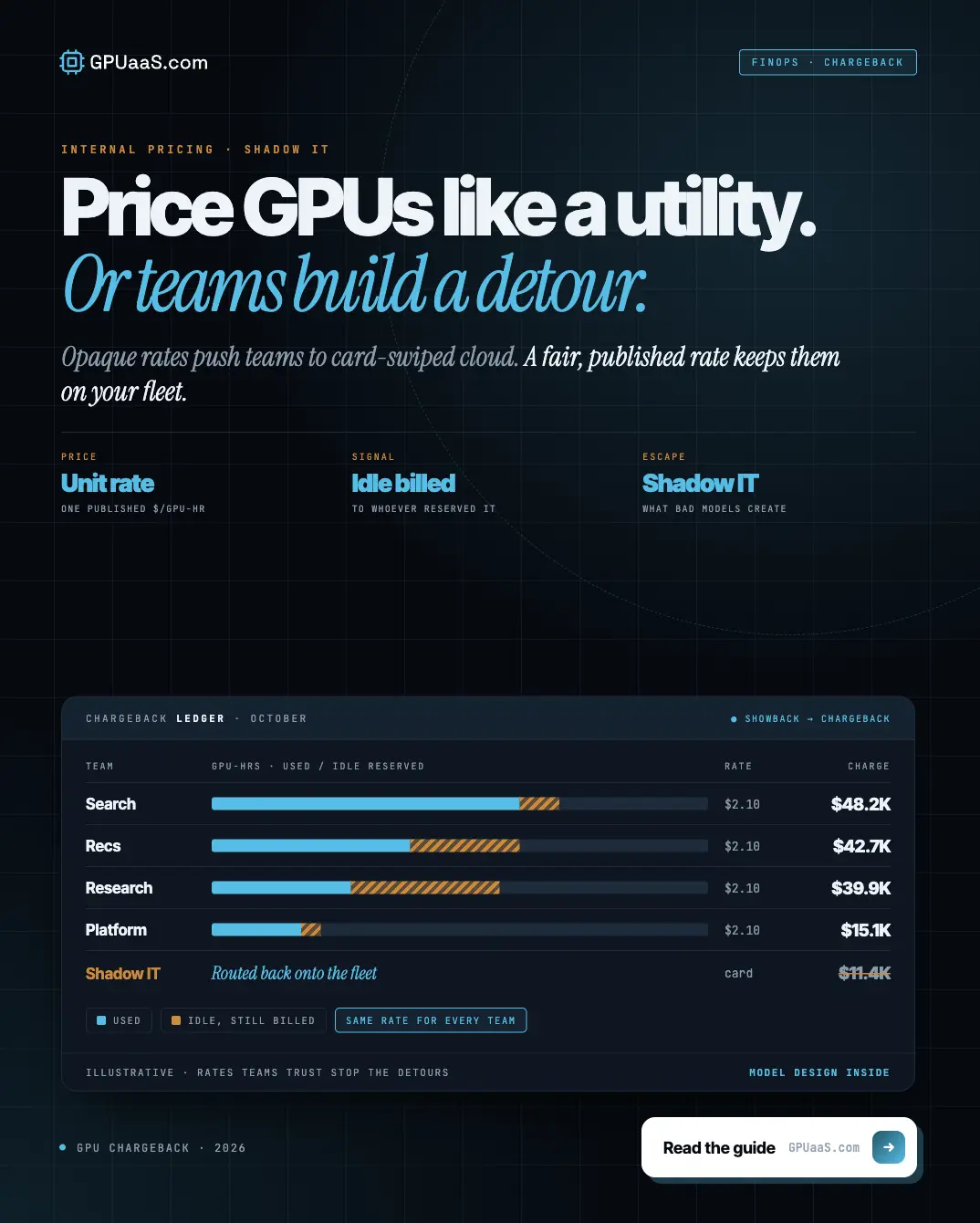
Attach financial consequences to imprecise allocation and teams optimise for allocation accuracy rather than cost efficiency. The three routes around a chargeback model.
Building a GPU Chargeback Model Teams Will Not Route Around
GPUaaS.com Team
GPU Infrastructure
September 21, 2026
No items found.
Attach financial consequences to imprecise allocation logic and teams optimise for allocation accuracy rather than cost efficiency.
That is the failure mode. The model gets gamed instead of followed, and the cluster gets no cheaper.
Key takeaways
Teams route around chargeback through selective tagging, shared-namespace dilution, and capacity hoarding. Each is a rational response to the allocation key
On a poorly tuned cluster 40 to 60% of the bill is idle. A 32-GPU cluster at 35% utilization wastes roughly $624 a day
Smearing idle cost across consuming teams makes efficient teams subsidise wasteful ones, which is how the model loses credibility
The defensible default is chargeback on direct costs and showback on shared ones, funded from the platform budget
Utilization is the wrong thing to charge against. Two teams at 70% can differ tenfold on cost per inference
◆ THREE ROUTES AROUND THE MODEL
Each one is a rational response
Three routes around a chargeback model show up repeatedly, and each one is a rational response to how the model was built.
Tag gaming is the simplest. Teams apply tags selectively so less of their consumption is attributable, and the untagged remainder lands in a pool somebody else funds.
Moving a workload into a shared namespace works better. Its cost spreads across several owners rather than one, so the charge disappears without the spend disappearing.
The allocation key creates the third route directly. Bill purely by GPU-hours consumed and a team that releases capacity early saves money for everyone except itself, so it holds the reservation instead.
None of those are bad actors. They are correct responses to a model that measured the wrong thing.
◆ WHERE CREDIBILITY IS LOST
Idle capacity, and who gets charged for it
Idle capacity is where most chargeback models lose credibility, and the numbers are large enough that the choice matters.
On a poorly tuned cluster, 40 to 60% of the bill is idle. A single idle H100 runs about $30 a day. A 32-GPU cluster sitting at 35% utilization wastes roughly $624 a day. Average enterprise GPU utilization measured across 23,000 production clusters came in around 5%.
Smear that idle cost silently across teams and efficient teams subsidise wasteful ones. The teams doing the best job see the largest unexplained line on their invoice, and the model loses the trust it needs to function.
$624/day
wasted by a 32-GPU cluster running at 35% utilization, a figure the allocation key decides the owner of rather than reduces
RealTimeCost Kubernetes namespace showback and GPU chargeback analysis, 2026
◆ THE DENOMINATOR PROBLEM
The rate rises when demand falls
There is a denominator problem underneath this that is worth understanding before picking a method.
If the rate is calculated from consumed hours only, the rate rises whenever demand falls. Teams absorb idle fleet cost implicitly, through a number that moves for reasons they did not cause and cannot see. A stable capacity rate with a separate idle pool produces the same total and is far easier to defend in a budget meeting.
◆ WHAT EACH ALLOCATION CHOICE PRODUCES
Choice
Behaviour it creates
Bill by GPU-hours consumed
Capacity hoarding, since releasing early benefits everyone else
Smear idle across consuming teams
Efficient teams subsidise wasteful ones
Rate from consumed hours only
Rate rises when demand falls, for no visible reason
No rule for platform namespaces
A rule gets invented under pressure
Charge on utilization percentage
Teams optimise utilization, not cost
◆ THE DEFENSIBLE DEFAULT
Chargeback direct, showback shared
The most defensible default is to charge back direct costs and show back shared ones.
Teams get billed for workloads they own. Idle capacity and platform overhead get published transparently but funded from the platform budget. That puts the cost of idle on the group with the authority to reduce it, which is the only arrangement where the incentive and the capability sit in the same place.
Platform namespaces accumulate unattributed overhead regardless. The gpu-operator, monitoring, and system namespaces produce real cost with no obvious owner, and a model that has no rule for them will invent one under pressure.
◆ SEQUENCING
Showback first, chargeback at 80% coverage
Sequencing matters more than the formula.
Run showback for four to six weeks before any money moves, and wait until tagging coverage clears 80% before switching to chargeback. Visibility alone changes behaviour, and it does so without the political cost of a disputed invoice. Billing teams before they trust the model is the most reliable way to produce disputes instead of savings.
◆ ATTRIBUTION HAS TO BE GPU-NATIVE
No instance boundary corresponds to a team
The attribution has to be GPU-native. Cloud tags were not built for this.
When three teams share a GPU node running five models, native tagging collapses. There is no instance boundary that corresponds to a team. FOCUS 1.3 added a split cost allocation schema for exactly this case in December 2025, and OpenCost and Kubecost resolve per-workload GPU cost inside shared clusters.
For inference specifically, setting the served model name as an environment variable in vLLM puts that name into the Prometheus metric labels, which makes it joinable against GPU cost data. DCGM supplies the measured efficiency and energy numbers alongside it.
◆ TWO LIMITS
Worth stating before the model goes live
Two limits are worth stating plainly rather than discovering later.
Cloud billing lags 24 to 48 hours, so namespace chargeback is retroactive rather than preventive. Teams see waste days after it happened, when the decision that caused it is no longer live.
Static allocation formulas miss 15 to 25% of cost variance on bursty AI workloads, including well-designed weighted blends. Precision past a point is not available. A model that claims otherwise will be wrong in ways that invite argument.
◆ THE DEEPER ISSUE
Two teams at 70% can differ tenfold
The deeper issue is that utilization percentage is the wrong thing to charge against.
A team running inference at 70% utilization might be spending $0.003 per inference or $0.03 per inference. The difference comes from model size, batching efficiency, and whether the capacity is on-demand or reserved. Utilization says nothing about which of those two teams you are looking at. The mechanisms behind that gap are covered in how cost per token scales with concurrency.
Cost per unit of output is the number that distinguishes them, and it is the number that makes a chargeback model worth running. A team charged on utilization will optimise utilization. A team charged on cost per inference will optimise the thing that actually costs money.
Build the model so that the cheapest path for a team is also the cheapest path for the organisation. Where those diverge, teams follow the first one, and no amount of policy language changes that.
Get quoted on capacity you can actually allocate.
Sized against real load rather than reservation habit. No buyer fees. For single GPUs, packet.ai handles self-serve access with 24/7 human support.
Because attaching financial consequences to imprecise allocation makes optimising the allocation cheaper than optimising the cost. The three common routes are selective tagging, moving workloads into shared namespaces where cost dilutes across owners, and hoarding reserved capacity because releasing it benefits every other team.
To the platform budget, published transparently rather than smeared across consuming teams. On a poorly tuned cluster 40 to 60% of the bill is idle, and spreading that across users makes efficient teams subsidise wasteful ones, which is what destroys trust in the model.
After four to six weeks of showback and once tagging coverage clears 80%. Visibility alone changes behaviour without the political cost of a disputed invoice, and billing before teams trust the model produces disputes rather than savings.
Because no instance boundary corresponds to a team when three teams share a GPU node running five models. FOCUS 1.3 added a split cost allocation schema for this case in December 2025, and OpenCost or Kubecost resolve per-workload GPU cost inside shared clusters.
No. Two teams both running at 70% utilization can differ tenfold on cost per inference, from $0.003 to $0.03, depending on model size, batching and whether capacity is reserved. Cost per unit of output distinguishes them and utilization does not.
Last reviewed: 22 September 2026. Idle cost figures and per-inference cost variance from RealTimeCost's Kubernetes namespace showback and GPU chargeback analysis, 2026. Gaming behaviours and allocation dispute patterns from DigiUsher's cost allocation analysis. Idle and shared-cost policy from Atmosly's Kubernetes cost allocation guide, 2026. Showback sequencing, tagging thresholds and vLLM label configuration from Adroit's GPU FinOps field notes, 2026. FOCUS 1.3 split allocation schema and the 23,000-cluster utilization measurement via wetheflywheel's AI FinOps guide. Denominator and capacity-rate mechanics from OneUpTime's hybrid HPC GPU showback analysis, August 2026. Browse current GPU cluster availability on GPUaaS.com.