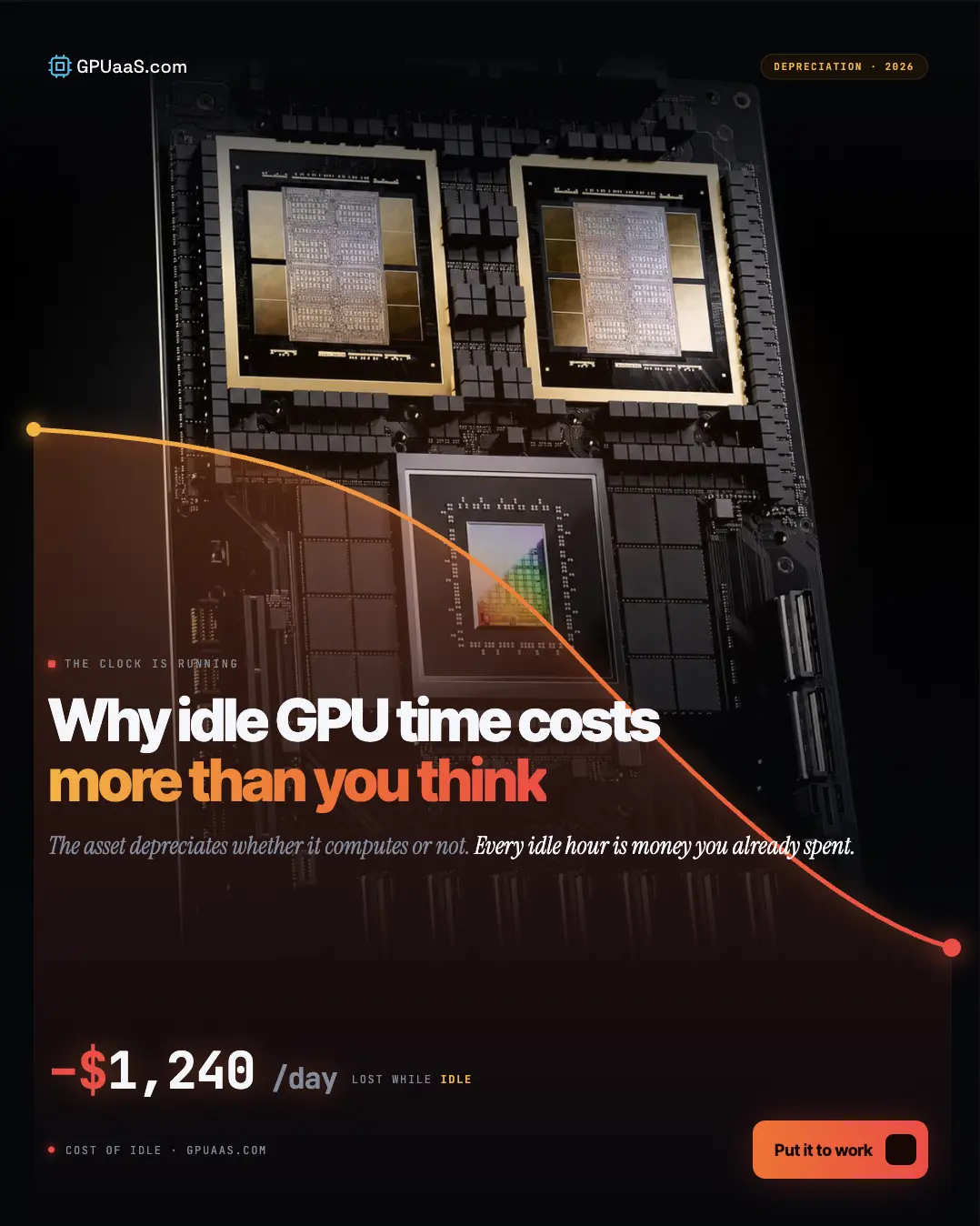
Blog ▸ The Depreciation Clock Is Running: Why Idle GPU Time Costs More Than You Think
GPU Infrastructure
H100 depreciation follows a step pattern, not a smooth curve, with a mid-life cliff around year three. Idle GPUs depreciate on the same schedule as active ones.
The Depreciation Clock Is Running: Why Idle GPU Time Costs More Than You Think
GPUaaS.com Team
GPU Infrastructure
July 21, 2026
No items found.
An H100 that sold for $40,000 in late 2023 held roughly 61% of that value at the two-year mark. By year three, that retention drops to 45 to 55%. Not a smooth line down. A cliff.
That's the part most depreciation conversations miss. The number doesn't slide. It sits, then resets.
Key takeaways
H100 list price held steady at $25,000 to $40,000 through 2024-2026 while the secondary market moved sharply underneath, trading as high as $50,000 in 2024's peak scarcity before dropping as supply normalized
Depreciation follows a step pattern, not a smooth curve: roughly 61% value retention at 2 years, dropping to 45-55% by year 3, a "mid-life cliff" triggered by architectural releases like Blackwell
An idle GPU depreciates on the exact same schedule as one running at full utilization. The clock does not check usage before it resets value
A 30 percentage point swing in resale assumption changes 3-year ownership cost on an 8-GPU HGX system by up to 30%
The real risk is sudden resets tied to supply shifts and new hardware generations, not predictable gradual decline
◆ THE MID-LIFE CLIFF
Age
Value retained
First 24 months
75-85% (CloudZero) / ~61% (BuySellRam)
Year 3
45-55%, the mid-life cliff
Beyond year 3
10-20% annual decline as newer generations expand
Sources: BuySellRam GPU Cluster Liquidation report, CloudZero H100 GPU Cost 2026, Silicon Data H100 Market Value Trends
◆ THE STICKER PRICE WAS NEVER THE REAL PRICE
Retail stayed flat. The secondary market didn't
Retail price told a different story the whole time. H100 list price held steady at $25,000 to $40,000 from mid-2024 into early 2026. No discounting. No visible erosion. On paper, remarkably stable hardware.
The secondary market was doing something else entirely underneath that stable sticker. Used and refurbished H100s traded as high as $50,000 during 2024's scarcity peak. Then supply normalized and the used market repriced sharply, while the retail sticker never moved. The sticker price was never the real price. The secondary market was.
◆ WHY THE CLIFF EXISTS
Architectural releases trigger resets, not gradual wear
That's the mechanism behind the mid-life cliff. A two-year-old H100 retains around 61% of its original value. At three years, that drops to 45 to 55%. The step happens because architectural releases trigger resets, not gradual wear. Blackwell hitting production is exactly this kind of trigger, hardware that was fine a quarter ago suddenly gets valued against what a B200 or B300 can do for the same workload.
◆ THE CLOCK DOESN'T CHECK UTILIZATION
Idle and running depreciate the same
None of this touches whether the GPU is actually running. A card sitting idle depreciates on the exact same schedule as one running at 90% utilization. The clock doesn't check usage logs before it resets the value.
Run the numbers on an owned H100 at 70% utilization and the effective cost lands around $1.40 to $1.80 per GPU-hour once power, colocation, and depreciation are counted together. At 90% utilization, that drops to roughly $1.20. The gap between those two numbers is utilization, and utilization is the one variable a finance team can actually influence after the purchase decision is made.
30%
how much a 30 percentage point swing in resale assumption changes 3-year ownership cost on an 8-GPU HGX H100 system
Mercatus H100 Server Price 2026 analysis
The resale assumption moves the math more than almost anything else in a buy-vs-rent decision. For an 8-GPU HGX system running $250,000 to $320,000, a 30 percentage point swing in resale value at exit changes three-year ownership cost by up to 30%. Most TCO models hard-code a resale number and move on. That number is a guess dressed up as a line item.
The risk isn't that H100 values drift down slowly and predictably. It's that they don't. Silicon Data's analysis of thousands of resale listings found the pattern is repricing, not depreciation, sudden resets triggered by supply shifts or sentiment changes, not a smooth curve anyone can plan against with confidence.
A GPU purchased today at current list price could trade meaningfully lower in 18 months if the next architectural cycle lands the way Blackwell did. That's not a forecast. It's the same pattern that already happened once. Idle time doesn't pause any of this. The depreciation clock runs whether the hardware is serving a workload or sitting unused between projects. A team holding capacity through a slow quarter is paying the full financial cost of ownership while getting none of the output.
Weigh ownership risk against a rental quote.
Get a quote within 24 hours, no resale risk on the books. No buyer fees. For single GPUs, packet.ai handles self-serve access with 24/7 human support.
H100 depreciation follows a step pattern rather than a smooth curve. Value retention sits around 61% at two years, then drops sharply to 45 to 55% by year three, a pattern known as the mid-life cliff. This step happens because new architecture releases like Blackwell trigger sudden repricing rather than gradual wear-based decline.
Retail list price is set by manufacturers and channel partners and tends to move slowly. The secondary market reflects real-time supply and demand from buyers and sellers directly, which is why it swung sharply, trading as high as $50,000 during 2024's scarcity peak before dropping as supply normalized, while the retail sticker stayed at $25,000 to $40,000 the whole time.
No. Depreciation is driven by market value shifts and architectural obsolescence, not wear from usage. A GPU sitting idle depreciates on the same schedule as one running at full utilization, which means idle time is a pure financial cost with no offsetting output.
Significantly. On an 8-GPU HGX H100 system costing $250,000 to $320,000, a 30 percentage point swing in the resale value assumption changes total three-year ownership cost by up to 30%. Most TCO models treat resale value as a fixed assumption, when it is actually one of the most uncertain and impactful variables in the calculation.
Yes, from the buyer's perspective. Renting shifts depreciation and resale risk onto the provider entirely. A team renting capacity pays for usage without carrying the asset's value risk on its own balance sheet, which is one reason renting tends to win for workloads that are not sustained at very high utilization for multiple years.
Last reviewed: 22 July 2026. Depreciation curve data from BuySellRam GPU Cluster Liquidation report and CloudZero H100 GPU Cost 2026 guide. Resale market analysis from Silicon Data's H100 Market Value Trends report and Hashrate Index's Used GPU Market analysis. Ownership cost modeling from Mercatus H100 Server Price 2026 and H100 GPU Cost 2026 guides. Browse current GPU cluster availability on GPUaaS.com.