Blog ▸ What GPU Buyers Are Asking For This Month: October 2026 Demand Snapshot
GPU Infrastructure
B300 overtook B200 as the most requested GPU this month, Europe is the region the network cannot fill, and twelve-month asks are beating month-to-month. What providers should list.
What GPU Buyers Are Asking For This Month: October 2026 Demand Snapshot
GPUaaS.com Team
GPU Infrastructure
October 5, 2026
No items found.
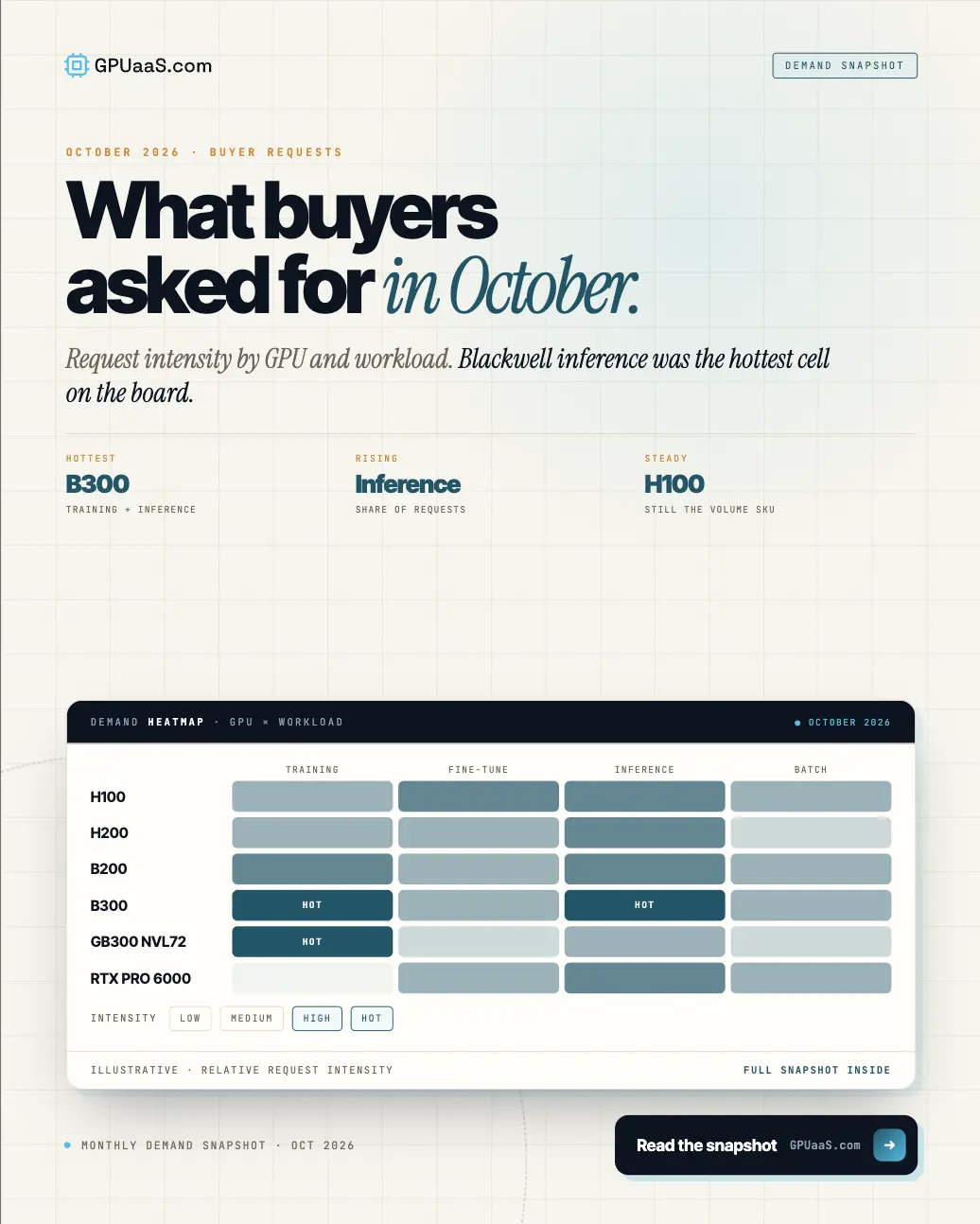
B300 is the most requested GPU across the GPUaaS.com network in October 2026, ahead of B200, with Blackwell-class parts making up the clear majority of specified requests and Hopper now a minority ask.
This is the supply-side companion to the October price benchmark. The benchmark tells buyers what capacity costs. This post tells providers what buyers are asking for: which GPUs, which regions, which term lengths, and what that means for a rack that is listed, or about to be. Everything here is direction and ranking from requests that came through the network. No buyer names, no counts, and no figures that could identify a request.
October 2026 demand at a glance
B300 is the most requested GPU this month, ahead of B200. Together they account for the majority of requests that name a part
H200 and H100 SXM still show up, but Hopper is now a minority of specified requests rather than the default
RTX PRO 6000 and GB300 NVL72 appear at similar frequency, at opposite ends of the budget
North America and Europe lead on region, roughly level with each other. APAC sits behind, with India, Japan and Australia all appearing
Committed terms of six months and longer are asked for more often than month-to-month on current-generation parts
Requests for AMD MI300-series and for Vera Rubin, which is not shipping, both appeared in small numbers
Training and inference where the spec was written before B300 landed
$7.00 - $8.00
3
H200 SXM
Long-context inference, mid-size training
$2.75 - $3.50
4
H100 SXM
Multi-node training on proven pipelines, cost-sensitive inference
$2.50 - $3.00
5
RTX PRO 6000
Mid-tier inference, 96GB per GPU on a PCIe budget
$1.25 - $1.75
5
GB300 NVL72
Rack-scale, single NVLink domain
$5.00 - $5.50
Tail
L40S, RTX 4090, MI300-series, Vera Rubin
Dev, small-batch inference, and two parts buyers want before they can have them
See benchmark
Ranking of GPU models named in requests through the GPUaaS.com network, October 2026. Bands are committed-term cluster bands from the October benchmark, per GPU-hour. Requests that did not name a part are excluded.
◆ THE TOP OF THE LIST
Blackwell is the default ask now, and B300 leads it
A year ago the default request named H100 and the question was how many. This month the default names B300, and B200 comes second mostly because it is the part people already had in a spec. Blackwell-class requests together make up the clear majority of everything that names a GPU.
Two things are driving that, and they are pulling in the same direction. The first is memory. B300 carries 288GB of HBM3e against 192GB on B200, and the workloads arriving this quarter are long-context inference and large open-weight models that run out of memory before they run out of compute. The second is price. On committed terms B300 is quoting below B200 across the whole band this month, which the benchmark covers in detail. Buyers have noticed. The requests that still say B200 are usually a spec that was written in the first half of the year and has not been revisited.
Outside the network, the same pressure shows up in public on-demand pricing. Compute Desk's index put on-demand B300 at roughly $7 to $10 per GPU-hour by mid-October, a record, with Supermicro build capacity named as the bottleneck. That gap between on-demand and committed is the whole reason committed demand lands on this platform instead of a marketplace, and it is the reason a provider with B300 capacity is getting more requests than it can take this month.
288GB
of HBM3e on the GPU buyers asked for most this month, which is 50% more than the part it overtook, on a committed band that sits below it
GPUaaS.com network, October 2026
◆ WHERE HOPPER LANDED
H200 and H100 are the value tier, not the headline
H200 sits third and H100 SXM fourth. Neither is going away, but the character of the request has changed. A Hopper request this month tends to come from a team with a working pipeline that does not want to requalify on new silicon, or from an inference buyer who has done the cost-per-token arithmetic and found that an H200 at $2.75 to $3.50 beats a Blackwell part for their batch profile.
That matters for a provider holding H100 or H200 racks, because the demand is real but it is price-sensitive in a way Blackwell demand is not. SemiAnalysis tracked one-year H100 contract pricing rising from about $1.70 to $2.35 per GPU-hour between October 2025 and March 2026, and spot has sat near $2.50 for most of the year. A committed H100 cluster quoted inside the $2.50 to $3.00 band wins when interconnect and support are documented, and loses when the quote arrives without them. The two-price market explains why both numbers can be right at once.
H100 PCIe barely registers in named requests this month. Where it does, it is a single-node ask for inference or fine-tuning, and it competes directly with RTX PRO 6000 on price.
◆ THE TWO ENDS OF THE BUDGET
RTX PRO 6000 and GB300 NVL72 show up about as often as each other
This is the part of the ranking that surprises providers. A workstation-class PCIe card at $1.25 to $1.75 and a 72-GPU liquid-cooled rack at $5.00 to $5.50 appear at similar frequency, because they serve two buyer groups that have nothing in common except that neither wants an 8-GPU HGX node.
The RTX PRO 6000 ask is an inference team with 96GB-per-GPU models and a budget that rules out Hopper SXM. These requests are small, often one or two nodes, and they want to start this week. The GB300 NVL72 ask is a lab or a frontier-scale inference operator that needs one memory domain across 72 GPUs and will wait for allocation to get it. This month that rack-scale configuration is quoting at the bottom of the Blackwell Ultra range rather than the top, which the benchmark flagged as unusual.
For a provider the lesson is that the middle of the list is not where the easiest fills are. A listed RTX PRO 6000 node fills fast because the buyer is in a hurry. A listed NVL72 rack fills slowly but on long terms. The 8-GPU B300 node in between fills on both, which is why it tops the list.
◆ DEMAND BY REGION
North America and Europe are level, and Europe is the one short of supply
Requests naming a region split roughly evenly between North America and Europe this month, with APAC behind and India, Japan and Australia each appearing. The Middle East appears, mostly from sovereign programs specifying H200 or GB300. Requests that name no region at all are the largest single group, and those get sourced wherever the band and the lead time work.
The European ask is the one worth paying attention to as a provider, because it is the one the network has the most trouble filling. EU AI Act obligations reached full applicability in August, and buyers in regulated sectors are now specifying EU-located, EU-governed capacity as a condition of sign-off rather than a preference. Scaleway took the first EU allocation of B300 earlier this year, and new entrants such as TensorX are raising money specifically to buy Blackwell for Dublin and Helsinki, with the stated reason that demand is outpacing supply. A rack in Germany, the Netherlands or the Nordics with documented residency gets a different class of request than the same rack in Virginia.
Pricing does not move much with region this month. The benchmark found similar bands holding across most sourcing regions, which means a European provider is not being asked to discount for location. The premium, where there is one, is paid in speed of fill rather than rate.
◆ TERM LENGTHS
Six months and longer is asked for more than month-to-month
On current-generation parts, requests for a committed term of six months or more outnumber requests for month-to-month or shorter. Twelve-month asks are common on B300 and B200. The short-term requests cluster on Hopper and RTX PRO 6000, where a team wants to run a pilot, a benchmark, or a burst of fine-tuning and then decide.
This is the opposite of what a provider coming from the marketplace side expects. On a spot marketplace the volume is hourly and the buyer leaves when the price moves. Here the buyer is trading flexibility for a rate inside the band, which is why the band exists. Term length moves a quote more than any other variable, and a provider who prices a twelve-month commitment at the bottom of the band and a three-month at the top is reading the request correctly.
A minority of requests ask for capacity that is not live yet. Buyers planning a Q1 2027 start will commit now against a stated available date if the terms are clear, which is how a rack can arrive with contracts attached. Presell is covered in how to sell GPU capacity without building a cloud business.
◆ THE TAIL
MI300, Vera Rubin, and the parts nobody specs anymore
A small but persistent stream of requests names AMD MI300-series parts, almost always for inference, and almost always from a team that has already run their stack on ROCm. The network has limited MI300 supply, so a provider holding it is in a thin market with little competition for the requests that do arrive.
A handful of requests already specify Vera Rubin, which is not shipping. These are planning conversations rather than orders, but they tell a provider something: the buyers at the top of the market are already asking what comes after B300, and the answer to "can you presell Rubin" is going to come up in Q1. A provider with an allocation date should say so.
A100 barely appears in named requests this month, and L40S and RTX 4090 show up only for dev and small-batch inference. That does not mean the capacity is worthless. It means the buyer who wants it will find it on packet.ai for single GPUs and tokens rather than through a cluster request, and a provider with a previous-generation fleet should consider listing it there instead of waiting for a committed cluster ask that is unlikely to come.
◆ WHAT TO DO WITH THIS
Four things a provider can act on this month
List B300 if you have it, including allocation that has not landed. It is the most requested part and the fill rate on committed terms is the highest on the platform. An 8-GPU node is the minimum, and the B300 node price breakdown covers what owned cost per GPU-hour looks like against the committed band.
Document interconnect, power density and residency before the first request arrives, not after. On Hopper in particular, that documentation is the difference between winning inside the band and losing to a provider who had it ready. The checklist in the supply anchor post lists what buyers check first.
If the rack is in Europe, say which country and under whose jurisdiction the data sits. That single line moves a listing into the group of requests the network is shortest of supply for.
Price twelve-month terms at the bottom of the band and short terms at the top. Buyers are asking for the longer term more often, and a provider who prices certainty rather than silicon fills first. The November snapshot will cover what moved.
List your capacity against this month's demand.
One node is enough to start. Quoting begins as soon as your capacity is listed, and there is no cost to apply or list. For inference capacity sold as tokens, packet.ai is the second route for the same hardware.
B300 first, then B200, H200, and H100 SXM, with RTX PRO 6000 and GB300 NVL72 appearing at similar frequency below them. Blackwell-class parts make up the clear majority of requests through the GPUaaS.com network that name a GPU. Hopper is now a minority ask rather than the default.
Yes, but it is price-sensitive. H100 SXM ranks fourth in named requests this month, mostly from teams with working pipelines or inference buyers who have done the cost-per-token arithmetic. Committed H100 clusters quote at $2.50 to $3.00 per GPU-hour and win when interconnect and support are documented up front.
Europe. Requests split roughly evenly between North America and Europe, but European requests specifying EU-located, EU-governed capacity are the hardest to fill, driven by EU AI Act obligations in regulated sectors. Bands do not move much with region, so the advantage for a European provider is speed of fill rather than rate.
Six months and longer more often than month-to-month on current-generation parts, with twelve-month asks common on B300 and B200. Short-term requests cluster on Hopper and RTX PRO 6000 for pilots and benchmarks. Term length moves a quote more than any other variable, so longer terms should be priced lower in the band.
Yes. A minority of requests this month are for a Q1 2027 start, and buyers will commit against a stated available date when the terms are clear. Capacity can be listed on GPUaaS.com with a future date, which is how a rack arrives with contracts already attached.
From buyer requests submitted through the GPUaaS.com network during the month, read as ranking and direction only. No buyer names, request counts, or figures that could identify a request are published. The snapshot refreshes monthly alongside the price benchmark, with the next edition in early November.