



An 8-GPU B300 node quotes anywhere from $300,000 to $795,000 depending on who builds it. Same eight GPUs.
That spread decides whether owning beats renting, and most buy-versus-rent models pick one number and skip the question.
- Published 8-GPU B300 node quotes span $300,000 to $795,000, a 2.6x range for the same GPU count
- A B300 node draws about 14.5 kW, costing $50,000 to $145,000 a year to run at 70% utilization
- Owned cost lands between $3.06 and $8.05 per GPU-hour over three years, depending entirely on purchase price
- Committed rental bands run $5.00 to $6.50 per GPU-hour, which sits inside that owned range rather than above it
- Most B300 capacity is still quoted through sales conversations rather than listed, so published rates understate what is achievable
◆ WHAT AN 8-GPU B300 NODE ACTUALLY QUOTES AT
| Configuration | Quoted price | Per GPU |
|---|---|---|
| DGX B300, lower anchor | $300,000 - $350,000 | $37,500 - $43,750 |
| DGX B300, reseller | $400,000 - $500,000 | $50,000 - $62,500 |
| HGX B300, integrator listing | $496,728 | $62,091 |
| HGX B300, OEM typical | $550,000 - $750,000 | $68,750 - $93,750 |
| HGX B300, high listing | $795,000 | $99,375 |
Published listings and reseller quotes, September to October 2026, excluding VAT. A standalone B300 module runs roughly $40,000 to $60,000.
◆ WHY THE SPREAD IS THAT WIDE
The GPUs are the smaller half of the bill
Eight B300 modules at roughly $53,000 each come to about $424,000. A node listed at $795,000 is therefore carrying around $370,000 of everything that is not the GPU: chassis, CPUs, NVLink fabric, NICs, power delivery, liquid cooling, integration and support.
At the $300,000 anchor the arithmetic implies either volume pricing on the modules or a thinner platform around them. Both exist, and they are not the same product even though the GPU count matches.
Comparing node quotes without comparing what surrounds the GPUs is the most common error in these models. Interconnect tier alone changes throughput on multi-node training enough to matter, which is covered in InfiniBand vs Ethernet.
2.6x
the gap between the cheapest and most expensive published 8-GPU B300 node, before a single hour of compute has been run on either
Published listings, September to October 2026
◆ THE LINE THAT GETS LEFT OUT
14.5 kW, every hour it runs
An HGX B300 node draws roughly 14.5 kW. Hosted in colocation at 70% utilization, that works out to about $50,000 to $145,000 a year once energy, contracted power, cooling, support and remote hands are counted. Staff and software licences sit on top.
Contracted power runs $130 to $380 per kW per month depending on the facility, which alone accounts for $23,000 to $66,000 of that annual figure. Facilities built for 8 to 12 kW racks cannot take a Blackwell Ultra node without work.
Over three years the run cost adds $150,000 to $435,000 to the purchase price. On the cheapest node that is more than the hardware cost again.
◆ WHAT OWNING COSTS PER GPU-HOUR, THREE YEARS AT 70% UTILIZATION
| Node price | Low run cost | High run cost |
|---|---|---|
| $300,000 | $3.06 | $4.99 |
| $496,728 | $4.39 | $6.33 |
| $550,000 | $4.76 | $6.69 |
| $750,000 | $6.12 | $8.05 |
Purchase price plus three years of run cost, divided by 8 GPUs across 26,280 hours at 70% utilization. Excludes financing, staff, software and residual value.
◆ AGAINST THE RENTAL BAND
Owning sits inside the range, not below it
Committed B300 cluster capacity is quoting at $5.00 to $6.50 per GPU-hour this month. Set that against the owned range of $3.06 to $8.05 and the comparison stops being obvious.
Owning wins clearly at the low end, where a node bought near $300,000 and run in a cheap facility lands around $3.06. It loses clearly at the high end, where a $750,000 node in an expensive facility reaches $8.05 and renting is cheaper outright. In the middle, which is where most real purchases sit, the two overlap.
And that owned figure assumes 70% utilization sustained for three years. At 40% the same node costs roughly 1.75 times more per useful GPU-hour, which is usually what decides it.
◆ THE DELIVERY GAP
Months before the first hour runs
Current-generation Blackwell nodes run 16 to 26 weeks from order to delivery, and one integrator listing in September quoted November delivery against a September order. Rented capacity provisions in minutes.
That gap does not appear in a cost-per-GPU-hour comparison, but it decides whether the hardware arrives in time to matter. A model trained six months from now on owned hardware competes against models trained next week on rented capacity, and the cost advantage has to be large enough to justify the wait.
◆ TERM LENGTH MOVES THE RENTAL RATE
The ladder is visible in published rate cards
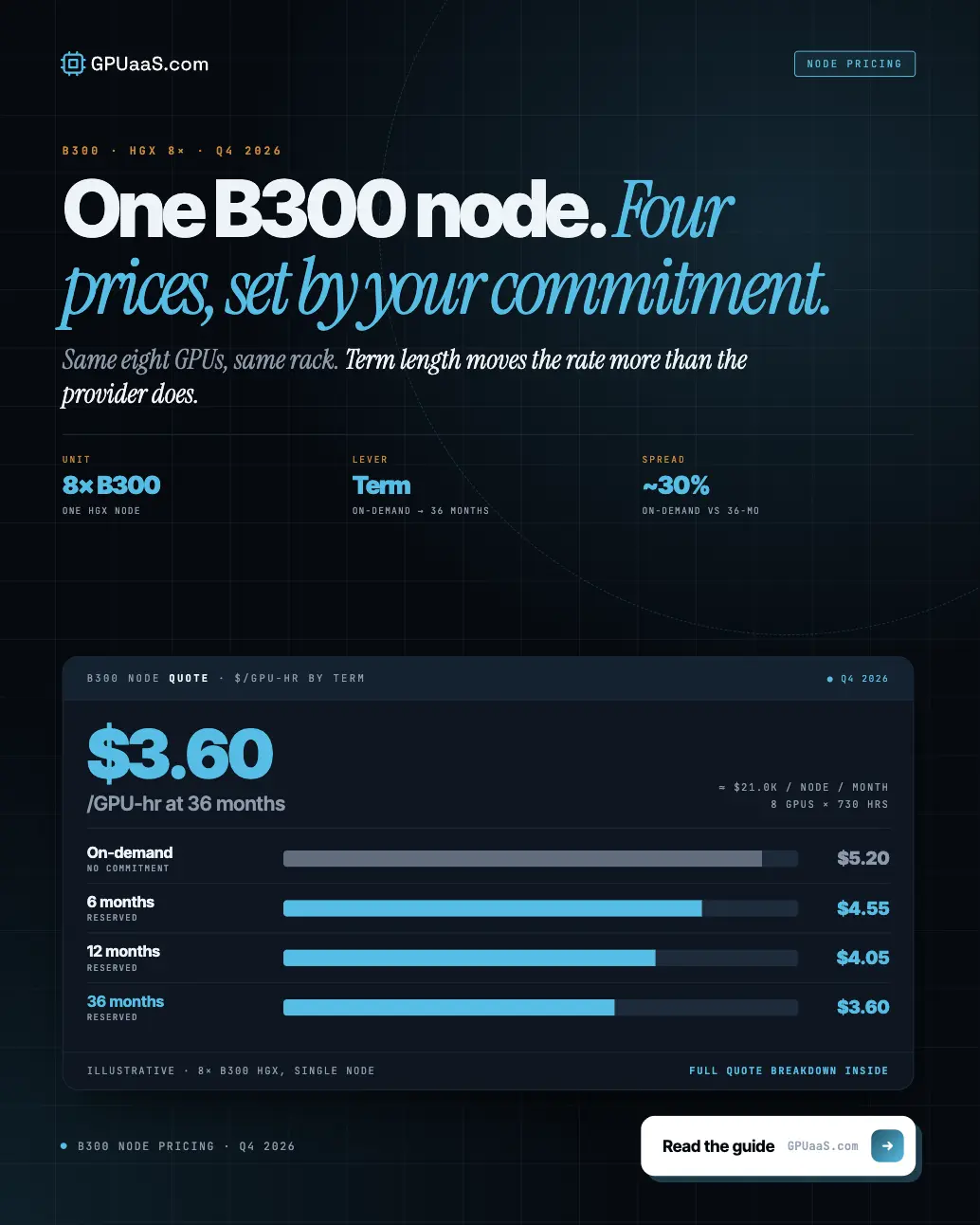
One provider publishes B300 at $7.49 on demand, $6.49 on a twelve-month term, $5.99 at twenty-four months and $5.49 at thirty-six. Another lists $4.65 at thirty-six months and $4.10 at forty-eight.
That ladder is the clearest illustration of what a committed band actually prices. The provider is selling certainty, and the discount scales with how much of it the buyer hands over.
It also means a quoted rental rate without a term attached is not a number. Across 33 tracked providers B300 spans $3.49 to $7.49, and most of that spread is term rather than provider quality.
◆ MOST B300 IS NOT ON A RATE CARD
Contact sales is the default
Several of the largest specialist providers list HGX B300 and GB300 as contact sales rather than publishing a rate. That is not evasion, it reflects that most Blackwell Ultra capacity is still allocated through conversations rather than self-serve.
The practical consequence for a buyer is that published rates are a floor on information rather than a ceiling on price. A spec taken to several providers will usually produce numbers that no page displays.
◆ THE COSTS BUY-VS-RENT MODELS LEAVE OUT
Financing, staff and residual value move the number further than people expect
The $3.06 to $8.05 per GPU-hour range above excludes three things that most owners actually pay. Financing is the largest. A node bought on a loan or lease at anything above a token interest rate adds real cost on top of the purchase price, and a $600,000 node financed over three years at a typical equipment-loan rate can add $60,000 to $90,000 in interest alone, which moves the owned figure up by roughly $0.75 to $1.10 per GPU-hour at the utilisation assumed above.
Staff is the second. Someone has to rack the node, keep the firmware current, monitor it, and be the person who gets paged when a GPU throws an error at 2am. For a single node that cost is proportionally large; for an organisation already running infrastructure at scale it is closer to free, since the incremental node adds little to an existing team's workload. That is the main reason the real-world answer to buy-versus-rent often splits by how much infrastructure an organisation already operates, not by the raw arithmetic on one node.
Residual value cuts the other way and is usually ignored entirely. A three-year-old B300 node is not worthless at the end of the depreciation schedule; it still has resale or internal-redeployment value, and the resale value post covers what current-generation GPUs have actually fetched on the secondary market. Crediting even a conservative resale figure back against the purchase price narrows the owned range by several tens of cents per GPU-hour, which is often enough to tip a borderline case toward buying.
◆ A WORKED EXAMPLE
One node, three scenarios, three different answers
A lab buying a single $550,000 HGX B300 node for a sustained research programme, with an existing data centre team and 70% utilisation expected over three years, lands near $4.76 to $6.69 per GPU-hour once run cost is added, before financing or staff overhead, which are close to zero for them since the team already exists. Against a committed rental band of $5.00 to $6.50, owning is a reasonable bet and gets better the longer the programme runs past three years, since the node keeps working after the model fully depreciates.
A startup buying the same node with no existing infrastructure team, financing the purchase, and running it at a more realistic 40% utilisation while the product finds its workload, pays the same $4.76 to $6.69 run-cost range but stretches it across far fewer useful hours, pushing the effective figure past $8 to $11 per GPU-hour once financing and a part-time hire are added. For that buyer, renting at $5.00 to $6.50 committed is simply cheaper, and it avoids the 16 to 26 week wait for delivery on top.
A sovereign or regulated buyer who must keep the hardware in a specific jurisdiction for compliance reasons is not really choosing on cost at all; residency requirements can rule out rental if no provider holds documented capacity in that jurisdiction, in which case owning is the only option regardless of what the arithmetic says. The India pricing post and the regional demand report cover how residency narrows the rental option specifically.
The question worth answering before any of this is utilization. A node sustained above 70% for three years makes ownership defensible at the right purchase price. Below that, the fixed cost spreads across fewer useful hours and renting wins on arithmetic rather than preference.
Current committed bands across every tier are published in the October price benchmark.
Price a B300 node against a committed quote.
Submit a spec and get quotes back within 24 hours, sourced across 20+ vetted partners. No buyer fees. For single GPUs, packet.ai handles self-serve access with 24/7 human support.
Get a quote◆ FAQ
Frequently asked questions
Published quotes run from $300,000 at the DGX anchor to $795,000 for a high-end HGX listing, with OEM integrated systems typically $550,000 to $750,000. A standalone B300 module runs roughly $40,000 to $60,000.
Because the GPUs are the smaller half of the bill. Eight modules come to roughly $424,000, so a $795,000 node carries about $370,000 of chassis, CPUs, NVLink fabric, NICs, power delivery, cooling and integration. Those are not equivalent platforms despite matching GPU counts.
About $50,000 to $145,000 at 70% utilization in colocation, covering energy, contracted power, cooling, support and remote hands. The node draws roughly 14.5 kW, and contracted power alone runs $23,000 to $66,000 a year.
Sometimes. Over three years at 70% utilization, owning works out between $3.06 and $8.05 per GPU-hour depending on purchase price and facility cost. Committed rental bands run $5.00 to $6.50, so owning wins at the low end, loses at the high end, and overlaps in the middle. Financing, staff and resale value can move the owned figure meaningfully in either direction.
Current-generation Blackwell nodes run 16 to 26 weeks from order to delivery. Rented capacity provisions in minutes, which is a gap that does not appear in a cost-per-GPU-hour comparison but decides whether the hardware arrives in time to matter.
Last reviewed: 6 October 2026. Node pricing from published listings and reseller quotes compiled by Thunder Compute, IntuitionLabs, GPUSmith and qdna, September to October 2026. Power draw and annual run cost from Haink's AI infrastructure cost guide, September 2026. Rental term ladders and the 33-provider range from ComputePrices and provider rate cards, October 2026. Lead times from Presenc AI GPU supply research. Committed cluster bands from the GPUaaS.com October 2026 benchmark. Hardware prices move frequently and should be confirmed before use in a model. Browse current GPU cluster availability on GPUaaS.com.


