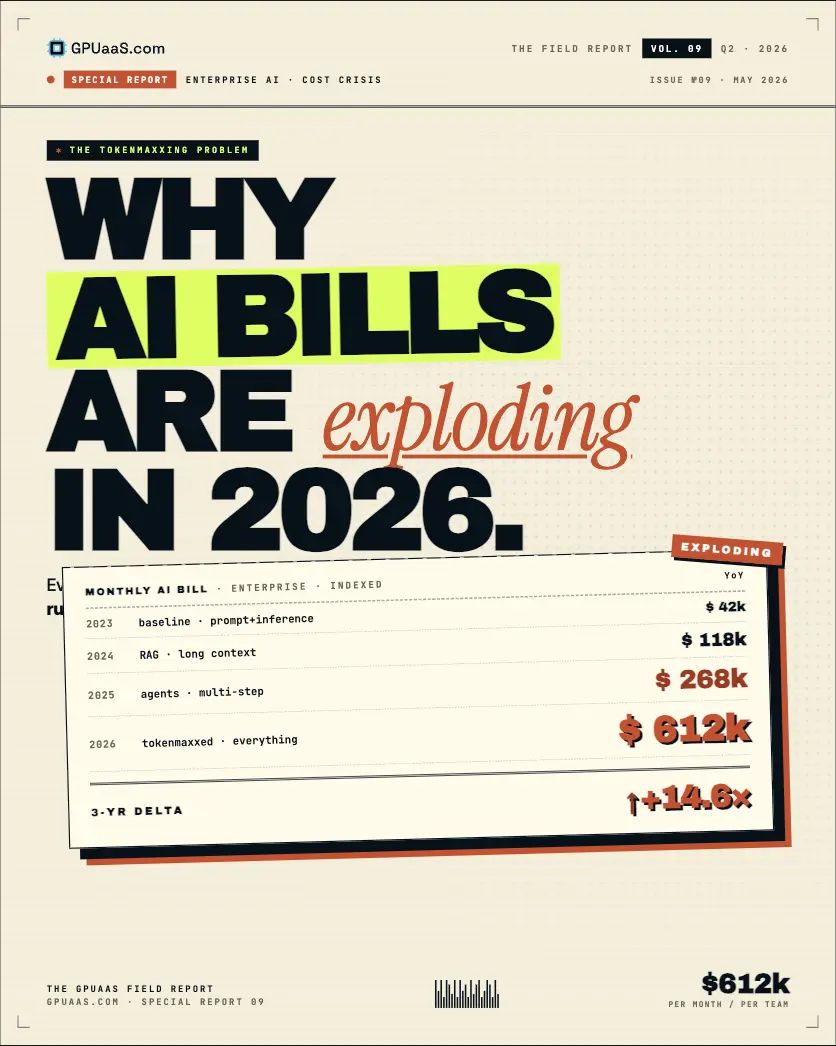
Enterprise AI bills are exploding in 2026 not because GPU prices are rising, but because token-based pricing scales non-linearly with adoption, and most companies never modelled for it. Uber burned through its entire 2026 AI tools budget in four months. Microsoft cancelled its internal Claude Code licences six months after rolling them out. GitHub just announced it can no longer absorb the inference cost of agentic usage at flat rates. The pattern is the same everywhere: the tools got used, the bills arrived, and nobody had a framework to manage them.
- Uber burned through its entire 2026 AI tools budget by April, four months after rollout. Monthly per-engineer API costs hit $500–$2,000. The budget was supposed to last twelve months
- Microsoft cancelled internal Claude Code licences across its Experiences & Devices division (Windows, Teams, Surface) on May 14, 2026. Engineers redirected to GitHub Copilot CLI
- GitHub moved all Copilot plans to usage-based billing from June 1, 2026, admitting it “can no longer absorb the escalating inference cost” of agentic usage at flat subscription rates
- The root cause is tokenmaxxing: employees maximising token consumption because tools are priced per seat but billed per token at the infrastructure layer. Agentic workflows consume 5–30x more tokens than basic chat
- The structural fix is owning your inference stack. Teams running models on dedicated GPU clusters at $1.20–$3.50/GPU/hr have deterministic, predictable costs, the opposite of API-layer token billing
This isn't about AI being too expensive. Per-token prices have fallen 280x over the past two years. The problem is volume, specifically what happens when agentic workflows replace single-query chatbots at scale. Every loop, every retry, every background agent running 24/7 compounds the bill in ways that seat-based procurement models simply don't predict.
If your team runs production inference on dedicated GPU clusters rather than API endpoints, this cost spiral hits you differently, and the maths are worth understanding. See the reserved vs on-demand GPU guide for the cost structure comparison, or the GPUaaS.com cluster catalogue for current pricing.
Three of the most prominent AI adopters in enterprise software hit the same wall between December 2025 and May 2026. The sequence matters because each story reveals a different layer of the same structural problem.
⚡ This isn't isolated
Deloitte's April 2026 CFO guide on AI token economics cited a healthcare enterprise that consumed 1 trillion tokens over six months, generating $6 million in unplanned costs before finance understood what was driving the bill. A separate report documented a software company that racked up $150,000 in AI token spend in a single billing cycle with no measurable business outcome. FinOps Foundation 2026 State of FinOps: 73% of respondents said AI costs exceeded original budget projections.
Enterprise AI spending jumped 108% year-over-year in 2026, hitting an average of $1.2 million per organisation. 78% of IT leaders reported unexpected AI charges they had never budgeted for. Source: Zylo 2026 SaaS Management Index.
Tokenmaxxing is the term now circulating in enterprise AI circles for what happened at Uber: employees maximise token consumption, either because they genuinely find the tools useful, or because internal leaderboards and incentive structures reward visible AI usage over outcomes. Uber's engineers were literally ranked on a dashboard by how much AI they used. The budget didn't have a chance.
The mechanics are simple. Enterprise software licences work on a per-seat model: pay for 5,000 seats, get 5,000 seats. Everyone on that seat counts the same whether they're sending one email a day or 10,000. AI tools work differently. The licence is per seat. The actual cost is per token. When every query, every debugging session, every multi-step agent loop, every background process generates billable compute, usage-based billing exposes the true cost that seat pricing was masking.
Vendors subsidised this gap during the adoption phase. Claude Code, GitHub Copilot, and similar tools were priced to win market share, not to reflect actual inference costs. That phase is over. GitHub's admission that its pricing is “no longer sustainable” is the clearest public statement that the subsidy era has ended.
How token costs accumulate
- Each autocomplete suggestion: ~200–1,000 tokens
- A debugging session with context: ~5,000–20,000 tokens
- A multi-step agentic coding loop: ~50,000–500,000 tokens
- A background RAG pipeline running hourly: millions of tokens per day
- 5,000 engineers × 8 hours × constant agentic use: budget collapse
What nobody modelled for
- Seat pricing doesn't reflect token volume
- Adoption is faster than procurement budgets can track
- Internal leaderboards reward usage, not outcomes
- Agentic features trigger 5–30x more tokens per task than chat
- Finance teams have no framework for token-based cost forecasting
Jensen Huang's framing
At GTC 2026, NVIDIA CEO Jensen Huang said he'd be “deeply alarmed” if a $500,000 engineer didn't consume at least $250,000 worth of AI tokens per year, and confirmed NVIDIA is targeting $2 billion in annual token spend for its engineering team. He's pitching token budgets as a fourth component of compensation. That framing tells you exactly where this is headed: AI compute is not reducing costs. It's creating a new cost centre that scales with usage, not headcount.
The root cause of the enterprise AI cost crisis isn't AI adoption. It's the specific shift from single-query chatbots to agentic workflows. Gartner's March 2026 analysis quantified this: agentic AI models require 5–30x more tokens per task than standard chatbots. Teams that sized their AI budgets based on chatbot-era consumption, then deployed multi-step agentic systems, hit cost multiplications they'd never modelled.
Token consumption: chatbot vs agentic workflow
Relative token consumption. Source: Gartner March 2026 agentic AI analysis.
The cost paradox Gartner identified makes this worse: token prices have fallen 280x over two years, yet total enterprise AI spend has risen 320% in the same period. The per-unit price drop doesn't matter when usage volume grows faster. A 10x increase in usage at a 5x lower price still multiplies your bill by 2x.
⚠ The GPU utilisation irony
Cast AI's 2026 State of Kubernetes Optimisation Report measured actual production telemetry across 23,000 clusters and found average GPU utilisation at 5%. For every dollar spent on GPU infrastructure, 95 cents is producing no useful output. Companies are simultaneously burning through API token budgets and running their own GPU fleets at near-idle. The waste is happening at both layers.
Token prices fell 280x over two years, yet total enterprise AI spend rose 320% in the same period. The volume of agentic workloads is dramatically outpacing per-unit price reductions. Source: Gartner 2026 AI infrastructure analysis.
Enterprise AI spending jumped 108% year-over-year in 2026, averaging $1.2 million per organisation. McKinsey's 2026 Global AI Survey puts the ROI failure rate at 73%, three out of four AI deployments failing to hit projected returns. Uber's COO framing the problem publicly is unusually candid, but the underlying challenge isn't unusual at all.
The structural challenge is that AI tools proved too successful to afford. Once engineers have access to agentic coding assistants, usage doesn't stay modest. It expands to fill every available workflow. That's not waste in the traditional sense, engineers genuinely find these tools useful. The problem is that “useful” and “producing measurable business outcomes” aren't the same thing, and the budgets were sized for the latter while the usage patterns reflect the former.
The AI FinOps emergence
A new discipline called AI FinOps is emerging in direct response to this problem: applying cloud financial operations discipline to AI inference spend. Token budget allocation by business unit, model cost chargebacks, inference optimisation teams, outcome-based ROI measurement. If your organisation's AI spend exceeds $500,000 per year and is growing faster than planned, AI FinOps is no longer optional. The FinOps Foundation identified AI as the fastest-growing new spend category in their 2026 State of FinOps Report.
If your team is running production inference on your own GPU clusters rather than calling third-party API endpoints, you're operating under a fundamentally different cost model. Understanding the difference is what determines whether the Uber problem can happen to you.
The calculation that makes dedicated GPU compute compelling for production inference: an H100 SXM5 at $1.49/GPU/hr on GPUaaS.com running at 85% utilisation delivers roughly 21,000 tokens per second (Llama 3 70B at FP8). That's approximately $0.020 per 1,000 tokens, a fixed cost that doesn't change whether your engineers run one agentic session or a thousand. On API pricing, the same token volume at $3–10/million tokens costs $0.063–$0.21 per 1,000 tokens, 3–10x more, with no ceiling.
When dedicated compute makes sense
The crossover point is roughly 500 million tokens per month. Below that, API pricing is usually simpler and more cost-effective. Above it, especially for teams running persistent agentic workflows, internal coding assistants, or high-traffic inference APIs, dedicated GPU clusters on wholesale providers like GPUaaS.com deliver materially lower and predictable cost. See the wholesale vs hyperscale cost breakdown for the full comparison.
GPUaaS.com infrastructure data: teams migrating from third-party API endpoints to dedicated H100 or H200 clusters for production inference at volumes above 500M tokens/month see cost-per-token reductions of 60–80%, with fully predictable monthly invoices.
Whether you're on API pricing today or already running your own clusters, the Uber and Microsoft stories surface a set of questions worth answering before your next budget cycle hits the same wall.
Audit your current token consumption and cost-per-useful-output
The question Uber's COO couldn't answer is the one to start with: can you draw a line between your AI token spend and a measurable business outcome? If not, you have the same problem Uber has, and you'll hit it at the same scale they did. Token dashboards aren't enough, you need outcome attribution.
Calculate your crossover point for dedicated compute
Take your current monthly token volume. Multiply by your API price per token. Compare against an H100 cluster at $1.49/GPU/hr or an H200 cluster at $3.50/GPU/hr running at 80% utilisation. At volumes above ~500M tokens/month, dedicated compute almost always wins on cost. At lower volumes, API pricing has lower operational overhead.
If you're on API pricing, add hard spend caps immediately
GitHub now lets admins set user-level token budgets that hard-block access when exhausted. Most API providers have similar spend alert and cap mechanisms. Uber's problem wasn't that the tools existed, it was that nobody set a ceiling. The leaderboard incentivised usage without a corresponding cost limit.
If you're on dedicated GPU clusters, fix your utilisation
5% GPU utilisation is the enterprise average, which means most clusters are burning 95% of their hourly rate producing nothing. Continuous batching, FP8 quantisation, and proper vLLM configuration can bring this to 70–85% utilisation without hardware changes. For context on KV cache and memory efficiency, see the KV cache inference cost guide.
Right-size your GPU for your actual workload
The most expensive version of the tokenmaxxing problem on the GPU layer is buying H200 clusters for workloads that run equally well on H100 or A100. At 5% utilisation, a B200 is more expensive per useful token than an A100, not because B200 is bad, but because the premium chip compounds the waste. See the H100 vs A100 cost guide for the break-even maths.
Running your own inference? Get a wholesale GPU quote.
GPUaaS.com connects you directly to wholesale GPU providers, no broker, no hyperscaler margin, no usage-based surprise invoices. H100 from $1.49/hr, H200 from $3.50/hr.
See how GPUaaS.com works →Last reviewed: May 27, 2026. Sources: Fortune (May 26, 2026), The Verge, TechRadar, Zylo 2026 SaaS Management Index, Cast AI 2026 State of Kubernetes Optimisation Report, Gartner March 2026, McKinsey Global AI Survey 2026, GitHub Blog (April 28, 2026).