A team was two weeks from renewing a GPU contract with their hyperscaler. Same rep for years. Nobody had gotten a second quote.
A new hire asked why not. Nobody had an answer.
Two specialized providers quoted the same H100 tier. Both came in 40 to 50% below the renewal.
- The same H100 GPU spans a 4x to 6x price range in 2026: AWS ~$6.88/hr, Azure ~$12.29/hr, specialized providers $2 to $3/hr, spot under $1.50/hr
- Enterprises that skip benchmarking and default to their existing hyperscaler consistently pay 40 to 60% more for equivalent hardware (AgamiSoft, 2026)
- AWS cut H100 pricing roughly 44% in mid-2025. A benchmark from before that cut is already stale
- Contract length is a separate variable from price. A one-year and three-year reserved rate on the same GPU can differ 15 to 20%, and the cheapest hourly rate is not always the cheapest total cost
- Two or three quotes on a clearly specified workload is enough. More than that slows decisions down without adding useful signal
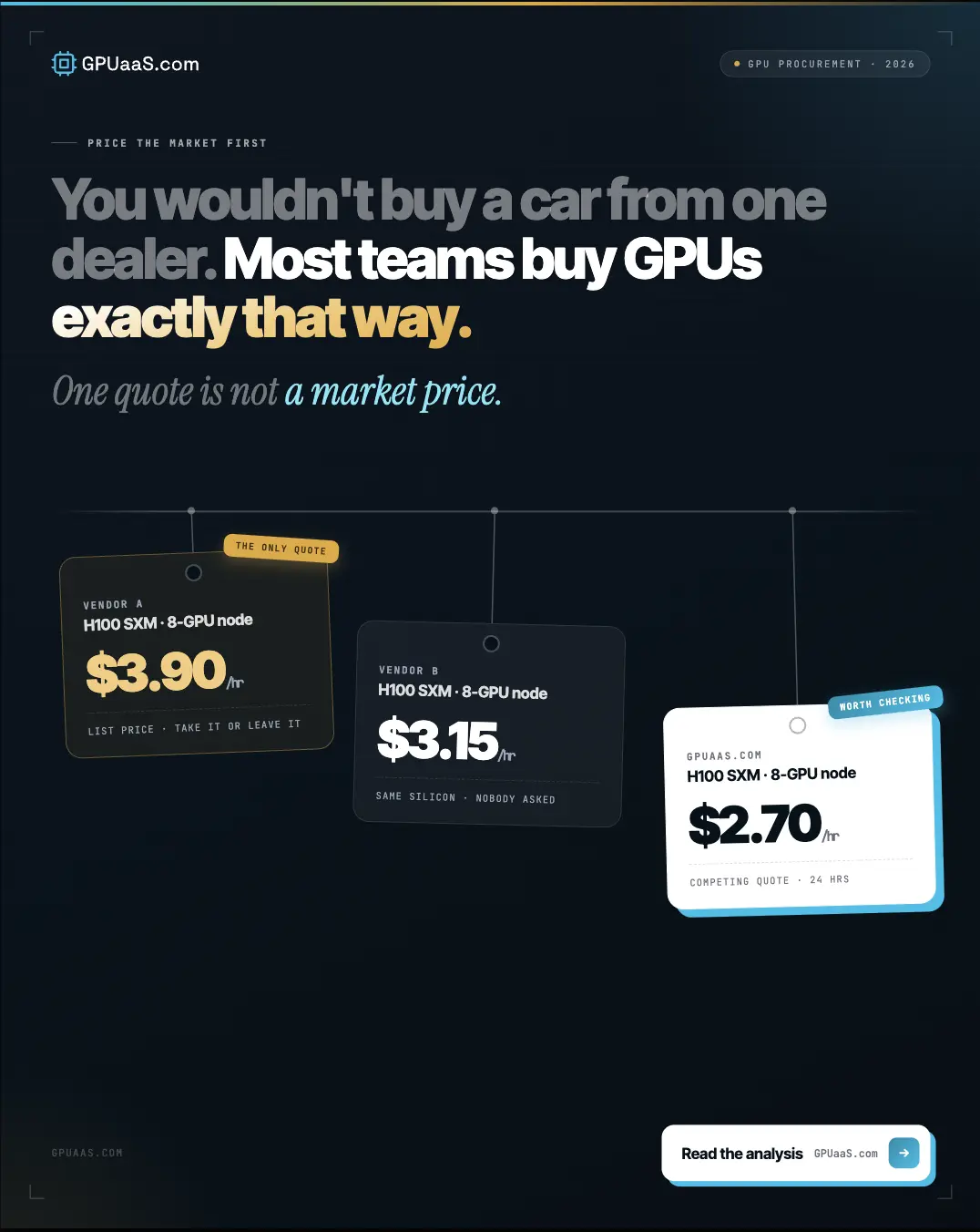
AWS runs H100 at $6.88 an hour. Azure is $12.29. Lambda Labs and GMI Cloud price the same chip at $2 to $3. Spot markets go under $1.50.
Same GPU. Four to six times the price difference depending who you ask.
Hyperscalers bundle in region coverage and compliance certs. Specialized providers strip that out. Neither price is wrong. Most teams only ever see one of them.
4-6x
price spread for the same H100 GPU in 2026, depending entirely on which provider quotes you
Spheron Network, GMI Cloud, AgamiSoft pricing data, 2026
Nobody at the renewing team did anything wrong. They renewed with the same provider because that's what they did last time. Nobody owns the job of checking elsewhere. So nobody checks.
This shows up everywhere once you start looking for it. A team running inference on Azure never priced GCP. A team on a three-year AWS commit never asked what a one-year term would cost. Not because the numbers would be worse. Because asking wasn't anybody's job.
A different team overcorrected. Six quotes for an 8-GPU, two-week job. Three weeks spent comparing SLAs. By the time they picked a provider, the workload had changed and they needed a different GPU tier. Two or three quotes is enough. Six is its own kind of waste.
Sometimes the hyperscaler is right. Deep tooling integration, specific compliance requirements, the premium buys something real. Benchmarking isn't about always picking cheap. It's about knowing the alternative price exists before deciding not to take it.
Prices move fast enough that a benchmark from last year is already stale. AWS cut H100 prices roughly 44% in mid-2025. A quote from before that cut and one from after look nothing alike. A team that checked in April and never checked again is pricing against a market that no longer exists.
Hidden costs make this worse. Egress and storage can add 20 to 40% on top of a hyperscaler's advertised rate. A team comparing sticker prices without adding those in is comparing the wrong numbers before the comparison even starts. The full breakdown of what those hidden charges look like is in the GPU quote hidden costs post.
Contract length adds a second variable most teams never separate from price. A one-year reserved rate and a three-year reserved rate on the same GPU can differ by 15 to 20%, and a team that only ever benchmarks the headline hourly rate misses that entirely. Two providers can quote the same on-demand number and still land in very different places once term length enters the picture.
A finance team ran this comparison properly once. Same H100 tier, three providers, three contract lengths each. Nine numbers on a spreadsheet instead of one. The cheapest hourly rate wasn't the cheapest total cost once they matched contract length to how long they actually planned to run the workload. The provider with the second-lowest hourly rate won because its one-year term didn't carry the penalty the cheapest provider's did.
That's the part a single quote can never show you. Not just whether you're overpaying, but whether the term length you defaulted into is the right one for what you're actually doing. The full framework for matching contract length to workload is in the reserved vs on-demand GPU guide.
Write the spec first. Tier, count, duration, region. Get two or three quotes outside your default provider every renewal, not once.
Track cost per GPU-hour, not the monthly total. Hyperscalers quote per instance. Specialized providers quote per GPU. Compare the wrong units and the gap disappears on paper even though it's real on the invoice.
8 H100s for six months costs about $240,000 at AWS rates. The same job at $2.50 an hour runs closer to $88,000. That gap shows up whether or not anyone asked.
Regional pricing adds another layer most teams never check. The same GPU in different regions can carry meaningfully different rates depending on local demand and energy costs. A team locked into one region by default is potentially leaving money on the table twice: once on provider, once on geography.
Get a second quote before you renew.
H100, H200, B200, B300 clusters across vetted providers. Quotes within 24 hours. No buyer fees. Also on packet.ai for self-serve access.
View available GPU clustersGPUaaS.com surfaces quotes from vetted providers next to whatever a team already pays. Submit a spec, get quotes back in 24 hours. The comparison happens automatically instead of depending on someone remembering to run it.
Last reviewed: 3 July 2026. Pricing spread data from Spheron Network GPU Cloud Pricing Comparison 2026, GMI Cloud 2026 pricing guide, and AgamiSoft enterprise AI cost research. AWS pricing action data from Cast AI 2026 GPU Price Report. Browse current GPU cluster availability on GPUaaS.com.