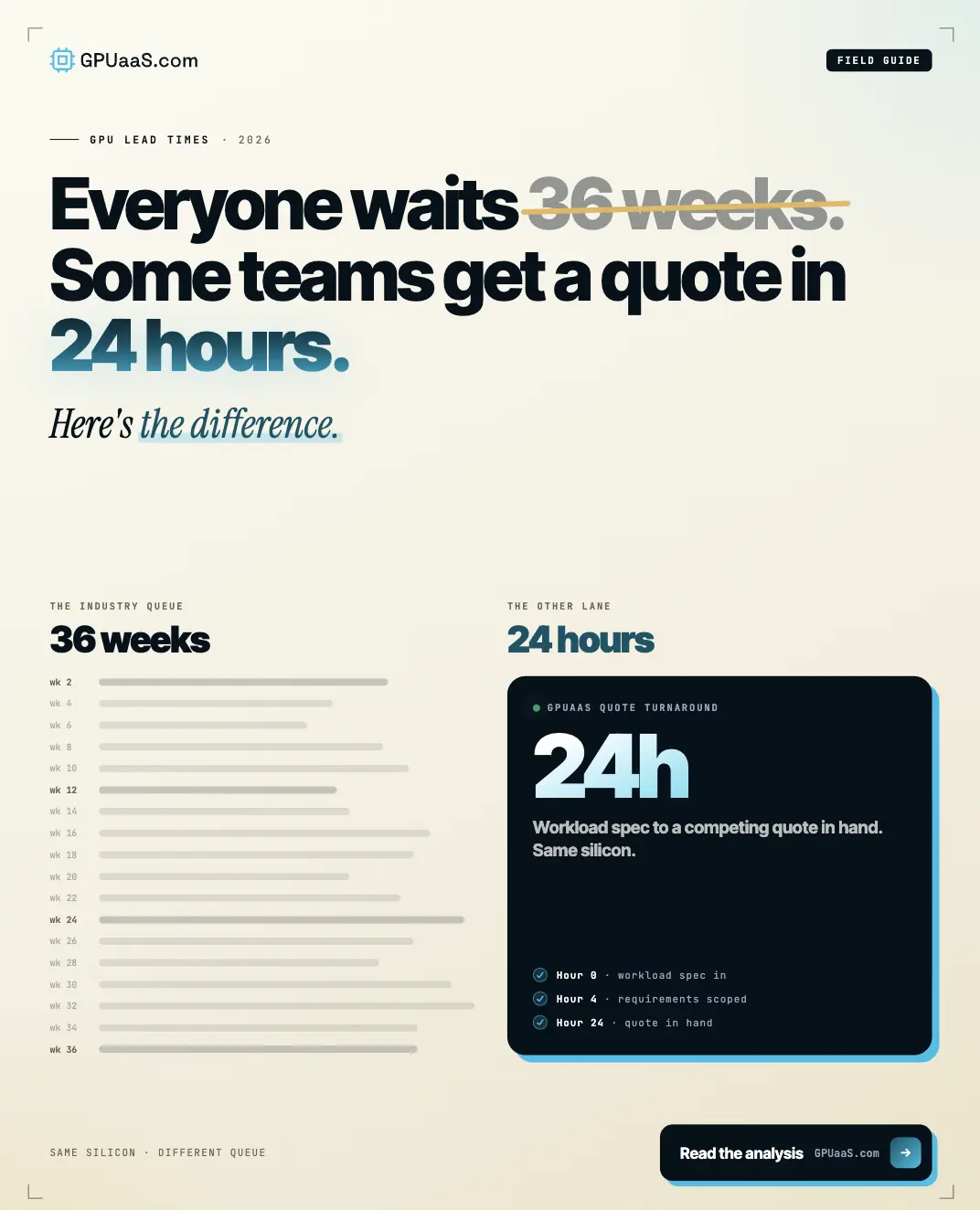
Blog ▸ Everyone Is Waiting 36 Weeks for GPUs. Some Teams Are Getting Them in 24 Hours. Here's the Difference.
GPU Infrastructure
Most GPU procurement delay is an internal approval queue stacked on a vendor quota queue, not a hardware shortage. Here is what teams that move fast on GPU access actually do differently.
Everyone Is Waiting 36 Weeks for GPUs. Some Teams Are Getting Them in 24 Hours. Here's the Difference.
GPUaaS.com Team
GPU Infrastructure
July 1, 2026
No items found.
A team needed 32 H100s for a three-week fine-tuning run. They put in a capacity request with their existing hyperscaler. Support came back asking for a use case justification, then routed them to their account manager, then asked for a revised request at a smaller GPU count because the original number "would need executive review." Eleven days in, they had eight GPUs. They needed thirty-two.
A different team needed the same thing around the same time. They had already documented their GPU tier requirements, their expected duration, and their budget ceiling before they needed any of it. When a cluster became available through a provider relationship they had built months earlier, they signed within four hours and started training the same day.
Both teams were trying to solve the same problem. One of them had already done the boring part.
Key takeaways
GCP first-time GPU quota requests can take up to a week and require manual review. AWS quota increases are commonly denied for smaller accounts without an enterprise support tier
The delay most teams hit is an internal approval queue stacked on a vendor quota queue, not a hardware shortage
Specialized providers price GPU capacity 40 to 85% below hyperscaler rates for the same hardware, and some advertise provisioning measured in hours rather than weeks
B200 lead times are a different problem entirely. CoWoS packaging and HBM3e supply are the binding constraint, and no procurement tactic solves a hardware shortage that has not resolved yet
Teams that document workload specs, pre-approve a budget ceiling, and build multi-provider relationships before they need capacity can move in hours instead of weeks when a cluster becomes available
◆ WHERE THE DELAY ACTUALLY LIVES
The part that takes time is not the GPU
GCP's own documentation says first-time GPU quota requests can take up to a week, and approval requires a manual review of the use case. AWS quota increases for GPU instance types get denied constantly for smaller accounts without an enterprise support tier, a pattern visible across AWS's own developer forums. None of this is a hardware shortage. It is an approval queue.
The team that waited eleven days was not waiting on NVIDIA. They were waiting on an internal review process and a vendor's manual quota approval, stacked on top of each other, with nobody owning the handoff between the two.
◆ WHAT THE FAST TEAM HAD ALREADY DONE
Paperwork done early is a speed advantage
Before they needed any GPUs, the fast team had three things sitting ready: a written spec of exactly what tier and how many hours they needed, a budget ceiling that did not require a new approval cycle, and relationships with more than one provider so they were not dependent on a single quota queue.
None of that is sophisticated. It is paperwork. But paperwork done in advance is the difference between signing a contract in four hours and waiting eleven days for eight GPUs you did not ask for.
◆ PROVIDER DIVERSITY IS A SPEED LEVER
Not just a cost lever
Neoclouds and specialized providers price GPU capacity 40 to 85% below hyperscaler rates for the same hardware, largely because hyperscalers bundle in global region coverage, compliance certifications, and managed services that not every workload needs. That gap has been true for over a year. What changed is that more teams are treating provider selection as a speed lever, not just a cost lever.
Axe Compute, a neocloud that went public on Nasdaq in 2025, advertises 48-hour provisioning across 200+ locations for its immediate-access program. Whether or not that specific number holds for every workload, the model it represents, cutting out the internal quota-review layer entirely, is the structural reason specialized providers can move faster than hyperscaler channels for teams that do not need the hyperscaler's full service stack.
The point is not that one provider is universally faster. The point is that a team with relationships across more than one provider has options when one channel is slow. A team locked into a single hyperscaler has no options. They wait. For the full breakdown of what the hyperscaler premium actually buys, the wholesale vs hyperscale pricing post covers it in detail.
◆ WHERE SPEED TACTICS STOP WORKING
B200 is a different problem entirely
H100 availability has been easing through specialized channels. B200 has not. New enterprise buyers placing volume B200 orders are still facing lead times measured in months, largely because CoWoS packaging capacity and HBM3e supply remain the binding constraint, not any single vendor's allocation policy.
For teams that specifically need Blackwell-class throughput, none of the speed tactics above solve that constraint. Speed helps with access to available capacity. It does not create capacity that does not exist yet. Teams with a genuine B200 requirement need to plan on the actual hardware timeline, not the workaround timeline. The full picture of where GPU capacity actually sits right now is in the GPU capacity window breakdown.
◆ WHAT TO ACTUALLY SET UP
Four things, done before you need them
Write the workload spec before you need it. GPU tier, GPU count, expected duration, budget ceiling. This takes an afternoon and it is the single highest-leverage thing on this list, because everything else depends on having it ready.
Get a budget ceiling pre-approved for a defined range, so that when capacity appears, the finance conversation already happened. Waiting for a new approval cycle after the opportunity shows up is how the eleven-day team lost eight of the days.
Build a relationship with at least one provider outside your primary hyperscaler before you need the capacity. Not during a crunch. Cold, in advance, when there is no urgency and the conversation is easier.
Know which of your workloads actually need Blackwell-class hardware and which do not. Most fine-tuning and inference work does not. Reserving the scarce hardware for the workloads that genuinely require it, and routing everything else to whatever is actually available, is how teams avoid competing for the tightest tier of supply when they do not need to.
Have your spec ready. Get quotes in 24 hours.
H100, H200, B200 clusters across vetted providers. North America, EU, MEA, APAC. No buyer fees. Also on packet.ai for self-serve access.
Most of the delay is procedural, not physical. GCP quota requests require manual review and can take up to a week for first-time approvals. AWS quota increases are commonly denied for accounts without enterprise support. Add an internal budget approval cycle on top and the total delay often has nothing to do with actual hardware availability.
GPU tier (H100, H200, B200, or A100), GPU count, expected run duration, region constraints if any, and a pre-approved budget ceiling for that range. Having this documented before a capacity opportunity appears means the decision to commit takes minutes instead of a new internal review cycle.
Often, yes, because they skip the manual quota-review layer hyperscalers apply to GPU instance types. Some advertise provisioning in hours rather than weeks. The speed advantage comes from a simpler approval structure, not from having fundamentally different hardware access.
For B200 specifically, no procurement tactic overcomes a genuine supply constraint. CoWoS packaging and HBM3e memory availability are the binding limits, not vendor allocation policy. Multi-provider relationships help you find whatever B200 capacity does exist faster, but they do not create capacity that has not been manufactured yet. Teams with a firm B200 requirement should plan around the actual hardware timeline.
GPUaaS.com surfaces GPU capacity across multiple vetted providers, including inventory not listed on hyperscaler portals. Teams that submit a completed workload spec receive quotes within 24 hours. For a team that has already documented tier, count, duration, and budget, that turnaround compresses procurement from weeks to hours.
Last reviewed: 2 July 2026. GPU quota and approval process data from Google Cloud documentation and AWS developer forums. Provider pricing spread data from Spheron Network, AIMultiple, and Northflank 2026 GPU pricing comparisons. Provisioning claims for specialized providers sourced from company disclosures and cross-checked against independent reporting. Browse current GPU cluster availability on GPUaaS.com.