Blog ▸ What Is GPUaaS? The 2026 Definition, the Four Business Models, and Where the Price Gaps Are
GPU Infrastructure
The same H100 costs $2.50 or $7.89 an hour depending on which of four business models you buy it from. The acronym hides that. The definition should not.
What Is GPUaaS? The 2026 Definition, the Four Business Models, and Where the Price Gaps Are
GPUaaS.com Team
GPU Infrastructure
October 8, 2026
No items found.
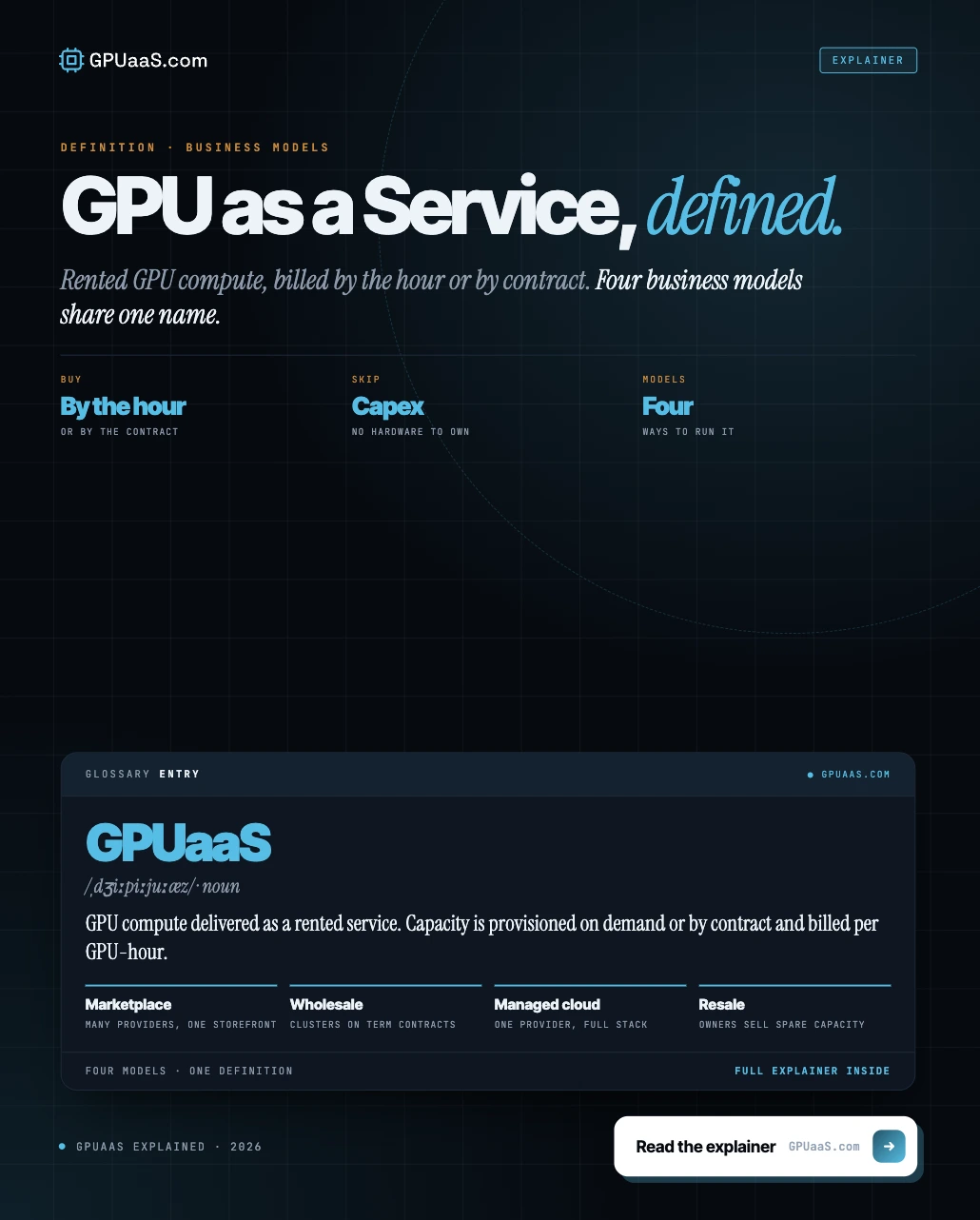
GPUaaS, or GPU as a Service, is renting GPU compute by the hour, the month or the year instead of buying it, and in 2026 it is sold through four distinct business models: hyperscalers, neoclouds, marketplaces and matchmaking networks, with the same H100 priced anywhere from about $2.50 to $7.89 per GPU-hour depending on which one you buy from.
The term gets used for all four as if they were the same thing. They are not. They differ in who owns the hardware, who holds the contract, how capacity is priced and what a buyer gives up to get the price. This post defines the term as it is actually used in 2026, maps the four models, and puts the price gap between them next to each other using the October benchmark. It is the long-form companion to the what is GPUaaS page.
Key takeaways
GPUaaS means renting GPU compute rather than owning it. The acronym covers hourly on-demand, spot, reserved and multi-year committed capacity alike
Four business models sell it: hyperscalers (AWS, Azure, Google, Oracle), neoclouds (CoreWeave, Lambda, Nebius and others), marketplaces (Vast.ai, Shadeform, SF Compute) and matchmaking networks (GPUaaS.com)
Late-September hyperscaler on-demand medians ran near $7.89 for H100, $10.85 for H200 and $14.24 for B200. Specialist clouds published roughly $5.00, $4.50 and $7.88
Committed cluster bands through the GPUaaS.com network in October are $2.50 to $3.00 for H100 SXM, $2.75 to $3.50 for H200 and $7.00 to $8.00 for B200
Spot sits lowest, near $2.50 for H100, and is the only tier where the price can be taken away mid-job
The gap between the top and bottom of the market on the same GPU is about 3x. The thing being paid for is flexibility, not silicon
◆ THE DEFINITION
What GPUaaS means in 2026, and what it stopped meaning
In 2023 GPUaaS mostly meant spinning up an H100 instance on a cloud console and paying by the hour. By 2026 the term covers the whole range of ways to get GPU compute without buying it: hourly on-demand, interruptible spot, reserved instances with a term discount, dedicated bare-metal clusters on six or twelve month commitments, rack-scale allocations sold a year ahead of delivery, and tokens sold per million without any GPU being visible at all.
What ties those together is that someone else owns the hardware, the facility, the power contract and the financing, and the buyer pays for use. What separates them is everything else: whether the capacity is guaranteed, whether it can be taken away, whether the GPUs share a NVLink domain, whether the buyer gets bare metal or a virtual machine, and who they are actually contracting with.
The useful way to sort that in 2026 is by business model rather than by product name, because the business model decides the price. There are four.
◆ THE FOUR GPUaaS BUSINESS MODELS
Model
Who owns the GPUs
Who holds the contract
How it is priced
Examples
Hyperscaler
The hyperscaler
Buyer and hyperscaler
List price per instance-hour; reserved and savings plans discount it
AWS, Azure, Google Cloud, Oracle
Neocloud
The neocloud, often debt-financed
Buyer and neocloud
Published on-demand plus negotiated committed clusters
CoreWeave, Lambda, Nebius, Crusoe, Hyperstack
Marketplace or aggregator
Many third-party hosts
Buyer and the host, via the platform's terms
Hosts set or bid; spot and on-demand, hourly
Vast.ai, Shadeform, SF Compute, Compute Exchange
Matchmaking network
Vetted providers
Provider, network and buyer, three parties
Quoted per request against published committed bands
GPUaaS.com
Model definitions as used in GPUaaS.com market analysis, October 2026. Some companies straddle categories; the model describes the dominant way they sell.
◆ MODEL BY MODEL
What each one is good at, and what it charges for
Hyperscalers sell GPUs the way they sell everything else: as instances inside a platform of managed services, with identity, storage, networking and billing already wired together. That integration is what the premium pays for, and it is real if the rest of the workload already lives there. The costs that surprise people are the ones around the GPU, which the hidden costs post covers: egress, storage, managed networking, and the gap between reserved commitments signed in 2024 and the on-demand price in 2026.
Neoclouds are GPU-first clouds that bought hardware at scale, usually on debt secured against customer contracts, and sell it with less platform around it and a lower price. They publish on-demand rates and negotiate committed clusters privately. The 2026 story for neoclouds is capacity: several have been sold out on current-generation parts for months, and the provider shakeout earlier this year removed some of the smaller ones.
Marketplaces and aggregators own nothing. They list capacity from many hosts, from individuals with a 4090 to data centers with H100 racks, and let buyers pick by price. Spot clears lowest here, near $2.50 for H100 through 2026, because the host is competing with every other host for the next hour. The price is excellent and the capacity can be withdrawn mid-job, which is the whole trade.
Matchmaking networks also own nothing, but they work the other way round. A buyer submits a spec, a term and a region; the network routes it to vetted providers who quote inside a published band; the contract that results runs between the provider, the network and the buyer. The capacity is dedicated and committed, the price sits at or near spot, and what the buyer gives up is the ability to spin it down next week. That is the model GPUaaS.com runs, and how it works covers the mechanics.
◆ THE PRICE GAP, SAME GPU, FOUR MODELS, OCTOBER 2026
GPU
Hyperscaler on-demand
Neocloud on-demand
Marketplace spot
Matchmaking committed
H100 SXM
About $7.89
About $5.00
About $2.50
$2.50 - $3.00
H200 SXM
About $10.85
About $4.50
Varies, thin
$2.75 - $3.50
B200
About $14.24
About $7.88
About $5.89 where listed
$7.00 - $8.00
B300
$10 to $18 where offered
$7 to $10, record in October
About $6.94 where listed
$5.00 - $6.50
Per GPU-hour. Hyperscaler and neocloud medians from published rate cards, late September 2026, as cited in the GPUaaS.com October benchmark. Spot from published marketplace listings and the Compute Desk B300 index, October 2026. Committed bands from the GPUaaS.com October 2026 benchmark. On-demand and committed are different products; the comparison is directional.
3x
the spread between hyperscaler on-demand and committed cluster pricing on the same H100 in October 2026. The silicon is identical. The flexibility is not
GPUaaS.com October 2026 benchmark against published hyperscaler medians
◆ WHERE THE GAPS COME FROM
Flexibility is priced, and so is who carries the risk
The 3x spread on H100 is not four companies disagreeing about what an H100 is worth. It is four different products. Hyperscaler on-demand is the right to start and stop any time, inside a platform, with the hyperscaler carrying all the utilisation risk. Neocloud on-demand is the same right with less platform and a provider carrying the risk on a thinner balance sheet. Spot is the right to use capacity until someone pays more for it, with the buyer carrying the risk. Committed is dedicated capacity for a fixed term, with the buyer carrying the utilisation risk and getting the lowest guaranteed price in exchange.
The two-price market post covers why spot and committed can sit at the same number and still be different products, and the wholesale pricing post covers why the committed band sits around 30% below what most enterprise buyers pay today.
One gap in the table deserves a note. On B300, the committed band through the network sits below both the neocloud on-demand record and the marketplace spot listing this month, which the B300 vs B200 post explains. That is unusual and it is the clearest case this year of the business model, not the GPU, setting the price.
◆ WHICH MODEL FOR WHICH BUYER
Match the model to how predictable the workload is
A team that does not know what it needs next month should be on-demand, and should pay the premium knowingly. A hyperscaler if the rest of the stack is there; a neocloud if it is not. A team running experiments that can be checkpointed and restarted should use spot and treat preemption as a feature of the price. A team with a production workload, a training run with a known end date, or an inference service with a known floor should be on committed capacity, because that is the only tier where the lowest price is also guaranteed.
Most organisations end up with more than one. The rent, reserve or buy framework sets out how to split a workload across tiers, and the billing models post covers how each one lands on a finance team's ledger.
For single GPUs and token-metered inference rather than clusters, packet.ai is the sister route: the same provider network, sold as tokens with 24/7 human support, which is a fifth way to buy GPU compute that does not need a GPU to be visible at all.
See where your workload lands on the committed band.
Submit a spec and quotes come back within a few hours from 20+ vetted partners, around 30% below hyperscaler rates. No buyer fees.
GPUaaS, GPU as a Service, is renting GPU compute instead of buying it. Someone else owns the hardware, facility, power and financing, and the buyer pays for use: by the hour on-demand, interruptibly on spot, on a reserved term, as a dedicated committed cluster, or as tokens. In 2026 it is sold through hyperscalers, neoclouds, marketplaces and matchmaking networks.
Four. Hyperscalers such as AWS, Azure, Google Cloud and Oracle sell GPU instances inside a managed platform. Neoclouds such as CoreWeave, Lambda and Nebius own GPU fleets and sell them with less platform at lower rates. Marketplaces such as Vast.ai and Shadeform list third-party hosts, mostly spot and on-demand. Matchmaking networks such as GPUaaS.com route committed requests to vetted providers on a three-party contract.
For an H100 SXM, from about $2.50 per GPU-hour on spot or committed terms to about $7.89 at hyperscaler on-demand medians in late September 2026, with neoclouds near $5.00. H200 runs $2.75 to $3.50 committed against about $10.85 hyperscaler on-demand. B300 runs $5.00 to $6.50 committed against $7 to $10 on-demand. The gap is flexibility, not silicon.
No. A marketplace lists capacity and lets buyers pick by price, mostly hourly. GPUaaS.com is a matchmaking network: a buyer submits a spec, term and region, vetted providers quote inside published committed bands within a few hours, and the resulting contract runs between the provider, GPUaaS.com and the buyer. The capacity is dedicated and the term is fixed.
Because the price includes the right to start and stop any time, a managed platform around the GPU, and the hyperscaler carrying all of the utilisation risk. That is worth paying for when the workload is unpredictable or the rest of the stack already lives there. For a steady production workload it is paying 2 to 3x for flexibility that is never used.
Match it to workload predictability. Unknown next month: hyperscaler or neocloud on-demand, and pay the premium knowingly. Checkpointable experiments: marketplace spot. Production inference, a training run with a known end date, or any workload with a known floor: committed capacity through a matchmaking network, which is the only tier where the lowest price is also guaranteed.