Blog ▸ The GPU Market Has Two Prices: The One You're Quoted and the One the Market Clears At
GPU Infrastructure
Retail GPU pricing is stable and published. The secondary and wholesale market moves with real supply and demand, and most enterprise buyers only ever see the retail number.
The GPU Market Has Two Prices: The One You're Quoted and the One the Market Clears At
GPUaaS.com Team
GPU Infrastructure
July 23, 2026
No items found.
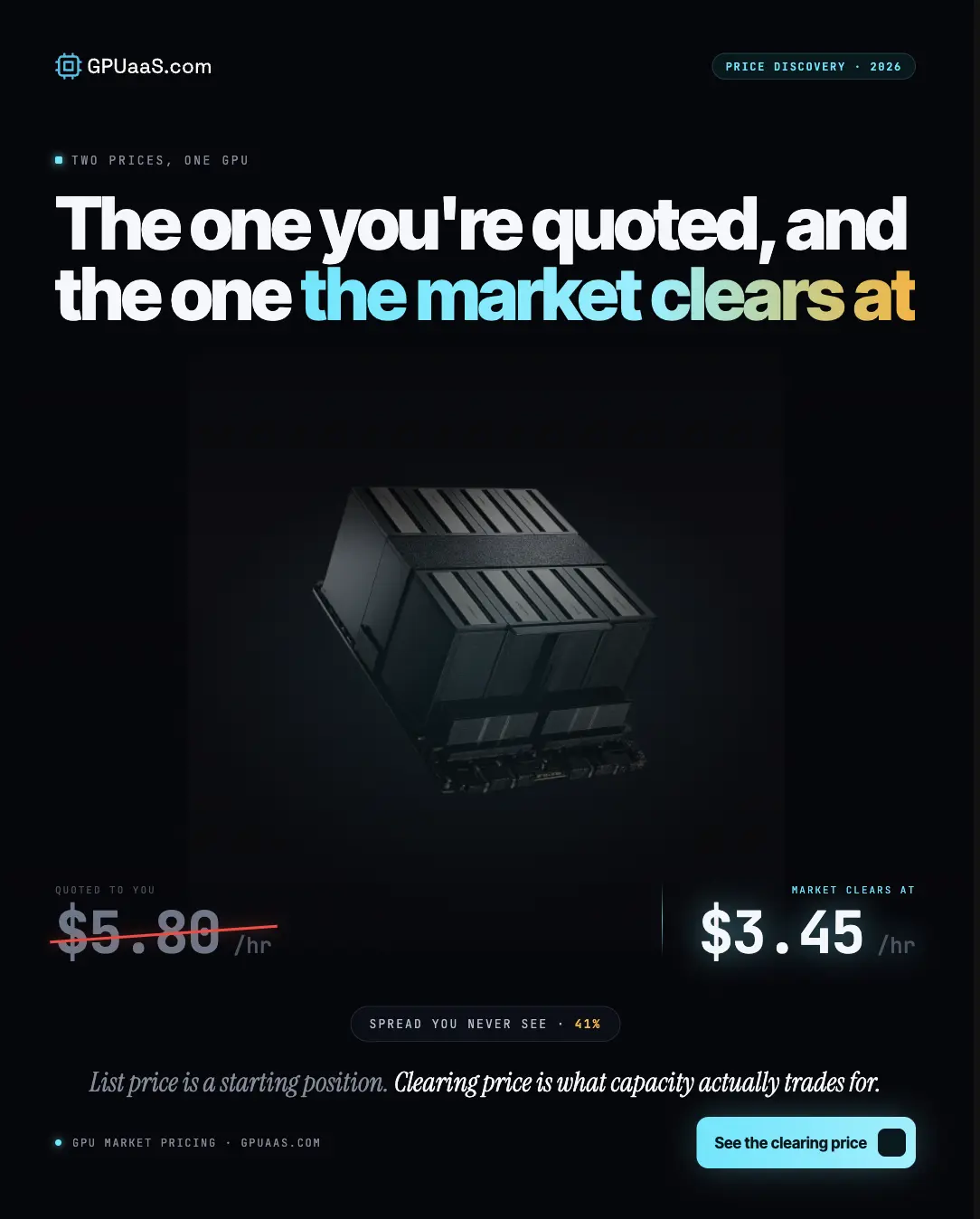
A hyperscaler quotes $10.60 an hour for an H200. A wholesale buyer gets the same chip for $3.79 to $4.54. Neither number is fake. Both are real prices for the same GPU, quoted to two different buyers in two different markets.
Most enterprise buyers only ever see one of those markets.
Key takeaways
H100 retail held steady at $25,000 to $40,000 from mid-2024 into early 2026, while the secondary market swung from $50,000 during 2024's scarcity peak down to $21,000-$34,000 refurbished as of Q2 2026
Hyperscaler H200 on-demand runs around $10.60/hr versus $3.79 to $4.54/hr wholesale for the same silicon
A100 cloud rental rates range $1.29 to $3.43/hr depending on provider, nearly a 3x spread for the same chip
The retail price is quoted to whoever asks casually. The clearing price moves with real-time supply and demand among buyers actually transacting
Q2 2026 secondary supply is loosening further as B200 deployments accelerate, with continued softening expected on H100 and A100 inventory specifically
◆ THE RETAIL PRICE THAT NEVER MOVED
While the real number moved twice
Retail is the price everyone quotes in headlines. Stable, published, disconnected from what actually changes hands underneath it. H100 retail held steady at $25,000 to $40,000 from mid-2024 into early 2026. No visible movement. On paper, boring.
The secondary market told a different story during that exact window. Used and refurbished H100s traded as high as $50,000 per GPU during 2024's scarcity peak. Above retail entirely. Then supply normalized. The same cards dropped sharply, now sitting at $21,000 to $34,000 refurbished as of Q2 2026. Retail never moved. The real number moved twice.
◆ TWO PRICES, TWO DIFFERENT QUESTIONS
The gap isn't a rounding error
That's the two-tier structure. One price gets quoted to whoever's asking casually. A second price, the one that actually clears transactions, moves with real-time supply and demand among buyers and sellers actually transacting. The gap isn't a rounding error. Tens of thousands of dollars on a single card.
The same split shows up in rental rates, not just purchase price. Hyperscaler on-demand carries a premium built for buyers who need the full managed stack, global region coverage, compliance certification, native tooling. Specialized providers price the same H200 silicon closer to what the hardware costs to run, without the bundle. Both numbers are legitimate. They're pricing different things wrapped around the same chip.
◆ THE A100 TELLS THE SAME STORY
A nearly 3x spread for the same chip
Most enterprise buyers never see the second number because they never go looking for it. The retail quote shows up first, on the first call, from the first vendor. Getting the wholesale number requires knowing it exists and asking a different set of people.
The A100 tells the same story from a different angle. Cloud rental rates for A100 now range $1.29 to $3.43 an hour depending on provider, a spread wide enough that the cheapest and most expensive quotes for the same chip differ by nearly 3x. Purchase prices for used A100s are projected to fall another 10 to 15% through the rest of 2026 as more enterprises move to Blackwell-generation hardware. Every generation this happens to. The retail number for the current chip stays put while the secondary and rental markets for it, and for whatever it's replacing, move constantly underneath.
$10.60 vs $3.79
the per-hour gap between hyperscaler on-demand and wholesale rates for the same H200 silicon, two real prices for the same chip depending which market a buyer is standing in
Published provider pricing, 2026
The gap doesn't stay constant either. Q2 2026 secondary supply is loosening further as B200 deployments accelerate and legacy contract inventory flows back into circulation. Continued softening expected on H100 and A100 inventory specifically, the exact segment where the retail-versus-real gap has been widest.
The buyers who consistently land on the right side of this gap aren't smarter. They just ask a different question before signing anything. Not "what's the rate," but "which market is this rate coming from." A quote from a hyperscaler sales page and a quote from a wholesale broker are answering different questions even when they name the same chip.
None of this makes the retail quote wrong. A buyer who needs the managed stack, the compliance layer, the enterprise support tier bundled into a hyperscaler agreement is paying for something real at that price. The problem isn't the existence of two prices. It's not knowing which one you're being quoted, and never checking whether the other one exists for your workload.
See where the market is actually clearing.
Get a quote within 24 hours. No buyer fees. For single GPUs, packet.ai handles self-serve access with 24/7 human support.
Retail list price is set by manufacturers and channel partners and tends to move slowly and predictably. The secondary market reflects real-time supply and demand among buyers and sellers actually transacting, which is why it can swing sharply, trading above retail during scarcity and well below it once supply normalizes.
Both are real. They price different things bundled around the same chip. Hyperscaler pricing includes global region coverage, compliance certification, and managed tooling. Wholesale pricing reflects closer to the underlying hardware cost. Neither is wrong, but they answer different questions, and a buyer needs to know which one they're actually being quoted.
For H200, hyperscaler on-demand runs around $10.60 an hour versus $3.79 to $4.54 an hour wholesale for the same silicon. For A100 rentals, rates range $1.29 to $3.43 an hour depending on provider, nearly a 3x spread. These gaps vary by chip generation and current market conditions.
Secondary supply is loosening as B200 deployments accelerate and legacy contract inventory returns to circulation. Continued softening is expected on H100 and A100 inventory specifically through the rest of 2026, meaning the gap between retail and clearing prices on older generations may narrow as more of that hardware becomes available secondhand.
Submit a workload spec, GPU tier, count, duration, region, and GPUaaS returns a competitive quote from a vetted provider within 24 hours, reflecting where the market is actually pricing that specific workload rather than a generic headline rate.
Last reviewed: 24 July 2026. Retail and secondary market pricing from TBR Trade Group's Q2 2026 GPU Market Update and Hashrate Index's Used GPU Market analysis. A100 rental pricing from Hashrate Index's GPU depreciation report. Hyperscaler and wholesale H200 pricing from published provider rate cards. Browse current GPU cluster availability on GPUaaS.com.