The world's most wanted GPU, NVIDIA B200 bare metal DC in US West - live on packet.ai →→(Access it from Bare metal CTA on top after login)

Claim Your Node →
#00c0e8
#000000
#ffffff
BlogWhen to Rent, When to Reserve, When to Buy: A Decision Framework for GPU Procurement

GPU Infrastructure

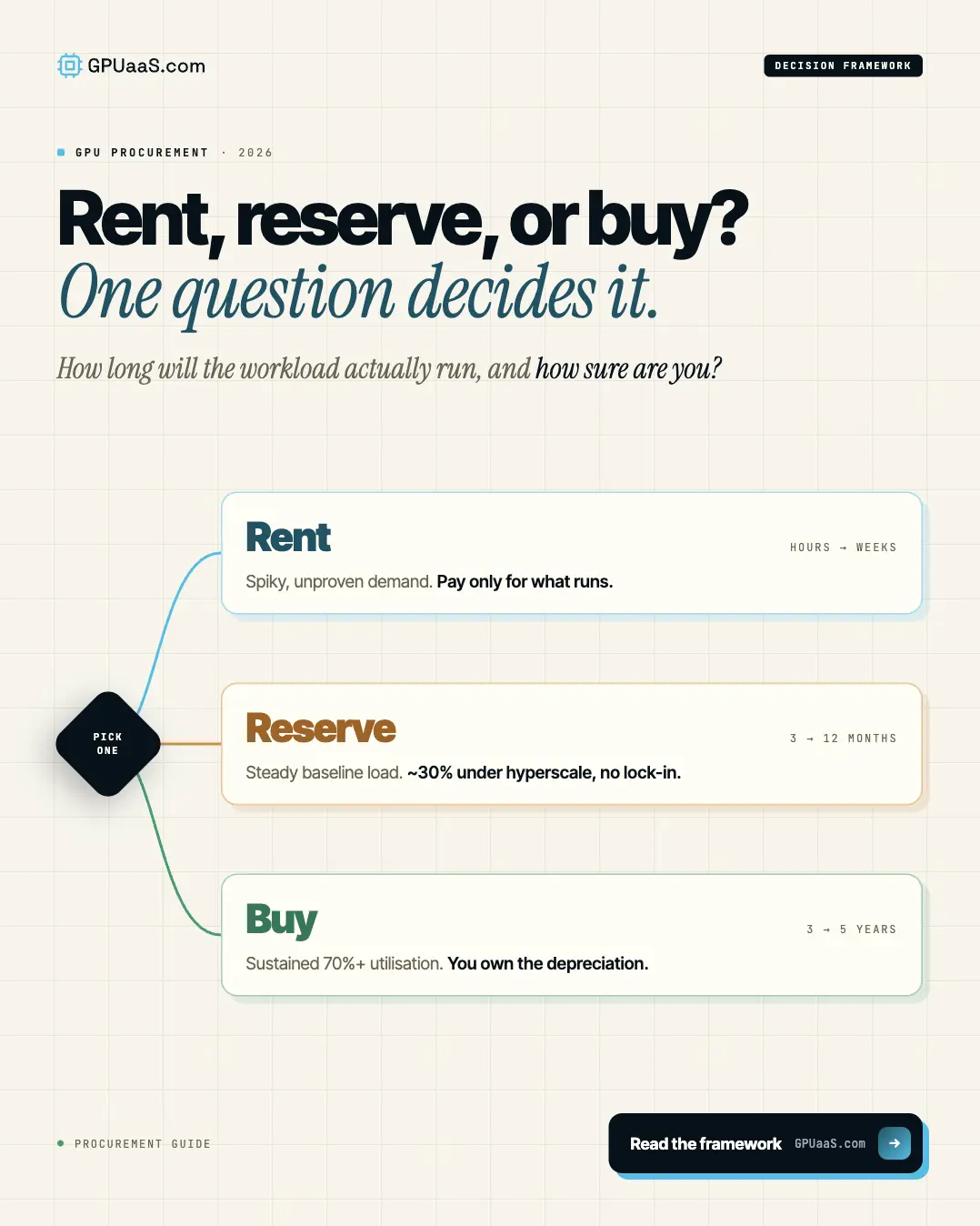
Below 30% utilization, rent. Above 75-80% sustained, buy. In between, reserved cloud is the right answer. Here is the actual breakeven math behind each GPU procurement model.

When to Rent, When to Reserve, When to Buy: A Decision Framework for GPU Procurement

GPUaaS.com Team
GPUaaS.com Team
GPU Infrastructure
August 3, 2026
Blog post cover image

The world's most wanted GPU, NVIDIA B200 bare metal DC in US West - live on packet.ai →→(Access it from Bare metal CTA on top after login)

Claim Your Node →
#00c0e8
#000000
#ffffff

An 8x H100 system costs roughly $833,806 fully built. Cloud on-demand for the same configuration runs $98.32 an hour. Run the math and the breakeven lands at 8,556 hours, just under 12 months of continuous use.

That's the number nobody runs before signing a three-year lease.

Key takeaways
  • Below roughly 30% utilization, renting wins outright. Teams under 40 GPU-hours a week fall well inside this zone
  • Above 75-80% sustained utilization against reserved cloud rates, owning starts to win. Teams over 200 GPU-hours a week sit in this range
  • Reserved cloud sits in the middle zone: a 1-year term extends breakeven to ~15 months, a 3-year term to ~22 months
  • A GPU loses roughly 50% of its value by month 18, and 70-80% by month 30, a real risk that cloud rental avoids entirely
  • The same utilization number means something different depending on whether you're escaping expensive on-demand or already on efficient reserved capacity

◆ THE DECISION FRAMEWORK

Weekly usageUtilizationBest model
Under 40 GPU-hoursBelow ~30%Rent, on-demand
40-200 GPU-hours~30-75%Reserved (1 or 3-year term)
Over 200 GPU-hours, consistent75-80%+Buy or own

◆ WHEN RENT WINS OUTRIGHT

Below 30% utilization, no close call

A GPU sitting mostly idle costs more to own than to rent by a wide margin, since ownership pays a fixed cost regardless of use while rental only bills for hours actually consumed. Teams under 40 GPU-hours a week fall well inside this zone.

◆ WHEN OWNING WINS

75-80% sustained, and it has to stay that way

Above roughly 75-80% sustained utilization against reserved cloud rates, owning starts to win. At that usage level, the fixed cost of ownership finally gets outrun by what the same capacity would cost rented hour by hour, for years. Teams running over 200 GPU-hours a week, consistently, sit in this range.

◆ THE MIDDLE ZONE: RESERVED

Where most teams get it wrong

Between those two lines is where the real decision-making happens, and where most teams get it wrong by defaulting to whichever option feels safer rather than running the actual math. Reserved cloud sits in exactly this middle zone. A 1-year reserved commitment extends the breakeven point to roughly 15 months. A 3-year reserved term extends it further, to nearly 22 months. Reserved pricing buys a real discount over on-demand, but it also locks in a specific configuration for a specific term, which only pays off if utilization actually holds at the level assumed going in.

50-80%

the value a purchased GPU can lose within 30 months, a risk cloud rental avoids entirely

GPUnex GPU Financing Guide 2026

Depreciation changes the buy side of this math faster than most teams price in. A GPU loses roughly 50% of its value by month 18. By month 30, that loss reaches 70 to 80%. A $25,000 H100 bought today can be worth $5,000 to $7,500 in under three years. Cloud rental carries none of that risk, since a rented GPU is never an asset sitting on a balance sheet losing value while it depreciates.

The utilization threshold moves depending on what a team is comparing against. A buyer escaping expensive hyperscaler on-demand pricing sees a strong return even at moderate utilization, because the baseline they're leaving is so much more expensive. A buyer already sitting on well-negotiated reserved capacity at $1.30 to $1.80 per GPU-hour needs utilization near 95% just to justify buying, because the rental baseline they're comparing against is already efficient. The same utilization number means something completely different depending on what it's being measured against.

Workload type matters as much as utilization level. Training runs benefit from dedicated, owned hardware, since the load is sustained and predictable for the duration of the run. Inference benefits from renting, since it's variable, needs geographic distribution close to users, and scales up and down in ways owned hardware can't match without sitting idle half the time. A team running both workload types often gets the split wrong by applying one procurement model to both.

An H100 lease runs $1,200 to $1,800 a month on 24 to 36 month terms, no upfront capital required. That's 30 to 50% more expensive than buying outright over the same term, but it shifts residual value risk onto the lessor instead of the buyer. Worth knowing as a fourth option, even for teams that end up choosing rent, reserve, or buy instead.

None of this requires picking one model forever. A generational stagger works for teams that can plan around it: buy the current generation for premium workloads now, and as the next generation launches and rental rates for the current generation fall, shift routine work to renting the newer tier while repurposing owned hardware for lower-priority jobs.

Run the real math against your actual utilization.

Get a quote within 24 hours instead of a guess. No buyer fees. For single GPUs, packet.ai handles self-serve access with 24/7 human support.

Get a quote

◆ FAQ

Frequently asked questions

Roughly 75 to 80% sustained utilization against reserved cloud rates, held consistently. Below that, the fixed cost of ownership doesn't get outrun by rental savings fast enough to justify the capital outlay and depreciation risk.

At full continuous utilization against on-demand cloud rates, breakeven lands around 8,556 hours, roughly 12 months. Against reserved cloud pricing, that breakeven stretches to about 15 months for a 1-year term and nearly 22 months for a 3-year term.

Roughly 50% by month 18, and 70 to 80% by month 30. A $25,000 H100 bought new can be worth $5,000 to $7,500 within three years, a risk that cloud rental avoids entirely since a rented GPU is never an owned depreciating asset.

No. Training benefits from dedicated owned hardware given its sustained, predictable load. Inference benefits from renting given its variable, geographically distributed nature. Applying one procurement model to both workload types typically leaves one of them poorly served.

Submit a workload spec, expected hours, region, duration, and GPUaaS returns a competitive quote within 24 hours, giving a real number to run against your own utilization rather than estimating against a generic rate card.

Last reviewed: 4 August 2026. Breakeven modeling from SoftwareSeni's GPU Procurement Strategy 2025-2026 report and BuySellRam's Renting vs Owning GPUs analysis. Depreciation and leasing data from GPUnex's GPU Financing Guide 2026. Utilization threshold data from Mercatus's GPU ROI 2026 report. Browse current GPU cluster availability on GPUaaS.com.
Share this article:LinkedInX / TwitterCopy link

The world's most wanted GPU, NVIDIA B200 bare metal DC in US West - live on packet.ai →→(Access it from Bare metal CTA on top after login)

Claim Your Node →
#00c0e8
#000000
#ffffff
FIND THE BEST GPU DEAL

Get a wholesale GPU quote in a few hours

NVIDIA B200, H200, H100, A100, RTX Pro 6000 — N. America, EU, MEA, APAC. No buyer fees.

Related articles