Blog ▸ The Provider Shakeout: What Q1-Q2 Exits Taught the Market
GPU Infrastructure
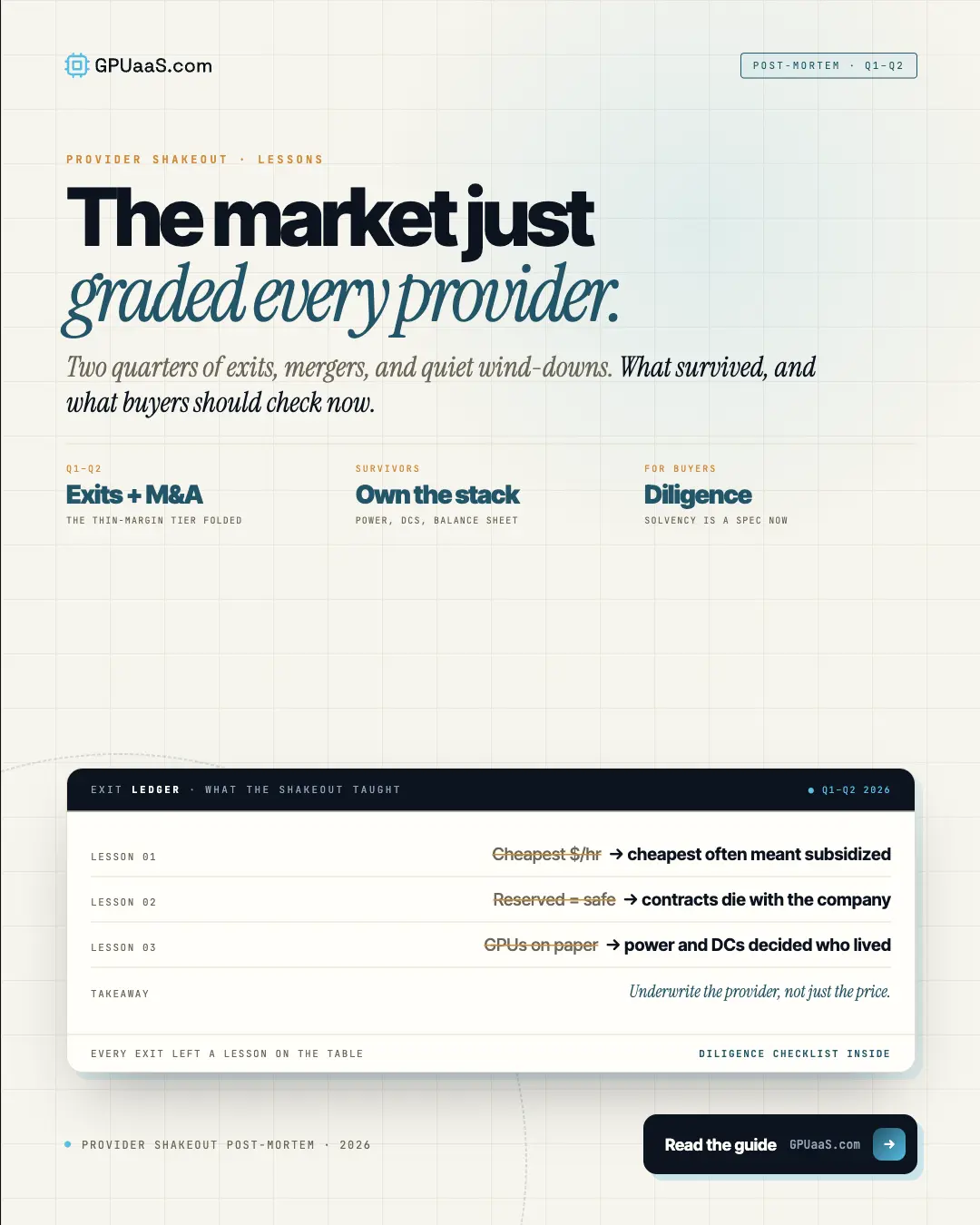
H100 spot fell to $1.99 an hour, below the cost basis for debt-financed providers. Five to seven are projected to survive from over a hundred. The mechanism, and what it means for buyers.
The Provider Shakeout: What Q1-Q2 Exits Taught the Market
GPUaaS.com Team
GPU Infrastructure
September 3, 2026
No items found.
H100 spot pricing fell to $1.99 an hour during the first half of 2026. That is below the cost basis for providers carrying debt-financed hardware.
Analysis across multiple sources now puts the number of GPU cloud providers likely to survive the next 18 to 24 months as standalone businesses at five to seven. There are well over a hundred competing today.
Key takeaways
H100 spot fell to $1.99/hr, below the cost basis for debt-financed providers. Five to seven providers are projected to survive the next 18 to 24 months as standalone businesses
A debt-financed cluster breaks even around 70 to 75% utilization. At 70%, right at the threshold, a 1,024-GPU H100 cluster still loses $80K to $130K a month
Provider stress is visible before any announcement: capacity rationing, slower response for non-enterprise customers, sudden pricing changes
Vendor-financed providers must price to cover both debt service and the vendor's revenue cut, so an unexplained premium may be structural rather than opportunistic
Renewals from 2024-2025 land through late 2026 against a changed standard: sovereignty, geographic resilience, compliance, not just access
◆ NOT BAD LUCK, NOT BAD OPERATORS
A model with almost no margin of safety
The Q1 and Q2 exits were not bad luck or bad operators. They were a business model with almost no margin of safety meeting three pressures at once.
The model itself is simple to state. Sign multi-year take-or-pay contracts for GPU capacity, borrow against those contracts, and race depreciation to the bank. It works when utilization holds and the debt clears before the hardware loses value. The whole art of the raise is arranging capital so the debt is repaid before the collateral decays and before the customer contract runs out. Get that right and a forty-person operator raises hundreds of millions on terms that used to be reserved for utilities. Get it wrong and the facility that funded the growth becomes the thing that ends the company.
◆ A 1,024-GPU H100 CLUSTER, BY UTILIZATION
Utilization
Monthly result
55%
Loss of roughly $330,000
70% (near breakeven)
Loss of $80,000 to $130,000
85%
Gain of roughly $340,000
90%
Gain of $170,000 to $220,000
Sources: American Compute 2026 via ModulEdge for the 55% and 85% figures, Spheron cost model dated 4 July 2026 for the 70% and 90% figures. The two models use different rate and colocation assumptions, which is why the bands differ
◆ UTILIZATION BREAKS FIRST
A fifteen-point swing decides solvency
A debt-financed cluster breaks even somewhere around 70 to 75% utilization. On a 1,024-GPU H100 cluster, 55% utilization produces a loss of roughly $330,000 a month while 85% produces a gain of roughly $340,000. Sit at 70%, right at the threshold, and the same cluster still loses $80,000 to $130,000 a month. Push to 90% and it generates $170,000 to $220,000. Bare-metal gross margins run 55 to 65% before depreciation is counted at all.
That is a business where a fifteen-point utilization swing decides solvency. When spot pricing falls below cost basis, the revenue side of that equation stops working regardless of how well the cluster is run.
$1.99/hr
H100 spot pricing in the first half of 2026, below the cost basis for providers carrying debt-financed hardware
Axe Compute asset-light GPU cloud market analysis, June 2026
◆ THREE FORCES CONVERGED, AND A QUIET FOURTH
All in the same two quarters
Capital raised in a different interest rate environment came due. Debt service on hardware depreciating faster than model generations is brutal arithmetic, and it does not improve with time. Over a hundred providers were competing for investment precisely when investor scrutiny of unit economics intensified, which meant the capital needed to refresh aging fleets became hardest to raise at the moment it was most needed.
Chip availability shifted the advantage. Blackwell production ramping through 2026 expanded supply, which sounds helpful and was not, for smaller players. Expanded availability makes volume purchasing power and supplier relationships more decisive, not less. A provider without scale loses the pricing advantage that scarcity had been providing.
Hyperscaler price cuts closed the gap that justified the category. Neoclouds existed partly because they were cheaper than AWS and Azure. When the hyperscalers cut, the differentiation narrowed for providers who had nothing else to offer.
First-generation infrastructure also hit depreciation limits at the same time, which is the quiet fourth factor. Fleets bought in the 2023 and 2024 build-out reached the point where the accounting and the competitive reality both said replace, and replacing requires capital that had become expensive.
◆ A DISCLOSURE BEFORE THE NEXT PART
Capital-heavy against asset-light
There is a structural distinction worth naming, and I should be upfront that GPUaaS sits on one side of it.
Capital-heavy providers raised billions, took on debt, and built or leased data center capacity to compete on infrastructure scale. CoreWeave, Lambda, and Nebius each made the same bet, that owning the hardware is the path to owning the market. Asset-light platforms aggregate existing capacity without carrying the balance sheet. Analysis from Axe Compute argues the asset-light model wins structurally, because it does not carry the debt, the hardware depreciation risk, or the customer concentration pressure. We are asset-light, so read that argument knowing we benefit from it being true.
What is not in dispute is that the two models fail differently. A capital-heavy provider under pressure has to keep utilization above a hard threshold or lose money every month. That constraint is real regardless of how the market eventually shakes out.
◆ THE SYMPTOMS ARRIVE BEFORE THE ANNOUNCEMENT
What provider stress looks like from the customer side
For buyers, provider financial stress shows up before any announcement does, and the symptoms are specific. Capacity rationing. Lower responsiveness for non-enterprise customers. Sudden pricing changes. Those are what a provider does when utilization is below break-even and cash is tight, and they are visible to a customer well before a shutdown notice.
There is a pricing tell worth understanding too. Providers financed through vendor arrangements carry locked-in cost structures tied to revenue-share terms, so their on-demand pricing has to cover both debt service and the vendor's cut. Providers without vendor-financed capital expenditure can price closer to market because they are not servicing those obligations. A price that seems inexplicably high may be structural rather than opportunistic.
The consequences of a mid-contract exit are worse than an inconvenience. Workload migration under time pressure, service disruption, renegotiated pricing from a weak position, and in the worst case stranded workloads with no clear recovery path.
◆ THE NEXT COHORT UNDER PRESSURE
The evaluation standard moved
The timing matters for anyone signing now. Commitments made in 2024 and 2025 come up for renewal through late 2026, and the evaluation standard has changed underneath them. The question in 2024 was whether GPUs could be accessed at all. The question now is data sovereignty, geographic resilience, and compliance architecture. Providers who could clear the first bar and cannot clear the second are the next cohort under pressure.
None of this argues against using a neocloud. It argues for asking about the balance sheet with the same seriousness as the fabric specification, because a provider's utilization threshold is a risk the customer carries whether or not anyone mentions it. For what to ask specifically, see the vendor evaluation checklist and the three questions most providers cannot answer.
Get matched with providers checked for counterparty stability.
Alongside compliance scope and infrastructure quality. No buyer fees. For single GPUs, packet.ai handles self-serve access with 24/7 human support.
Three pressures converged: capital raised in a different rate environment coming due, expanded Blackwell supply shifting advantage toward volume buyers, and hyperscaler price cuts narrowing the differentiation. H100 spot pricing at $1.99 an hour sat below the cost basis for debt-financed providers, which made the revenue side unworkable regardless of operational quality.
Analysis across multiple sources puts it at five to seven surviving the next 18 to 24 months as standalone businesses, from well over a hundred competing today. Others will be acquired rather than shut down, which is a different outcome for their customers but still a contract renegotiation.
Capacity rationing, slower responsiveness for non-enterprise accounts, and sudden pricing changes. Those are the operational symptoms of running below break-even utilization, and they appear well before any public announcement.
Often the capital structure. Providers financed through vendor arrangements carry cost structures tied to revenue-share terms, so pricing must cover debt service and the vendor's cut. Providers without vendor-financed capital expenditure can price closer to market. An unexplained premium may be structural rather than opportunistic.
No. Smaller providers often offer better pricing and more flexibility than tier-one operators. The point is to assess the balance sheet with the same seriousness as the fabric specification, and to know that a provider's utilization threshold is a risk the customer carries whether or not it is discussed.
Last reviewed: 4 September 2026. Spot pricing, survivor projections, and asset-light analysis from Axe Compute's neocloud market analysis, June 2026. Unit economics from American Compute 2026 via ModulEdge's neocloud business analysis and Spheron's NVIDIA neocloud backstop financing report dated 4 July 2026. Consolidation drivers from Vultr's Great Neocloud Consolidation analysis, January 2026, and Quicksilver Research's neocloud shake-out report, March 2026. Capital structure and SPV mechanics from Peony's neocloud capital raise analysis. Browse current GPU cluster availability on GPUaaS.com.