Blog ▸ The Reservation You Signed in 2024 Expires This Quarter. Now What?
GPU Infrastructure
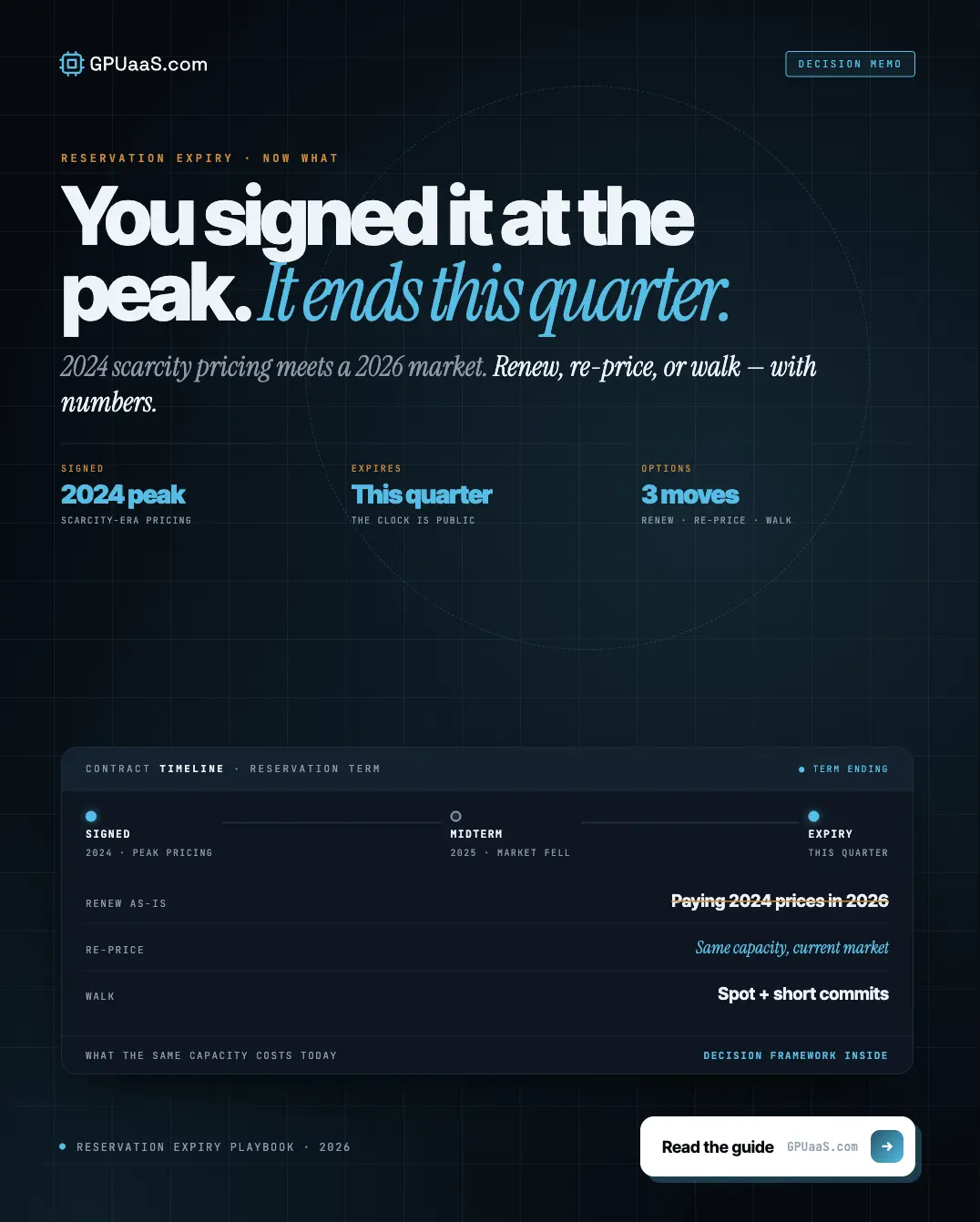
Prices fell 64 to 75% from peak but the market did not loosen. Where renewal leverage actually comes from, the three clauses that beat the headline rate, and the accounting consequence of term length.
The Reservation You Signed in 2024 Expires This Quarter. Now What?
GPUaaS.com Team
GPU Infrastructure
August 19, 2026
No items found.
Reserved H100 rates run from $1.07 to $10.14 per hour. Median $5.52.
Split by channel: marketplace median $1.70, neocloud median $2.31, hyperscaler median $6.11. The hyperscaler median is 3.3 times the combined non-hyperscaler median for identical silicon.
Key takeaways
Prices fell 64-75% from peak, but expiring contracts have not softened the market. Several neoclouds announced 20% increases, and on-demand is effectively sold out
Renewal leverage comes from holding hard-to-replace capacity, not from the price decline. Those are different negotiations
Three clauses matter more than the rate: step-downs at 12 and 24 months, SKU flexibility across a generation, and a defined 10-20% burst allowance
Under ASC 842, leases under 12 months can be operating leases. Longer terms generally capitalize as right-of-use assets, which finance may care about more than the rate
Competitive bidding cuts 15-20% on comparable deals. Most teams renew against a single quote because the incumbent relationship feels easier
A team renewing inside a hyperscaler agreement without checking the other two channels is renewing against the most expensive third of the market.
H100 rental prices have fallen 64 to 75% from their 2023 peak. Expiring A100 and H100 contracts are flowing back into availability channels now. Pricing has not softened in response. Several neocloud providers have announced 20% increases. On-demand capacity across most GPU types is effectively sold out, and providers are renewing existing contracts rather than releasing capacity to the open market.
The leverage at renewal is real. It runs the opposite direction from what the price decline suggests. The position is not "prices collapsed, match the new rate." The position is holding capacity that is hard to replace on short notice.
◆ VERIFY BEFORE THE NOTICE WINDOW CLOSES
Lapsing on an assumption is the expensive mistake
Letting a reservation lapse on the assumption that on-demand will absorb the workload is the expensive mistake at this point in the cycle. The gap between capacity commitment and volume production runs 18 to 24 months. Current constraints persist into 2027. Verify on-demand availability for the specific tier and region before the notice window closes, not after.
Knowing why the provider wants a long term changes the conversation. A multi-year customer commitment is what gives a neocloud the creditworthiness to secure its own data center and financing deals. The term is not only about locking in revenue. It is collateral. That is worth understanding before treating a long-term ask as pure vendor greed, and it is worth pricing into what a longer commitment should buy in return.
◆ LEVERAGE IS NOT UNIFORM ACROSS TIERS
A mixed-tier renewal is really two negotiations
On older hardware, A100 and L40S specifically, buyers have meaningfully more room on contract terms than they do on current-generation parts. A renewal covering mixed tiers is really two negotiations, and the older half should not inherit the terms the newer half requires.
Obsolescence risk on a short H100 renewal is lower than it looks. B200 capacity is allocated through the second half of 2027. Major cloud providers now assume a five to six year useful life for GPU infrastructure. A one or two year H100 commitment signed now carries relatively little risk of the hardware becoming unrentable inside the term. The risk sits in three-year and longer commitments, where H100 systems face roughly 40% value decline once the next generation ships in volume.
Utilization is the threshold that decides whether reserving still makes sense at all. At 70% or above sustained across the full term, longer commitments hold up. Below that, on-demand tends to win despite the higher hourly rate. Pull the actual utilization figures from the expiring term before renewing at the same capacity. That number is available now and was only a forecast in 2023.
3.3x
how much higher the hyperscaler median reserved H100 rate runs against the combined non-hyperscaler median, for identical silicon
Compute Exchange reserved GPU market data, 2026
◆ THREE CLAUSES THAT BEAT THE HEADLINE RATE
None were easy to get in 2023
Step-down clauses. A schedule that lets committed capacity shrink at defined checkpoints, typically 12 and 24 months into a three-year term, without breaching the contract. Anyone who overcommitted in 2023 knows why this matters. Providers grant it more readily now.
SKU flexibility. Commit to a GPU generation, not a part number. A contract allowing H100 hours to swap for H200 hours is worth more than a marginally better rate locked to hardware the workload outgrows mid-term.
Burst allowance. A defined 10 to 20% above committed capacity at a pre-agreed rate rather than open-market overage. Skipping this in 2023 is how teams discovered what open-market overage costs.
◆ TERM LENGTH IS AN ACCOUNTING DECISION TOO
The 12-month line under ASC 842
Term length carries an accounting consequence most technical teams never see. Under ASC 842, leases under 12 months can be treated as operating leases. Longer terms generally require capitalization as right-of-use assets on the balance sheet. Ask finance which side of that line they want before negotiating term, not after.
The discount curve: roughly 25% saving on a one-year commitment, roughly 45% over three years, against on-demand. Whether the extra 20 points justify two additional years depends on utilization confidence. 2023's forecasts are a useful reminder of how wrong that can run.
Competitive bidding at renewal reduces cost 15 to 20% on comparable deals. Most teams skip it because the incumbent relationship feels easier. Renewing against a single quote means never learning what the number could have been.
Consolidating spend scattered across business units into one negotiated volume commitment is the other lever teams leave unpulled. Separate contracts negotiated by separate teams against the same provider surrender the volume that would have moved the rate.
Read the auto-renewal clause before anything else. Some contracts renew into a term matching the original commitment rather than a shorter extension. On a three-year deal, missing the notice window under that structure costs three more years. The vendor evaluation checklist covers what to look for in that clause specifically.
The workload has changed more than the market has since the contract was signed. Model sizes, precision formats, and inference patterns all moved. Size the renewal against what runs today, not what someone estimated in 2023. For the underlying threshold math, see the rent, reserve, or buy decision framework.
Benchmark the renewal before you sign it.
Get a current quote within 24 hours. No buyer fees. For single GPUs, packet.ai handles self-serve access with 24/7 human support.
Not directly. Prices fell 64 to 75% from peak, but expiring contracts returning to market have not softened pricing, and several neoclouds announced 20% increases. The stronger position is that you hold capacity that is difficult to replace on short notice, which is a different argument than matching a published rate.
Verify availability for your specific tier and region before the notice window closes. On-demand capacity is effectively sold out across most GPU types, and the 18 to 24 month gap between capacity commitment and volume production means constraints persist into 2027. Lapsing on an assumption is the expensive path right now.
Step-down clauses at 12 and 24 month checkpoints, SKU flexibility that commits to a GPU generation rather than a part number, and a defined burst allowance of 10 to 20% above committed capacity at a pre-agreed rate. Providers grant all three more readily now than in 2023.
Under ASC 842, leases under 12 months can be treated as operating leases, while longer terms generally require capitalization as right-of-use assets on the balance sheet. That distinction can matter more to finance than the rate difference between a one-year and three-year term, so it is worth asking before negotiating length.
One and two year terms carry relatively little risk, since B200 capacity is allocated through the second half of 2027 and providers now assume a five to six year useful life. The risk concentrates in three-year and longer commitments, where H100 systems face roughly 40% value decline once the next generation ships in volume.
Last reviewed: 20 August 2026. Reserved pricing distribution and channel medians from Compute Exchange's reserved GPU market data, 2026. Contract term structures, ASC 842 treatment, and utilization thresholds from Compute Exchange's reserved GPU contract length guide. Negotiation clause detail from Spheron's GPU cluster reservation contract guide. Competitive bidding and consolidation figures from Introl's GPU procurement strategies analysis. Browse current GPU cluster availability on GPUaaS.com.