Blog ▸ The GPU Vendor Evaluation Checklist: What to Ask Before You Sign Anything
GPU Infrastructure
A SOC 2 badge, an interconnect diagram, and a friendly sales process are not enough. What to actually verify about compliance scope, stability, and exit terms before signing.
The GPU Vendor Evaluation Checklist: What to Ask Before You Sign Anything
GPUaaS.com Team
GPU Infrastructure
August 4, 2026
No items found.
A SOC 2 Type II attestation can cover a provider's premium tier of vetted infrastructure while saying nothing about a cheaper tier of the same platform, where workloads run on third-party host capacity with no equivalent compliance language. A buyer who saw "SOC 2" on the homepage and signed up for the cheaper tier bought a certification that doesn't apply to what they're actually running on.
That's the actual shape of vendor diligence in 2026, and it's less exciting than people expect going in. Not whether a provider has a certification. Which product the certification covers, and whether that's the tier being deployed on.
Key takeaways
A SOC 2 badge means little without checking the exact product tier and audit period it covers. A provider's premium tier and its cheaper, community-priced tier often carry very different compliance postures
Two GPU cloud companies shut down or froze new signups in Q1 2026, making counterparty stability a real procurement variable
A 90-day exit notice with no penalty and up to 12 months of free egress at contract end is the standard worth locking in, per Google Cloud's own published contract guidance
Some contracts auto-renew into a full new multi-year term matching the original commitment, not a one-year extension, if the notice window is missed
Three interconnect questions (fabric, NVLink-domain size, storage bandwidth) separate mature training infrastructure from inherited topology sold under a different brand
◆ THE CERTIFICATION SCOPE PROBLEM
Which product, which tier, which period
Get the actual SOC 2 report, not the marketing page referencing it. Check whether it's Type I or Type II, and which specific product or tier the audit boundary covers. Check the audit period too. A Type II report is a point-in-time snapshot of a historical window, not a standing certification. One where the observation period ended over a year ago, with no successor report in progress, tells you far less about current posture than a fresh one does. A handful of minor exceptions with documented remediation is normal in a report covering 6 to 12 months of real operations. A pattern of repeated exceptions on the same control, or an exception with no remediation noted, is worth raising with the vendor directly before anything gets signed.
◆ COUNTERPARTY STABILITY IS NOW A REAL VARIABLE
Two providers already disappeared this year
Two GPU cloud companies shut down or froze new signups in Q1 2026 alone. Customers who'd built on either one are now rebuilding on infrastructure that wasn't part of their original plan. Check how long the company has operated at current scale, whether it's raised capital recently, and what the actual data migration path looks like if service ends with short notice.
◆ THE THREE FABRIC QUESTIONS
Real training infra vs. someone else's topology
The interconnect question separates real training infrastructure from someone else's topology wearing a different logo. What's the fabric, NVLink, InfiniBand, or Ethernet, and is it non-blocking inside a pod. What's the NVLink-domain size, eight GPUs for standard HGX versus seventy-two for NVL72, and how does traffic route across that boundary. What's the actual peak read bandwidth from a 128-GPU job on the storage layer. A vendor that answers all three cleanly has mature training infrastructure. A vendor that deflects on any of them is usually inheriting infrastructure from an underlying partner and reselling it under their own brand.
◆ EGRESS IN WRITING
Where surprise bills actually come from
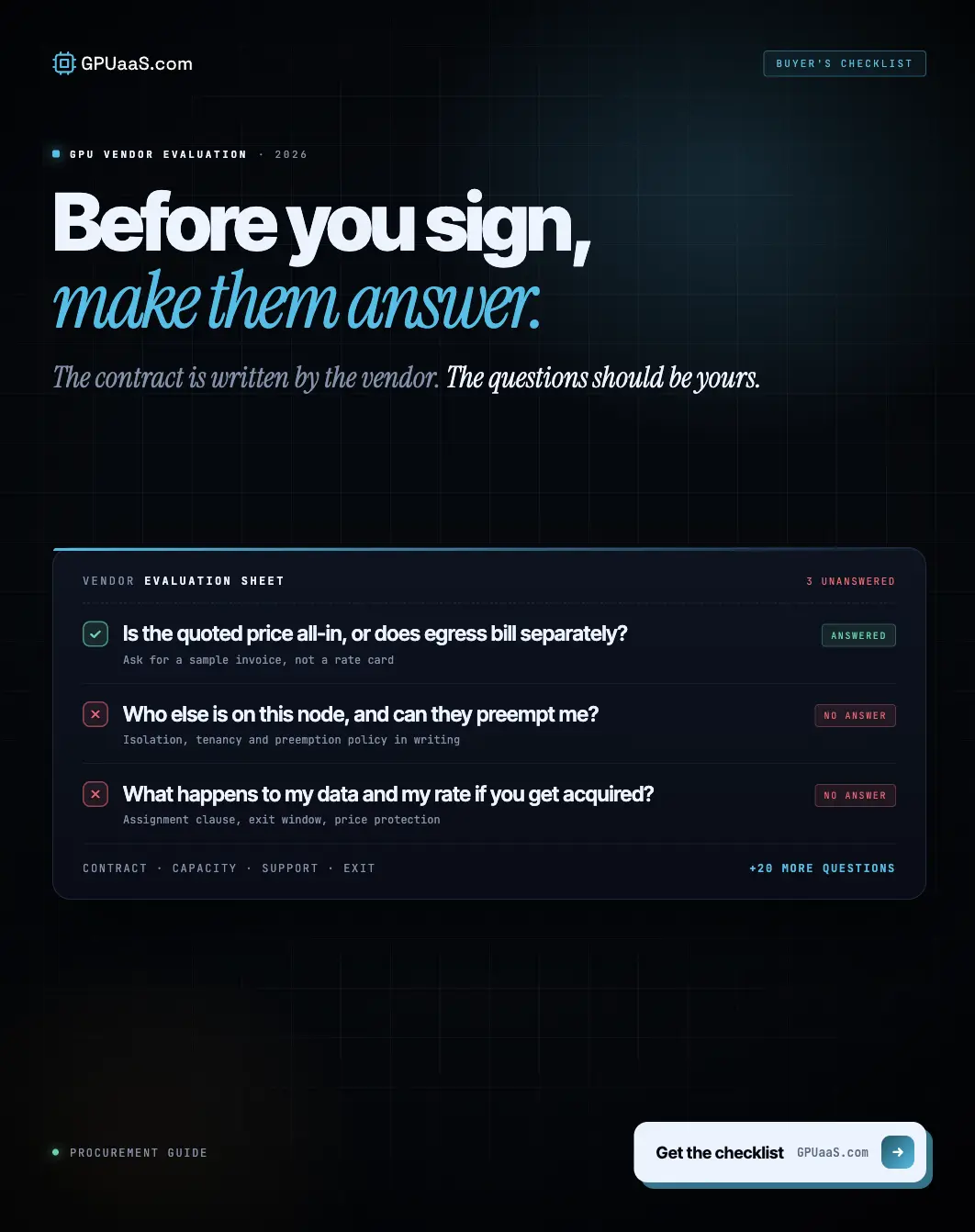
Egress fees need to be in writing, with real numbers, not a general policy statement pointing at a pricing page. This is where surprise bills come from more often than any other line item on a GPU contract. Worth asking specifically what happens during high-demand periods too, whether existing customers get squeezed out when everyone trains models in the same quarter, and what the reservation system actually looks like when that happens rather than what the sales deck says it looks like.
◆ EXIT TERMS DESERVE THE SAME SCRUTINY AS PRICING
The section most buyers skip because it's boring
Exit terms deserve the same scrutiny as the pricing itself, and this is the section most buyers skip because contracts are boring and fabric specs feel like the real work. Google Cloud's own published contract guidance treats a 90-day exit notice with no penalty as the standard to lock in, alongside up to 12 months of free egress at contract end. Fewer than that on a GPU contract is worth pushing back on directly.
Read the renewal clause word for word, not the summary of it. Some contracts don't auto-renew into a one-year extension. They auto-renew into a new term matching the original commitment. Miss the notice window on a three-year deal under this structure and the lock-in isn't one more year, it's three. Look specifically for phrases like "successive terms of the same length" or "renewal term shall match the initial term." Push for renewal terms that convert to month-to-month or one-year periods regardless of how long the original term ran, on any multi-year deal, no exceptions.
90 days
the minimum exit notice period with no penalty worth locking in on a GPU contract, alongside up to 12 months of free egress at contract end
Google Cloud published contract terms guidance, 2026
Check who owns the performance data too, since this one hides inside what looks like a standard reporting clause. A provider offering a dashboard is normal. A provider whose contract says customers can't export, scrape, or reproduce that dashboard's output outside vendor-authorized channels is something else, a data lock-in dressed up as intellectual property protection. That clause means the usage history, cost data, and performance metrics built up over a contract term can't leave with the buyer if they switch providers later.
Ask for the hardware refresh roadmap in real dates, not fiscal half-years. Firm calendar quarters for the next generation's general availability. Which SKUs are already under procurement contracts versus which ones are still slides in a deck. What penalty applies if the stated availability date slips by more than one quarter. A provider advertising consumer-grade cards as enterprise stopgaps, or showing "coming soon" without SKU numbers or network specs, is signaling something about how seriously to take the rest of the roadmap.
None of this requires adversarial energy at the negotiating table. It requires specificity, and a willingness to actually read the document instead of the summary someone wrote for it. A vendor with a real answer gives one immediately. A vendor without one changes the subject, points back to the marketing page, or answers a slightly different question than the one that got asked.
Skip the vetting, get matched with providers already checked.
Get a quote within 24 hours from a vetted provider. No buyer fees. For single GPUs, packet.ai handles self-serve access with 24/7 human support.
No. A SOC 2 badge on a homepage doesn't specify which product tier it covers or how recent the audit period is. A provider's premium tier and a cheaper, lower-cost tier of the same platform can carry very different compliance postures. Always request the actual report and check the exact scope boundary before assuming it applies to the tier being purchased.
A 90-day exit notice with no penalty and up to 12 months of free egress at contract end, per Google Cloud's own published contract guidance. It's also worth checking the renewal clause specifically, since some contracts auto-renew into a full new multi-year term rather than a shorter extension if the notice window is missed.
Two GPU cloud companies shut down or froze new signups in Q1 2026 alone, leaving their customers to rebuild on infrastructure that wasn't part of the original plan. Confirming how long a provider has operated at scale, and what the data migration path looks like on short notice, is now a standard part of due diligence rather than an edge case.
Ask about the interconnect fabric and whether it's non-blocking inside a pod, the NVLink-domain size and how traffic routes across it, and the peak storage read bandwidth from a large multi-GPU job. A provider with mature infrastructure answers all three specifically. A provider that deflects is likely reselling infrastructure inherited from an underlying partner.
Submit a workload spec and GPUaaS matches it with providers already vetted against compliance scope, counterparty stability, and infrastructure quality, returning a quote within 24 hours rather than requiring the buyer to run this entire evaluation independently.
Last reviewed: 5 August 2026. SOC 2 scope analysis from Spheron's 2026 SOC 2 Compliant GPU Cloud Providers guide. Interconnect evaluation criteria from wetheflywheel's 2026 AI Compute and Neocloud Providers guide. Counterparty stability data from Axe Compute's 2026 GPU Cloud Comparison. Exit clause and contract terms guidance from Redress Compliance's Google Cloud Contract Terms 2026 and Varisource's SaaS Contract Red Flags 2026 report. Browse current GPU cluster availability on GPUaaS.com.