Blog ▸ What Happens to Your Workload When a Provider Exits Mid-Contract
GPU Infrastructure
The EU Data Act gives about four months of protected window. Every obligation in it assumes the provider is still operating.
What Happens to Your Workload When a Provider Exits Mid-Contract
GPUaaS.com Team
GPU Infrastructure
September 30, 2026
No items found.
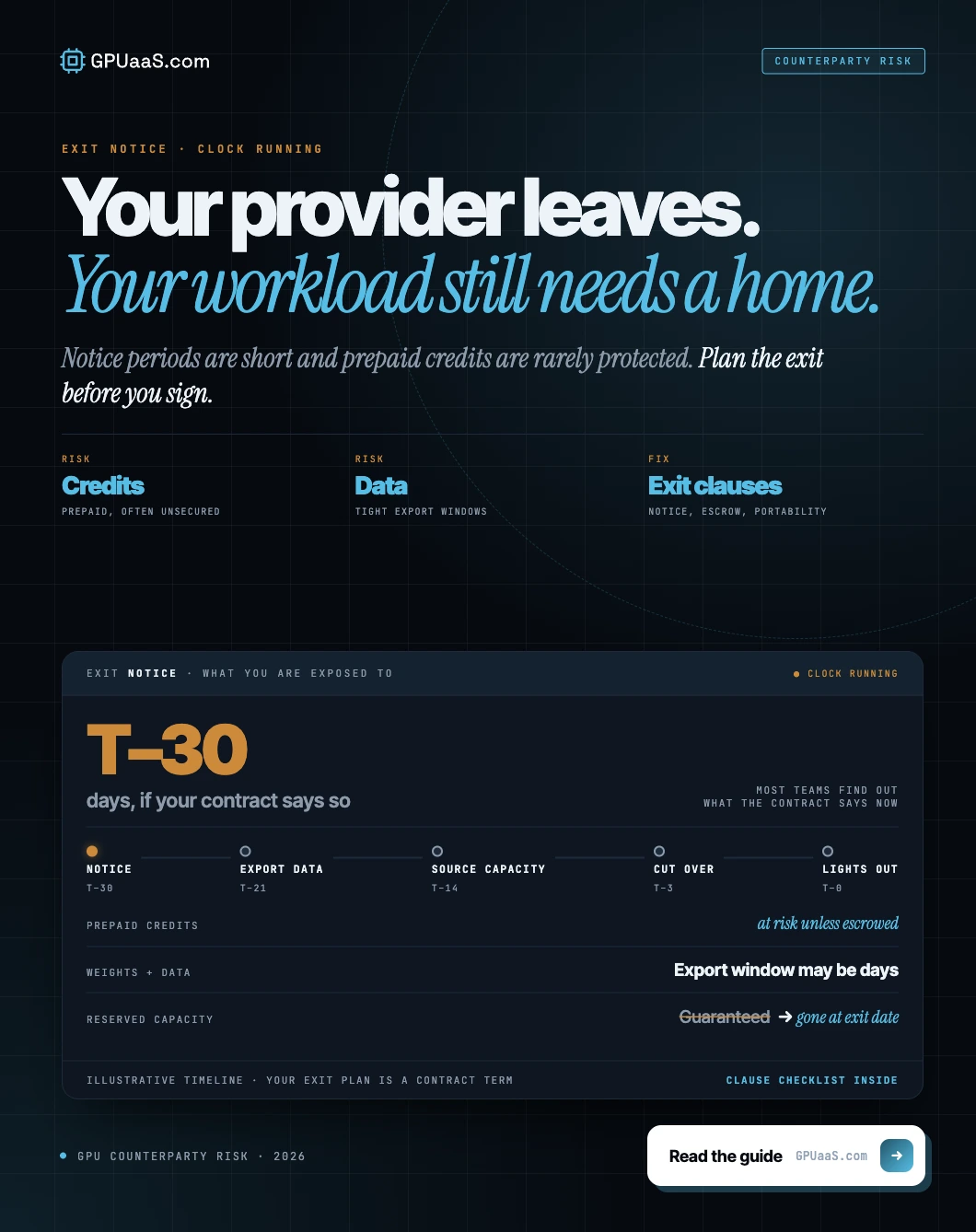
Under the EU Data Act a customer gets two months' notice, a 30-day transition, and at least 30 days to retrieve data. Roughly four months in total.
Every one of those obligations assumes the provider is still operating.
Key takeaways
The Data Act gives about four months of protected window: 2 months notice, 30 days transition, 30 days retrieval
Those are switching rights the customer exercises, not protections against a provider that stops operating
A multi-model fleet migration takes 8 to 12 weeks, so the guaranteed window is adequate only if it is actually available
Many contracts cut API access the day a subscription ends, which breaks integration pipelines overnight
The only reliable defence is exporting before the notice arrives, not after
◆ WHAT THE EU DATA ACT ACTUALLY GUARANTEES
Stage
Duration
Provider obligation
Notice period
Max 2 months
Service continues without degradation
Transition
Max 30 calendar days
Business continuity, technical assistance
If technically unfeasible
Up to 7 months
Must justify within 14 working days
Data retrieval
Min 30 calendar days
Export in machine-readable format, then delete
Article 25, applying to IaaS, PaaS and SaaS. Chapter VI switching duties have applied since 12 September 2025
◆ THE GAP IN THE PROTECTION
Switching rights are not failure protections
The Data Act gives the customer a right to leave. It obliges the provider to maintain business continuity during the transition, provide reasonable assistance, flag known risks and preserve data security.
A provider in financial distress cannot deliver any of that. Business continuity is not a clause a company can honour once it has stopped paying for power and staff, and an administrator's duties run to creditors rather than to a migration timetable.
The mechanism matters because the exits that cause real damage are unplanned ones. A provider winding down deliberately usually gives notice. A provider that runs out of money does not, and the regulation was written for the first case.
8-12 weeks
to migrate a multi-model inference fleet, against a protected window of roughly four months that only exists while the provider is still trading
Migration durations from Qovery's GPU inference migration playbook, 2026
◆ THE WINDOW AGAINST THE WORK
Adequate, but only just
A single-model inference service takes about four weeks to move. A multi-model fleet takes eight to twelve. Against a four-month protected window those numbers fit, with room for the quota approval on the receiving side that usually sets the critical path.
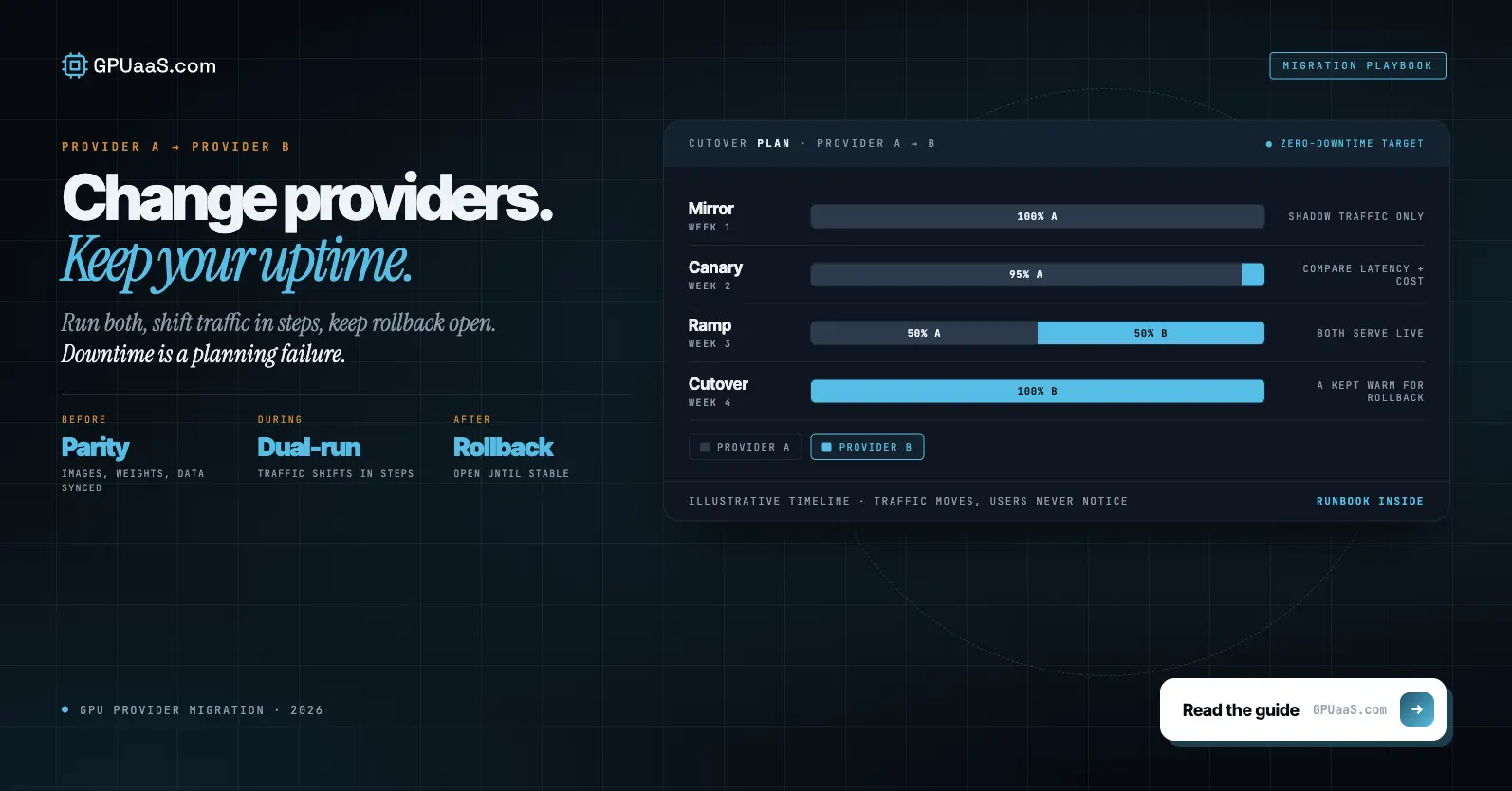
Remove the window and the same work still takes the same time. That is the asymmetry worth planning around: migration duration is a property of the workload, while the window is a property of the provider's solvency. The mechanics are in migrating between GPU providers without downtime.
Outside the EU there is no equivalent statutory floor. Whatever the contract says is what there is, and many contracts say considerably less than four months.
◆ WHERE CONTRACTS QUIETLY FAIL
API access ending with the subscription
Many contracts define customer data narrowly and cut API access on the day the subscription ends. Integration pipelines break overnight, and the export that was supposed to happen during the retrieval window turns out to require an interface that is already switched off.
The clause to negotiate is explicit API access for a defined transition window past termination, separate from any data retrieval right. One covers the files, the other covers the means of getting at them, and only having the first is a common way to discover the difference.
The Data Act also requires providers to publish a register of data structures, formats, standards and interoperability specifications. That register is worth reading before signing rather than during an exit, because it determines whether an export is usable or merely technically compliant.
◆ WHAT TO ASK FOR BEFORE SIGNING
Five clauses that matter at exit
Explicit API access for a transition window after termination. A defined list of exportable data and digital assets, including metadata, configurations and application-level state rather than just stored files. Export in a structured machine-readable format, named in the contract.
A named migration coordinator on the provider side, which turns an obligation into someone's job. And an exhaustive specification of what the provider excludes as trade secrets, since a vague exclusion can swallow the thing you actually need.
None of those clauses are unusual to ask for, and a provider that resists all five is telling you something about how an exit would go.
◆ THE DEFENCE THAT WORKS
Export before you need to, not after
The only reliable protection is holding a current copy of everything outside the provider before any notice arrives. Weights, configurations, and whatever application state the service holds, mirrored somewhere the provider does not control.
That converts a provider failure from an emergency into a scheduling problem. The migration still takes eight to twelve weeks, but it starts from a position where the data is already safe rather than from one where the first task is getting it out.
Stress is usually visible before it is announced. Pricing that drops below plausible cost, support response times stretching, and roadmap commitments going quiet are the signals worth watching, and the economics behind them are in the provider shakeout.
The question to ask of any provider contract is not whether it contains exit terms. Most now do, at least in the EU. It is whether those terms survive the scenario where they matter, which is the one where the provider is not in a position to honour anything.
A contract cannot make an insolvent company maintain business continuity. A current export held elsewhere does not need it to.
Capacity from vetted providers, with exit terms checked.
So the contract works in the case that matters. No buyer fees. For single GPUs, packet.ai handles self-serve access with 24/7 human support.
Under the EU Data Act the customer-side notice period for switching is capped at two months, followed by a transition of up to 30 calendar days and at least 30 days for data retrieval. Outside the EU there is no statutory floor, so the contract is the only protection.
Not meaningfully. The obligations require the provider to maintain business continuity and provide assistance, which a company in financial distress cannot do. The regulation was written for planned switching, not for failure, and the exits that cause damage are the unplanned ones.
For most workloads yes, with room to spare. A single-model service takes about four weeks and a multi-model fleet eight to twelve. The problem is not the duration of the window but whether it exists at all, since migration time does not shrink when the window disappears.
API access for a defined window past termination, a named list of exportable data including metadata and configurations, a specified machine-readable export format, a named migration coordinator, and an exhaustive list of what the provider excludes as trade secrets.
A current export held outside the provider at all times, covering weights, configurations and application state. That turns a failure from an emergency into a scheduling problem, because the migration starts from data that is already safe.
Last reviewed: 1 October 2026. EU Data Act Article 25 switching timelines, continuity and assistance obligations from DLA Piper's cloud exit analysis, 2026, Saga Compliance's Data Act guide, August 2026, and Digital Chiefs' switching duties analysis, August 2026. Scope across IaaS, PaaS and SaaS per the European Commission's 2026 FAQ. Data retrieval mechanics and export format requirements from Global Law Experts' termination analysis and McCann FitzGerald's switching rights guide. Interoperability register requirements from Turing Law's cloud contract analysis. Contract failure modes and export guidance from Alphonso Labs' vendor shutdown analysis, 2026. Migration durations from Qovery's GPU inference migration playbook. This is general information rather than legal advice. Browse current GPU cluster availability on GPUaaS.com.