Blog ▸ Running Multi-Provider GPU Infrastructure: When It Is Worth It
GPU Infrastructure
Effective GPU cost is rate divided by utilization. Provider choice moves it 2x, utilization moves it 20x. When a second provider earns its overhead.
Running Multi-Provider GPU Infrastructure: When It Is Worth It
GPUaaS.com Team
GPU Infrastructure
September 29, 2026
No items found.
Effective GPU cost is the hourly rate divided by actual utilization. At $12.29 an hour and 5% utilization, that is $245.80 per utilized GPU-hour.
Moving to a provider half the price takes it to $122.90. Fixing utilization takes it to $17.56.
Key takeaways
Provider choice moves cost by roughly 2x. Utilization moves it by up to 20x. Fix the denominator first
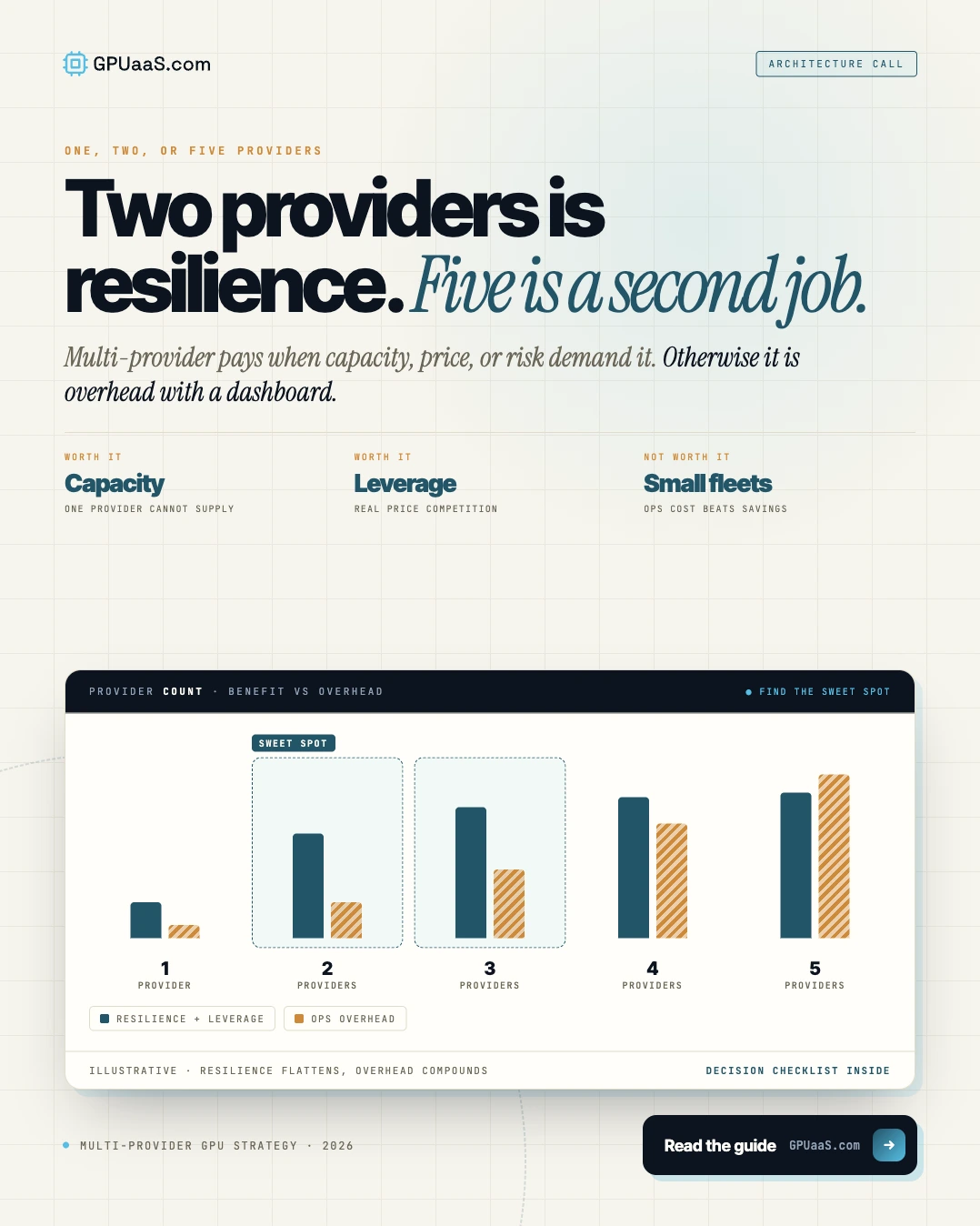
A workload-class split across providers saves 40 to 60%, but needs an orchestration layer to route jobs transparently
Egress adds 20 to 30% to effective cost on data-heavy pipelines, and inter-region networking another 10 to 20%
Availability is the strongest single reason. No provider has consistent capacity across every region and instance type
EU-based GPUs run 10 to 30% above US equivalents, so sovereignty requirements cost money rather than save it
◆ THE DENOMINATOR DOMINATES
Multi-provider optimises the smaller term
Multi-provider sourcing works on the hourly rate. Idle detection, scale-to-zero and GPU sharing work on utilization. Only one of those is where most of the money sits.
The spread between a hyperscaler and a specialist is real but bounded. Median H100 pricing ran $4.17 an hour on specialist providers against $7.89 on hyperscalers in August 2026, and neocloud savings against hyperscalers are generally quoted at 40 to 85%. That is somewhere between a 1.9x and a 6x improvement on the numerator.
Average enterprise GPU utilization measured across production clusters sits near 5%. Moving that to 70% is a 14x improvement on the denominator, available without renegotiating anything or adding a second vendor relationship.
◆ WHAT EACH LEVER IS WORTH
Lever
Effect on cost
What it requires
Raise utilization 5% to 70%
~14x
Idle detection, scale-to-zero, bin-packing
Workload-class split across providers
40-60%
Orchestration layer, multicloud competence
Hyperscaler to specialist
1.9-6x
One new vendor relationship
Egress between providers
Adds 20-30%
Nothing. It happens automatically
$245.80
effective cost per utilized GPU-hour at a $12.29 nominal rate and 5% utilization, which is twenty times the number on the invoice
Cast AI GPU cloud pricing analysis, 2026
◆ WHEN IT IS GENUINELY WORTH IT
Availability is the strongest reason, not price
No single provider has consistent GPU availability across every region and instance type. A second source lets a job schedule against whichever provider actually has capacity at that moment, which matters more during supply constraints than the hourly difference does.
Compliance is the second reason, and it is a requirement rather than an optimisation. Routing workloads that touch regulated data to compliant regions while keeping model development on cheaper capacity is a legitimate split that no single provider covers well.
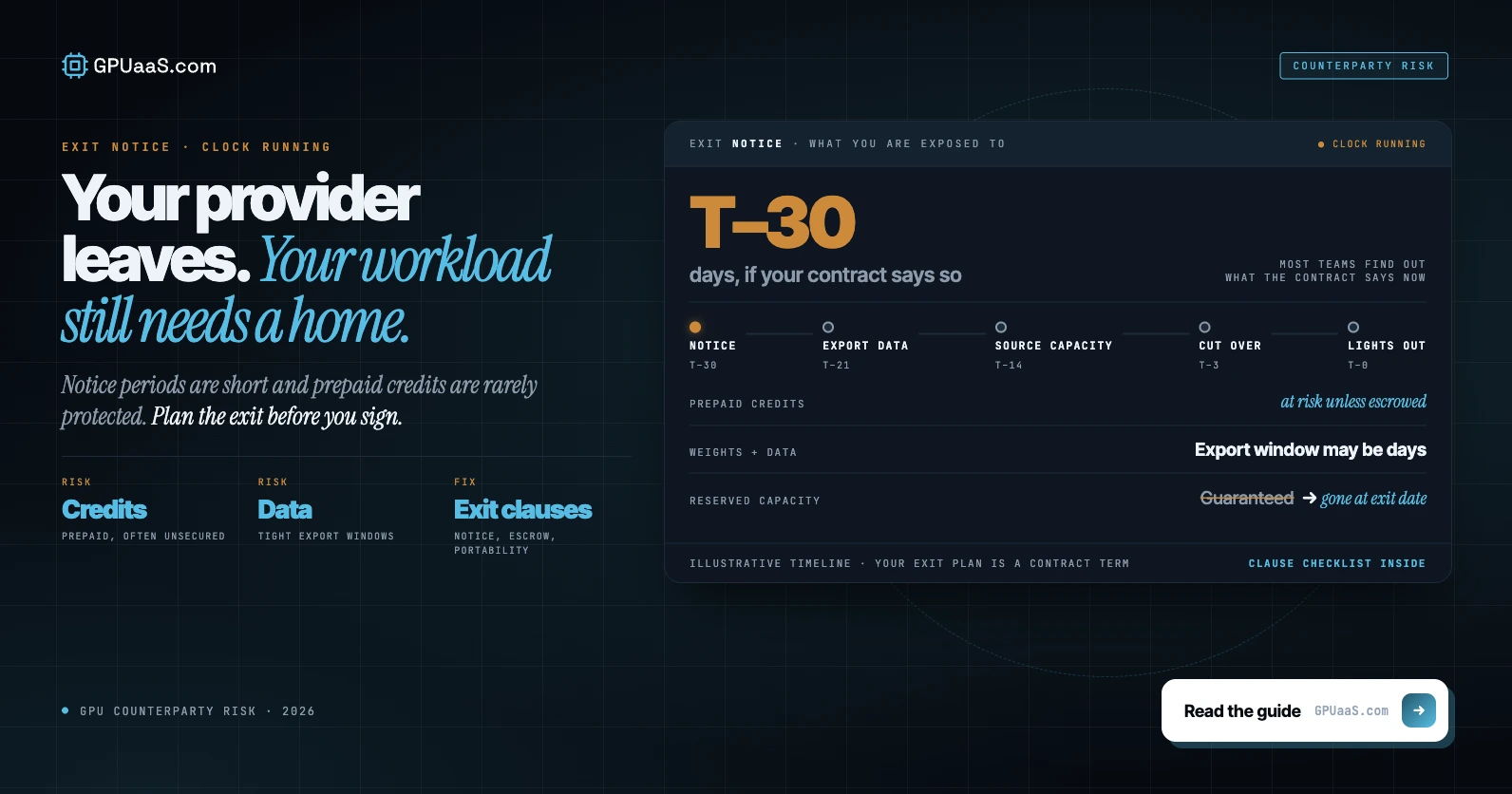
Counterparty risk is the third. A fleet concentrated with one provider inherits that provider's balance sheet, which is a live concern given how the market has consolidated. The failure modes are covered in the provider shakeout.
◆ THE SPLIT THAT ACTUALLY SAVES
By workload class, not by percentage
The arrangement that produces 40 to 60% savings against single-provider is a split by workload class rather than a blanket distribution. Training runs on the cheapest spot capacity, production inference on the most reliable provider, and batch inference back on spot.
That works because the three classes have different interruption tolerances. Training checkpoints and restarts. Production serving cannot. Batch inference can wait. Matching each to the capacity type that fits is where the saving comes from, not from arbitrage between rate cards.
It also requires genuine multicloud competence. Splitting by workload class means three deployment pipelines, three monitoring surfaces and three failure modes to understand.
◆ WHAT EATS THE SAVING
Egress, orchestration, and operational surface
Egress is the tax that only exists because the workload spans providers. Hyperscaler rates run $0.087 to $0.12 per GB, which on data-heavy pipelines adds 20 to 30% to effective cost. Inter-zone and inter-region networking adds another 10 to 20% on distributed training. Some specialist providers charge nothing for egress, which makes the direction of data movement a design decision rather than an afterthought.
Orchestration is the prerequisite most teams underestimate. Routing jobs across providers transparently needs a control plane that handles scheduling, credentials and failover. Without it, the operational overhead of managing multiple providers outweighs the benefit, which is the usual reason multi-provider programmes get quietly abandoned.
For teams running GPU work alongside the rest of their stack on one hyperscaler, the overhead of a separate specialist often exceeds the pricing premium outright. That is a real answer, not a cop-out.
◆ WHEN ONE PROVIDER IS THE RIGHT ANSWER
Concentration buys leverage
Splitting volume across providers splits negotiating position with each of them. A single committed relationship produces better rates, better support response and first call on constrained capacity, and those are worth something that does not appear in a rate comparison.
Below a certain scale the arithmetic is simply unfavourable. A team spending tens of thousands a month on GPUs will not recover the engineering cost of an orchestration layer from a 40% saving on a fraction of that spend. Multi-provider is a programme with fixed costs, and those costs amortise only above a volume threshold worth calculating before committing.
◆ THE SOVEREIGNTY TRAP
Compliance costs 10 to 30% more
EU-based GPU capacity runs 10 to 30% above US equivalents. A multi-provider strategy adopted for sovereignty reasons is therefore a cost increase being managed rather than a saving being captured, and presenting it as the latter sets up a conversation that goes badly later.
The pragmatic arrangement is a split by data classification. Workloads touching no personal data run on cheaper capacity wherever it sits, and anything regulated runs on compliant infrastructure at the premium. That keeps the premium attached to the workloads that actually require it.
The decision rule is sequential rather than either-or. Measure utilization first, because at 5% no provider choice matters much. Fix idle waste, then split by workload class if the interruption tolerances genuinely differ, then add a second provider for availability or compliance if either is a real constraint.
Adding providers before fixing utilization optimises the term that moves the number least, at the cost of the operational surface that makes everything else harder.
One relationship, capacity from vetted providers.
Availability without the orchestration overhead. No buyer fees. For single GPUs, packet.ai handles self-serve access with 24/7 human support.
A workload-class split saves 40 to 60% against single-provider, but utilization matters more. Effective cost is hourly rate divided by utilization, so at 5% utilization a provider change halves a number that fixing idle waste would cut by fourteen times.
Availability. No single provider has consistent capacity across every region and instance type, so a second source lets jobs schedule against whoever actually has GPUs. Compliance and counterparty risk are the other two legitimate reasons.
By interruption tolerance. Training on cheap spot capacity because it checkpoints and restarts, production inference on the most reliable provider because it cannot, batch inference back on spot because it can wait. That split is where the 40 to 60% comes from.
Egress adds 20 to 30% on data-heavy pipelines and inter-region networking another 10 to 20%. It also requires an orchestration layer to route jobs transparently. Without one, the operational overhead typically outweighs the benefit.
No. EU-based GPU capacity runs 10 to 30% above US equivalents, so a sovereignty-driven split is a cost increase being managed rather than a saving. Splitting by data classification keeps the premium attached only to workloads that require it.
Last reviewed: 30 September 2026. The effective cost formula, utilization figures and multi-cloud sourcing analysis from Cast AI's GPU cloud pricing guide, 2026. Specialist and hyperscaler median pricing from packet.ai's GPU cloud provider comparison, August 2026, noting packet.ai is part of the same group as GPUaaS.com. Neocloud savings range, workload-class split and EU pricing premium from Cloud Magazin's AI inference cost analysis, March 2026. Orchestration requirements from SISGAIN's multi-cloud GPU strategy analysis. Egress and networking overhead figures from GMI Cloud's GPU platform cost guide and Spheron's on-premise versus cloud analysis, April 2026. Browse current GPU cluster availability on GPUaaS.com.