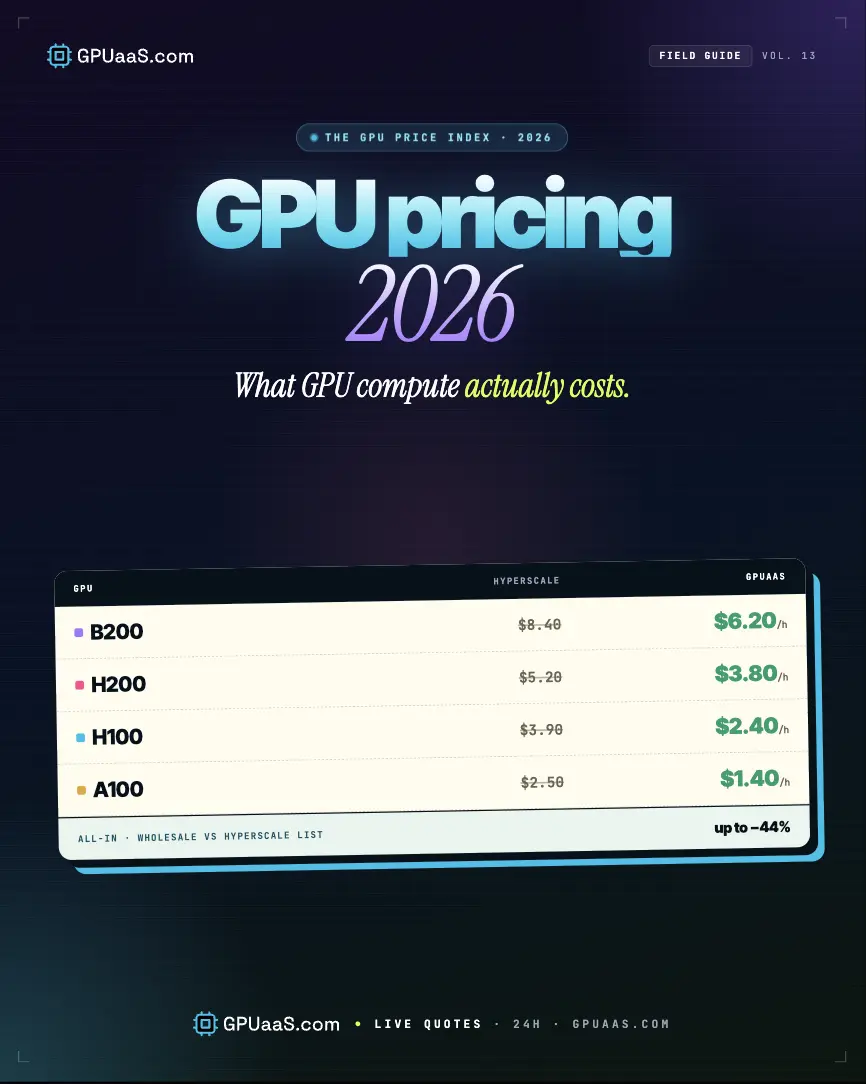
GPU pricing in 2026 depends on three variables: the GPU model you need, the provider you go through, and the contract length you commit to. Get all three right and you access H100 compute from $3.33/GPU/hr median through GPUaaS.com. Get them wrong and you pay significantly more for identical silicon.
- Through GPUaaS.com, get H100 GPU compute from $3.33/GPU/hr median, H200 from ~$3.00/GPU/hr, B200 and B300 from ~$4.50/GPU/hr. Hyperscaler contract rates for the same hardware run significantly higher
- GPU model choice is the biggest single lever on your compute bill. The right GPU isn't the newest one, it's the cheapest one your workload doesn't saturate
- GPUaaS.com is contract-based, not on-demand. Both short-term and long-term contracts are available, so you can start with a shorter commit and extend as your workload matures, without locking into multi-year terms upfront
- When evaluating hyperscaler GPU rates, the headline compute price is only part of the bill. Egress fees, attached storage charges, and support tier costs stack on top, and are worth modelling before you sign anything
- Average GPU utilisation across production clusters sits at 5% according to industry data. At that rate, the effective cost per unit of useful compute is 20x the headline rate. Fixing utilisation is the highest-ROI cost reduction available to most teams
GPU pricing isn't a single number. Three decisions made before you provision a single GPU determine what you'll actually pay: which model you need, which provider you go through, and what contract length you commit to. Each of these can move your effective hourly rate by 30 to 60%.
The GPU model sets the hardware floor. Memory bandwidth, VRAM capacity, and compute throughput determine which jobs the GPU can handle without bottlenecking, and that determines which model you actually need, not which one is newest. The provider type sets the cost structure on top of that floor. The contract length determines what rate you access.
GPUaaS.com gives you access to GPU cloud compute at prices hyperscalers can't match. Quote-based, connecting buyers directly to vetted GPU cloud compute providers, with both short-term and long-term contracts available.
◆ The three levers on your GPU bill
GPU model sets the hardware floor. Pick the cheapest model your workload doesn't saturate. Provider type sets the cost structure. Vetted GPU cloud compute providers via GPUaaS.com run significantly below hyperscaler contract rates for the same chip. Contract length determines your rate. Short-term commits give you flexibility; longer commits unlock better rates.
GPU model choice is the biggest single lever on your compute bill. The right GPU for your workload isn't the newest or most powerful one, it's the cheapest one whose VRAM, bandwidth, and compute your job doesn't saturate. Here's what each GPU costs through GPUaaS.com and where each fits.
| GPU | VRAM | Starting from (GPUaaS.com) | Best for |
|---|---|---|---|
| H100 SXM5 | 80 GB HBM3 | $3.33/GPU/hr median | 70B inference, FP8 training, production serving |
| H200 SXM | 141 GB HBM3e | ~$3.00/GPU/hr | 70B+ at long context, 405B quantised, multi-modal |
| B200 SXM | 192 GB HBM3e | ~$4.50/GPU/hr | 405B+ inference at scale, MoE, high-concurrency serving |
| B300 | 288 GB HBM4 | ~$4.50/GPU/hr | Frontier model training, next-generation inference at scale |
Indicative rates through GPUaaS.com, as of 31 August 2026. Quote-based service, actual rates depend on cluster size, contract length, and region. Get a quote for your specific workload.
The decision rule is straightforward: pick the cheapest GPU whose VRAM and bandwidth your workload doesn't saturate. Running a 13B model on an H200 means paying for 141 GB of HBM3e when 80 GB is sufficient. Running a 70B model on an H100 that's pushing VRAM limits means queuing and slower throughput on every forward pass. Right-sizing matters in both directions.
For the full H100 vs H200 decision framework, see the H200 vs H100 rental guide. For the full three-way comparison including B200, see the H100 vs H200 vs B200 comparison. For the full cost-per-hour breakdown on H100, see what an H100 really costs per hour in 2026.
Most GPU pricing decisions get made on the headline hourly rate. The total cost of running a workload includes the compute rate, the contract length you commit to, the region you deploy in, and any additional services billed separately. Modelling all four before committing is the difference between a budget that holds and one that doesn't.
GPUaaS.com gives you access to GPU cloud compute at prices hyperscalers can't match. For the full cost structure breakdown, see the wholesale vs hyperscale GPU pricing guide.
According to GPUaaS.com provider network data, teams accessing GPU compute through GPUaaS.com consistently pay less per GPU-hour than equivalent hyperscaler contract rates for the same chip, with both short-term and long-term contracts available across H100, H200, B200, and B300 clusters.
Get GPU compute at prices hyperscalers can't match
H100 from $3.33/GPU/hr median, H200 from ~$3.00/GPU/hr. Short-term and long-term contracts. Quote within 24 hours.
According to industry data, average GPU utilisation across production clusters sits at 5%, meaning most teams are paying full GPU contract rates for 95% idle hardware. Fixing utilisation is the highest-ROI cost reduction available before changing providers or renegotiating contracts.
GPU providers, including GPUaaS.com, are contract-based, not on-demand. The contract length you commit to affects your per-GPU-hour rate. Longer commits unlock better rates. Shorter commits give you flexibility to adjust as your workload evolves. Hyperscalers typically push buyers toward 1 to 3 year commits to access meaningful discounts. GPUaaS.com offers both short-term and long-term contracts, so you can start with a shorter commit and extend as your confidence in the workload grows.
For the full framework on the short-term vs long-term decision, including how to model utilisation and when longer commits pay off, see the reserved vs on-demand GPU guide.
Each post below covers one angle of GPU pricing in detail. Read the ones that match your workload or decision.
Why GPU compute costs less outside of hyperscalers
The full structural breakdown of how hyperscaler cost layers drive up the effective GPU rate, and what the pricing looks like on vetted GPU cloud compute providers instead.
Reserved vs on-demand GPU: when each makes sense
The decision framework for short-term vs long-term GPU contracts, including how to model utilisation and find the break-even point for committing capacity.
What an H100 really costs per hour in 2026
H100 SXM5 vs PCIe, cost-per-token maths at different utilisation rates, and how the H100 rate compares to H200 on a per-job basis.
H200 vs H100: the rental decision guide
When the H200's 141 GB HBM3e justifies its higher rate over the H100 and when it doesn't. Decision framework with real workload examples.
Why your GPU bill spikes (and how to flatten it)
Coming soon, the root causes of unpredictable GPU billing and the operational changes that make costs predictable.
GPU billing models compared: PAYG vs reserved vs spot for finance teams
Coming soon, a finance-team-focused breakdown of GPU contract structures, cash flow implications, and how to model GPU spend in a budget.
The real TCO of a GPU cluster
Coming soon, total cost of ownership model for GPU clusters including egress, storage, support, and utilisation-adjusted effective cost.
Get GPU compute at prices hyperscalers can't match
H100 from $3.33/GPU/hr median, H200 from ~$3.00/GPU/hr, B200 from ~$4.50/GPU/hr. Short-term and long-term contracts. Quote within 24 hours.
See how GPUaaS.com works →Last reviewed: 31 August 2026. GPU pricing through GPUaaS.com is indicative and quote-based, actual rates depend on cluster size, contract length, and region. Hyperscaler cost data referenced from published pricing documentation and third-party infrastructure research, June 2026.