Blog ▸ How GPUaaS.com Gives You Transparent Wholesale GPU Pricing
GPU Infrastructure
GPUaaS.com returns quotes roughly 30% below hyperscaler pricing from vetted providers within hours, not weeks, with the full contract shape included upfront.
How GPUaaS.com Gives You Transparent Wholesale GPU Pricing
GPUaaS.com Team
GPU Infrastructure
July 13, 2026
No items found.
A team got a quote from their hyperscaler. 8-GPU H100 cluster, six months. $6.88 an hour, plus egress, plus fees they hadn't budgeted for.
Same week, they ran the same spec through GPUaaS.com. Quote came back 30% below the hyperscaler number. Vetted provider. A few hours.
Same hardware. Same duration. A third less. They didn't find that provider themselves.
Key takeaways
GPUaaS quotes come in roughly 30% below hyperscaler rates for equivalent hardware, moving with region, GPU tier, and contract length
Quotes return within hours, not the multi-week sales cycle typical of going direct to hyperscalers or enterprise-only providers
Every provider in the network is vetted for real, bookable capacity before ever appearing in a quote, not just listed on a catalog
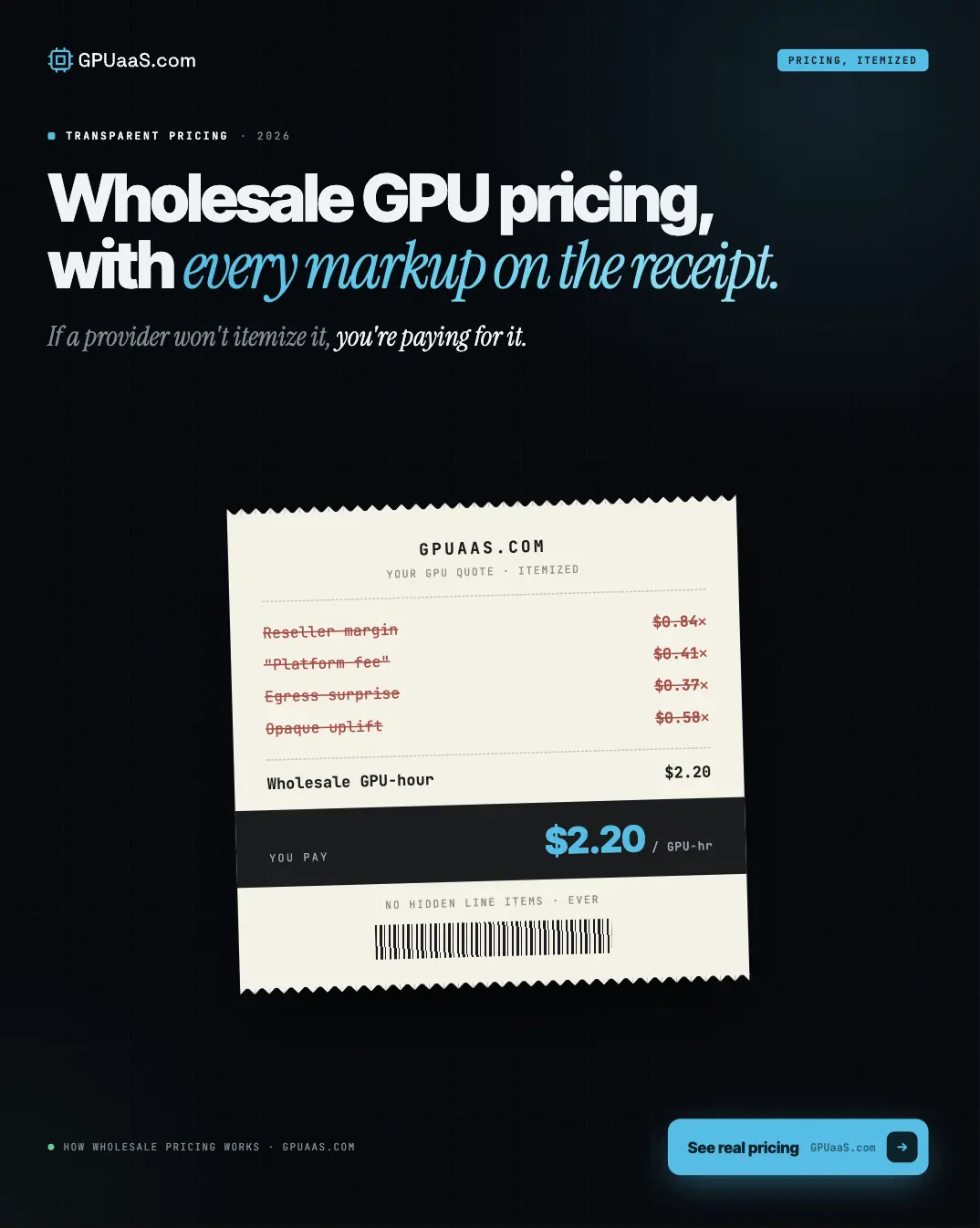
The price quoted is the price paid, with contract shape, minimums, term length, and region availability included upfront
This doesn't replace knowing the workload. Compliance-heavy or region-specific needs may still point to a specific provider directly
◆ WHERE THE 30% COMES FROM
Paying for the GPU, not the bundle
The gap is what a hyperscaler charges bundled with global region coverage and managed services versus what a specialized provider charges for the GPU alone. Most workloads never touch the bundle. GPUaaS doesn't run data centers. It sits between buyers and a network of vetted providers. Tier, count, duration, region. Quotes back within hours. Not the multi-week cycle of going direct.
◆ THE PRICE INCLUDES THE FINE PRINT
No surprises after the quote
The number quoted is the number paid. No egress surprise. No managed-service line nobody asked for. A team pricing a 12-month, 16-GPU deployment can see the real landed cost upfront, not a headline rate that turns into something else once the invoice arrives.
The rate itself only tells half the story without knowing what's included in it. A cheap hourly number that turns out to require an 8-GPU minimum, or a six-month floor on the contract, isn't actually cheap for a team that needed 4 GPUs for six weeks. A GPUaaS quote comes back with the full contract shape attached, minimums, term length, region availability, not just a headline number stripped of the terms that make it real.
◆ VETTED, NOT JUST LISTED
Cheap only matters if the hardware is actually there
Vetting is what makes the number trustworthy, not just cheap. Every provider gets checked for real, bookable capacity. Not a catalog listing that's sold out the moment someone tries to book it. A supply-side team runs verification on uptime history and interconnect specs before a provider ever shows up in a quote, so the buyer isn't the one discovering a gap mid-contract.
◆ SPEED IS PART OF THE PRODUCT
Hours, not weeks
Speed matters as much as rate. A team needing 16 GPUs next week doesn't have weeks. Hyperscaler quota requests can take a week with manual review before pricing even enters the conversation. CoreWeave's enterprise onboarding runs through a curated meeting request, no self-serve path. Going direct to a specialized provider means a sales call, a proposal, a follow-up. One spec submission here. A quote back the same day or the next.
~30%
below hyperscaler pricing for equivalent GPU capacity, moving with region, tier, and contract length. Quotes typically return within hours
GPUaaS.com quote data, 2026
Most teams get stuck not because the providers are bad. Because comparing six pricing models and six sales processes by hand takes time nobody has. A team that tries to do this manually ends up picking whichever provider responded first, not whichever provider actually fit the workload.
None of this replaces knowing the workload. A team that genuinely needs a hyperscaler's compliance stack or a specific region's data residency guarantee still needs that specific provider. The point isn't that GPUaaS beats every option on every workload. The point is seeing the real number before deciding the premium is worth paying.
For anything smaller than a cluster, single GPUs on demand or month to month, packet.ai runs the self-serve version, 24/7 human support built in.
See the real market rate before you sign.
Quotes from vetted providers within hours. No buyer fees. For single GPUs, packet.ai handles self-serve access with 24/7 human support.
It moves with region, GPU tier, and contract length. A workload in a tight region with a short commitment sees a smaller gap than a longer, more flexible one. The underlying mechanism stays the same regardless: a real quote from a vetted provider reflecting what the hardware actually costs to access.
A GPUaaS quote includes the full contract shape upfront, minimums, term length, and region availability, alongside the rate itself. Hyperscaler headline rates typically don't reflect egress fees, managed service add-ons, or minimum billing increments that only appear once the invoice arrives.
Providers are checked for real, currently bookable capacity, along with uptime history and interconnect specifications, before they're eligible to be included in a quote. This is meant to catch the gap between what a catalog lists and what's actually available to provision, before the buyer signs anything.
No. A workload that genuinely needs a hyperscaler's compliance certifications or a specific region's data residency guarantees may still be better served going direct to that provider. Seeing the real market rate helps confirm whether a premium is actually buying something the workload needs, rather than assuming it by default.
For single GPUs on demand or month-to-month access, packet.ai runs a self-serve platform with 24/7 human support, built for that scale of need rather than multi-node enterprise deployments.