Blog ▸ How GPUaaS Gives Buyers Early Access to GPU Capacity Before It Hits the Open Market
GPU Infrastructure
GPU allocation windows have compressed from 4-8 weeks in 2022 to 2-12 hours in 2026. Here is why a submitted spec surfaces capacity before any public page reflects it.
How GPUaaS Gives Buyers Early Access to GPU Capacity Before It Hits the Open Market
GPUaaS.com Team
GPU Infrastructure
July 15, 2026
No items found.
An allocation window that used to run four to eight weeks now closes in two to twelve hours. That's the actual shift behind why capacity disappears before it reaches a public listing.
NVIDIA's H100 and Blackwell production gets allocated before it leaves the fab. Roughly 40% flows to hyperscalers under reservation agreements signed 18 to 24 months out. Another 20% goes to frontier labs under similar long-duration contracts. Enterprise direct allocation takes another 15%. What's left, roughly a quarter of total supply, is what everyone else competes for in the spot and secondary market.
Key takeaways
GPU allocation windows have compressed from 4-8 weeks in 2022 to 2-12 hours in 2026
Roughly 40% of NVIDIA GPU production flows to hyperscalers under long-term reservation agreements, another 20% to frontier labs. Only about a quarter of total supply reaches the open spot market
A provider's public catalog reflects capacity as of its last update, not as it exists in real time
CoreWeave rebooks H100 capacity at 95% of original pricing when a reservation ends, releasing hardware back into circulation before any catalog reflects it
B200 general availability historically pressures H100 secondary values 10 to 20% lower, and that shift shows up in broker quotes before it becomes a documented trend
◆ WHY THE WINDOW COMPRESSED
Weeks to hours
In 2022, an operator who spotted a GPU cluster window had weeks to arrange financing and execute. In 2026, that window is hours. Sometimes minutes for the highest-demand configurations. A team running a 60-day capital approval process cannot compete for spot availability in a market where the window closes in twelve hours.
◆ WHY A CATALOG PAGE LAGS REALITY
The moment it exists vs. the moment it's published
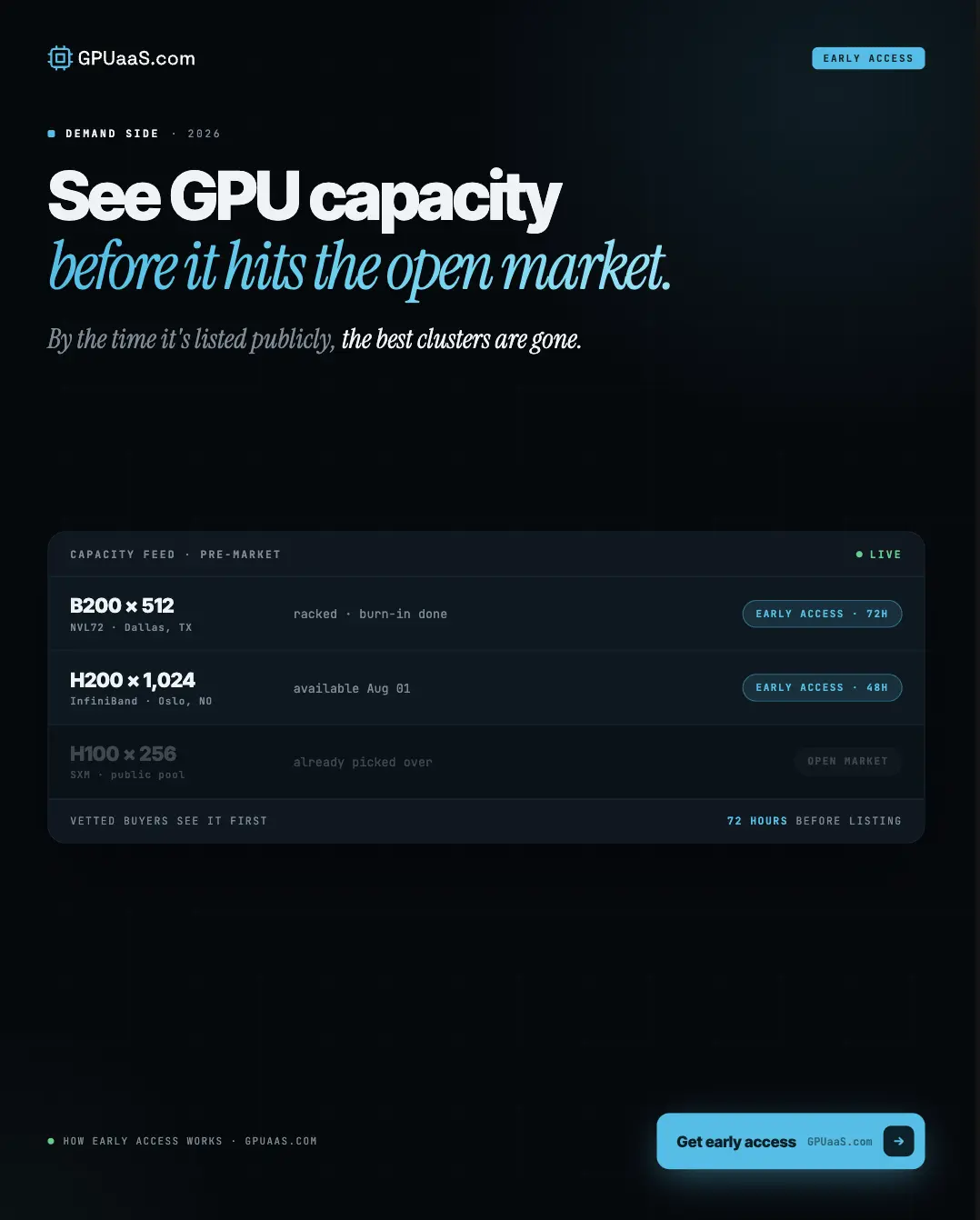
That compression is why a submitted spec beats a checked pricing page. A provider's public catalog reflects capacity as of whenever it was last updated. The actual state of available inventory moves faster than any catalog page refreshes. Data center expansions come online days before the published listing catches up. Reservations that end early release blocks back into circulation before anyone updates a website. Deals that fall through leave hardware sitting provisioned and unsold, sometimes for days, before that gets reflected anywhere public.
A team with a workload spec already sitting in a matching queue sees that inventory the moment it exists. A team checking provider pages on a schedule sees it whenever the page happens to update, which by definition is after the fact.
◆ MATURE TIERS VS. NEWEST HARDWARE
The liquidity split
This isn't unique to any one GPU tier. H100 spot pricing sits at $1.35 to $1.65 an hour on the most liquid platforms right now, but that liquidity masks a real split: mature H100 inventory has gotten easier to find as more of it enters circulation, while H200 and B200 capacity remains quota-bound precisely because everyone wants the same limited initial supply. The newest hardware intensifies the same allocation pressure that eased for older tiers.
◆ RESERVATION RELEASE CYCLES
Hardware moves before the catalog does
Reservation contracts create their own release cycle, separate from new hardware coming online. CoreWeave rebooks H100 capacity at 95% of original pricing when a reservation ends, which means the underlying hardware moves back into circulation as soon as the term closes, not when a provider's public page gets around to reflecting it. A team monitoring reservation cycles across multiple providers sees these releases before the general market does, simply because the release event and the catalog update are not the same moment.
4-8 wks → 2-12 hrs
how far GPU allocation windows have compressed since 2022, making capital and matching speed the primary determinant of compute access
Unseat Capital Intel, 2026 GPU market structure analysis
◆ SECONDARY MARKET TIMING
Broker quotes move before the trend is documented
Secondary market timing follows a related but distinct pattern. B200 general availability puts pressure on H100 secondary values, with historical patterns showing 10 to 20% price reductions for previous-generation hardware as enterprises upgrade to newer tiers. That price movement doesn't happen instantly or publicly. It shows up first in the quotes brokers and aggregators are actually receiving from sellers looking to move inventory ahead of that anticipated drop, before it becomes a documented trend anyone can point to.
None of this replaces knowing the workload's actual timeline. A team with no urgency gains nothing from seeing inventory two weeks before a public listing catches up, because two weeks doesn't matter to a project with no near-term deadline. The value only shows up when the gap between need and availability is the actual constraint, which for GPU allocation in 2026 is most of the time.
Get matched against capacity as it exists, not as it's published.
Submit a spec once, get quotes from vetted providers within 24 hours. No buyer fees. For single GPUs, packet.ai handles self-serve access with 24/7 human support.
GPU allocation windows have compressed from 4 to 8 weeks in 2022 to 2 to 12 hours in 2026, driven by demand consistently outpacing the roughly 25% of supply that reaches the open spot market after hyperscaler and frontier lab reservations are filled. Teams that can move within hours have a structural advantage over those relying on longer approval cycles.
A catalog reflects capacity as of its last manual or scheduled update, not in real time. Data center expansions, early reservation releases, and fallen-through deals all change actual availability before anyone updates the public page to match. A team already in a matching queue sees inventory the moment it exists rather than whenever the page catches up.
Generally yes. H100 spot pricing has settled into a more liquid range as more inventory enters circulation. H200 and B200 remain quota-bound because demand concentrates on the newest hardware early in its cycle, which can make premium tiers harder to access even as older tiers become more available.
Not much. The value of seeing capacity before it's publicly listed only matters when the gap between when a workload needs to start and when standard channels can deliver capacity is the actual constraint. A project with flexible timing can wait for standard public listings without losing anything meaningful.
Submit a workload spec, GPU tier, count, duration, region, and GPUaaS matches it against vetted provider inventory as it becomes available, including capacity from expansions, early reservation releases, and fallen-through deals that haven't yet been reflected on any public pricing page.
Last reviewed: 16 July 2026. Allocation window and supply distribution data from Unseat Capital Intel's 2026 GPU market structure analysis. Spot pricing and reservation cycle data from Sesame Disk's 2026 GPU spot price outlook and Compute Exchange's 2026 reserved GPU marketplace analysis. Secondary market pricing patterns from Introl's secondary GPU markets guide. Browse current GPU cluster availability on GPUaaS.com.