NVIDIA's GB200 NVL72 packs 72 B200 GPUs, 36 Grace CPUs, and 13.4 TB of unified GPU memory into a single liquid-cooled rack at 1.44 exaflops of FP4 compute. At roughly $2-3M per rack, 120-130 kW of power draw, and a 1.36 metric ton chassis that doesn't fit through standard datacenter doors, it's the most demanding piece of compute infrastructure most enterprises will ever evaluate. For trillion-parameter inference and frontier training, nothing matches it. For most workloads, it's overkill. This is the buyer's perspective on what changes between an 8-GPU HGX node and a 72-GPU NVL72 rack, and when the change is worth making.
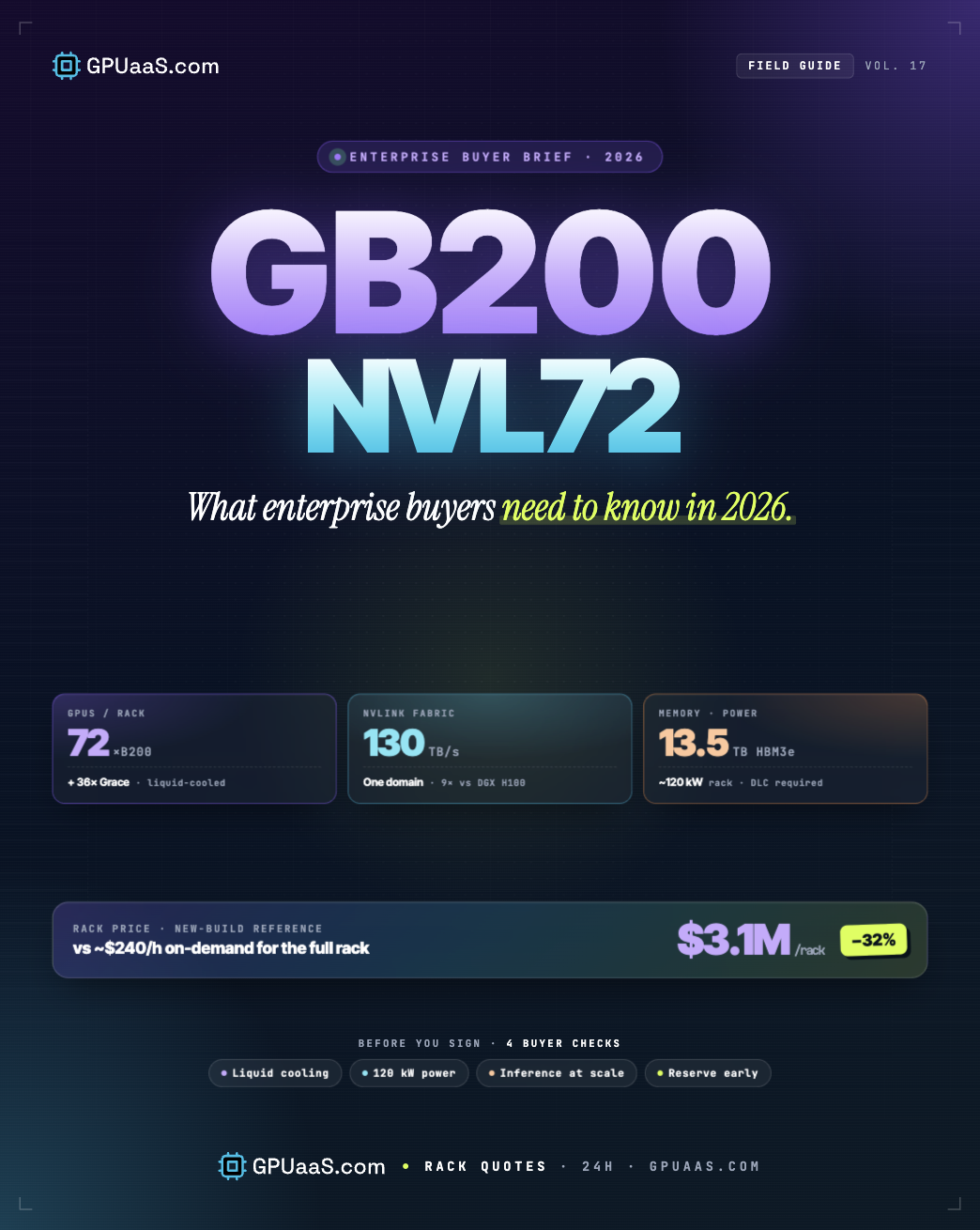
- GB200 NVL72 is sold as a rack-scale unit, not by GPU. 72 B200 GPUs + 36 Grace CPUs in one NVLink domain, 13.4 TB unified GPU memory, 1.44 exaflops FP4, 130 TB/s aggregate NVLink bisection bandwidth (NVIDIA, 2026)
- Liquid cooling is mandatory: 120-130 kW per rack, 20 L/min coolant flow at sub-30°C inlet, 1.36 metric ton chassis. Air-cooled datacenters face $5-10M retrofit costs per megawatt to support GB200 (Introl, April 2026)
- Choose NVL72 when the workload genuinely benefits from a single 72-GPU NVLink domain: trillion-parameter dense inference, large MoE all-to-all routing, long-context attention that overflows an 8-GPU node, or training jobs where tensor parallelism scales beyond 8
- For most enterprise workloads (sub-70B dense models, sub-200B MoE, standard fine-tuning), 8-GPU HGX B200 or even H200 nodes deliver lower cost per token. GB200 is the wrong tool below ~671B-parameter inference
- Availability: GA on CoreWeave since Feb 2025, Oracle, Azure, and GCP; 6-12 month lead times for new dedicated capacity in early 2026. The GB300 NVL72 successor (Blackwell Ultra, 288 GB HBM3e per GPU, 1,100 PFLOPS FP4) is the next-generation upgrade path with deployments since Q3 2025
- GPUaaS.com positions short-term and long-term B200 and B300 cluster contracts at rates hyperscalers won't offer, with flexible commitment terms. B200 from ~$4.50/GPU/hr, B300 from ~$4.50/GPU/hr, H100 from ~$2.50/GPU/hr, H200 from ~$3.00/GPU/hr
The GB200 NVL72 sits at the top of NVIDIA's 2026 lineup. It is also the GPU system most likely to be specified for a workload that doesn't need it. The marketing positions NVL72 as the unit of AI compute. The buyer's reality is narrower: NVL72 is the unit of AI compute for a handful of workload categories where a single 72-GPU NVLink domain is genuinely necessary. Outside those categories, a cluster of 8-GPU HGX B200 nodes does the job at lower cost, lower facility complexity, and far shorter lead times. This guide walks through what NVL72 actually is, when it wins, when it doesn't, and the procurement decisions that change at this scale. For the single-GPU Blackwell deep-dive, see the B200 SXM enterprise buyer's guide.
GB200 NVL72 is one rack. Inside the rack: 36 GB200 Superchips, each pairing one 144-core Grace ARM CPU with two B200 GPUs via NVLink-C2C at 900 GB/s. That's 72 B200 GPUs and 36 Grace CPUs in a single liquid-cooled chassis, connected by a fifth-generation NVLink Switch fabric that turns all 72 GPUs into a single NVLink domain. The math, per NVIDIA's official spec sheet and Spheron's March 2026 analysis:
| Spec | GB200 NVL72 | Notes |
|---|---|---|
| GPUs per rack | 72 B200 | All in one NVLink domain |
| CPUs per rack | 36 Grace | 144-core ARM, NVLink-C2C 900 GB/s to GPUs |
| GPU memory total | 13.4-13.5 TB HBM3e | 192 GB per B200 GPU |
| CPU memory total | ~17 TB LPDDR5X | 480 GB per Grace CPU |
| Compute (FP4) | 1.44 exaflops | ~20 PFLOPS FP4 per GPU |
| NVLink bisection bandwidth | 130 TB/s | 1.8 TB/s per GPU, all-to-all, 300 ns latency |
| Power draw per rack | 120-130 kW | ~6-13x typical air-cooled rack |
| Weight | ~1.36 metric tons | 3,000 lbs; ships in 4 components |
| Cooling | Direct liquid (mandatory) | 20 L/min @ sub-30°C inlet |
Sources: NVIDIA GB200 NVL72 datasheet; Spheron GB200 NVL72 guide (March 2026); Introl GB200 deployment analysis (April 2026); SemiAnalysis GB200 hardware architecture (October 2025).
Two structural details matter more than the headline numbers. First, the GB200 is not sold as individual GPUs. Cloud providers sell access at the Superchip or rack-node level, not as on-demand single-GPU slots. Second, the rack is not optional. The 72-GPU NVLink domain only exists when all 72 GPUs are in the same NVLink switch fabric, which means full-rack deployment. CoreWeave's own documentation confirms this: NVL72-powered instances must be deployed as full racks of 18 nodes, and larger node pools must be multiples of 18. You cannot buy half a rack.
That structural detail is the first procurement question. If a workload doesn't need a 72-GPU NVLink domain, the minimum buy is too large. A 16-GPU or 32-GPU job lands much more efficiently on two or four 8-GPU HGX B200 nodes scaled out over InfiniBand than on a single NVL72 rack where 40-56 GPUs sit idle.
The defining feature of NVL72 is not the GPU count. It's the NVLink Switch fabric that connects all 72 GPUs into a single NVLink domain. Nine NVLink Switch trays sit in the rack, each with four NVLink Switch chips, providing 1,296 ports that map exactly to the 72 GPUs × 18 NVLink connections per GPU. The result: any GPU can communicate with any other GPU at 1.8 TB/s with roughly 300 ns latency, with full all-to-all bisection at 130 TB/s aggregate, per Introl's April 2026 deployment analysis and fibermall's January 2026 architecture deep-dive.
Compare this to an 8-GPU HGX B200 node. Within the node, NVLink provides high-bandwidth GPU-to-GPU communication at similar 1.8 TB/s per GPU. Across nodes, however, communication drops to InfiniBand or Ethernet at a fraction of NVLink's bandwidth. A 64-GPU job running across eight HGX B200 nodes spends a significant fraction of its time waiting for cross-node tensor-parallel or all-reduce operations to complete over the slower interconnect. On NVL72, those same 64 GPUs sit in one NVLink domain. The communication overhead largely disappears.
Per Spheron's March 2026 analysis, the 13.4 TB of unified GPU memory and 130 TB/s NVLink bisection means a 671B-parameter model like DeepSeek-R1 can run entirely within one NVL72 rack at FP4 (~335 GB for weights) without crossing the slow InfiniBand boundary for KV cache access, attention computation, or expert routing in MoE models. On HGX B200, the same model would need to span multiple nodes with inter-node traffic on the critical path.
Workloads where this changes the picture:
- Trillion-parameter dense inference. 30x faster real-time LLM inference vs H100 for trillion-parameter models, per NVIDIA. The win is the NVLink domain, not just the GPU count.
- Large MoE inference. 10x greater MoE performance because all-to-all expert routing happens entirely within the NVLink fabric instead of crossing InfiniBand. For models like DeepSeek-R1 at 671B parameters, this is the difference between a workable production deployment and a benchmark.
- Tensor parallelism beyond 8 GPUs. NVL72 allows tensor parallelism to span all 72 GPUs without hitting the slow inter-node boundary, materially reducing latency for the largest dense models.
- Long-context attention. Workloads that overflow an 8-GPU node's combined HBM3e (1.44 TB) into multi-node KV cache management benefit from NVL72's 13.4 TB pool with NVLink-speed access.
- Frontier training jobs. Tensor-parallel × pipeline-parallel × data-parallel combinations where the tensor-parallel dimension wants to be larger than 8 to keep activation memory manageable.
Workloads where this changes nothing: dense models under ~70B parameters, MoE models under ~200B parameters, standard fine-tuning, embedding generation, and most production inference. For these, a fleet of 8-GPU HGX B200 or H200 nodes delivers similar throughput at substantially lower cost per token. For the framework around picking the right benchmark setup before committing, see how to benchmark your workload before committing to B200.
A GB200 NVL72 rack draws 120-130 kW. For context, per SemiAnalysis's October 2025 GB200 hardware analysis, a general-purpose CPU rack supports up to 12 kW, and a higher-density H100 air-cooled rack typically tops out around 40 kW. NVL72 is 6-13x the power density of a typical air-cooled rack. The facility doesn't quietly absorb that; it needs to be rebuilt around it.
Five facility line items that change at this density:
- Liquid cooling is mandatory. GB200 requires direct-to-chip liquid cooling with coolant flow at 20 L/min and inlet temperatures below 30°C, per Introl's April 2026 analysis. Air-cooled facilities face $5-10M retrofit costs per megawatt to support GB200 deployments. For an HGX B200 8-GPU node, rear-door heat exchangers rated for 50 kW per rack still work. NVL72 doesn't fit that envelope.
- Power distribution. 120 kW per rack at 208V is roughly 600 amps. Most facilities are not wired for this and need 480V distribution upgrades to deliver. This is electrical work at the building level, not a rack-level swap.
- Floor loading. The 1.36 metric ton chassis (3,000 lbs) exceeds floor loading capacity in many existing datacenters. Per Introl, the rack arrives in four separate components (compute rack 1,500 kg, NVLink Switch rack 800 kg, CDU 400 kg, PDU 300 kg) precisely because the assembled unit cannot be moved as one piece. Standard datacenter doors don't accommodate the assembled width; door frames and sometimes walls need to be removed.
- Chilled-water capacity. Per Alliance Chemical's May 2026 thermal density analysis, traditional raised-floor datacenters designed for 10-20 kW per rack face a 6-13x power density multiplier with a single NVL72 row. Greenfield AI datacenter designs commissioned in 2025-2026 are specifying 250-400 kW per cabinet row as baseline, with chilled-water capacity derived from liquid-cooling manifold flow rather than CRAC unit coverage.
- Deployment timeline. Specialized hydraulic lifts rated for 2,000 kg are needed to position components. Per Introl, the deployment process requires "military precision." This is not a server install.
⚠ Watch out
If the procurement plan involves owning the NVL72 hardware, the facility cost line in the TCO model is usually wrong. Air-cooled colos cannot host GB200 without retrofit. For colocation, very few facilities outside hyperscaler regions advertise liquid-cooling capacity at 120+ kW per rack. The realistic path to GB200 capacity for most enterprises in 2026 is a cloud provider that already operates a purpose-built liquid-cooled facility. For the procurement-side TCO math on owning vs renting GPU capacity, see the real TCO of a GPU cluster in 2026.
The genuine procurement decision in 2026 is rarely "GB200 NVL72 or nothing". It's "rack-scale NVL72 or a cluster of 8-GPU HGX B200 nodes". Both are Blackwell. Both deliver dramatic uplift over H100. The difference is the NVLink domain, the facility envelope, and the procurement minimum.
| Dimension | GB200 NVL72 | 8-GPU HGX B200 |
|---|---|---|
| GPUs in NVLink domain | 72 | 8 |
| Memory per node | 13.4 TB HBM3e (rack) | 1.44 TB HBM3e (per 8-GPU node) |
| Power per unit | 120-130 kW per rack | ~14 kW per node, ~60 kW per rack of 4 nodes |
| Cooling | Direct liquid (mandatory) | Air or liquid (optional) |
| CPU architecture | Grace ARM, NVLink-C2C | x86, PCIe |
| Minimum procurement | Full rack (~$2-3M) | Single node (~$300-500K) |
| Facility retrofit risk | High ($5-10M/MW for air-only sites) | Low (drop-in to most colos) |
| Best-fit workloads | Trillion-param dense inference, large MoE, frontier training | Sub-200B MoE, sub-70B dense, fine-tuning, most production inference |
Per-node power figures from amax Blackwell comparison; HGX B200 4U liquid-cooled systems available at higher density per Supermicro 2026 datasheet.
Per arccompute's analysis (March 2026): "The HGX B200 is the practical, cost-efficient choice for most enterprises... lower cooling and power complexity than rack-scale systems... well suited to LLM training, fine-tuning, and inference workloads." The HGX B300 (288 GB HBM3e per GPU) bridges between balanced enterprise deployments and rack-scale platforms for workloads that have outgrown B200 but don't need a full 72-GPU NVLink domain. NVL72 only earns its premium when the workload genuinely benefits from the 72-GPU NVLink fabric.
Three honest questions to ask before committing to NVL72
- Does the model genuinely need a 72-GPU NVLink domain? If tensor parallelism above 8 doesn't help, the answer is no.
- Will utilisation across 72 GPUs stay above ~50%? NVL72 is sold as a full rack. Below that utilisation, an HGX cluster of fewer nodes costs less.
- Is the facility ready, or is the plan to rent from a provider that already operates one? Self-hosting NVL72 without an existing liquid-cooled facility is a 12-18 month commitment before the first GPU runs a workload.
CoreWeave became the first cloud provider with generally available GB200 NVL72 instances in February 2025. By early 2026, GB200 NVL72 capacity is available across CoreWeave, Oracle Cloud, Azure, and Google Cloud per Spheron's March 2026 GB200 guide. CoreWeave's on-demand rate sits around $10.50/GPU-hr; hyperscalers (AWS, Azure, GCP) typically require reserved commitments and quote-based pricing.
Three availability realities to factor into procurement:
- Lead times. Per Awesome Agents' April 2026 analysis, supply remains severely constrained with 6-12 month lead times for new dedicated capacity in early 2026. Blackwell demand at the system level has pushed new orders for owned hardware to a 12-month waitlist, per Introl's April 2026 update.
- Full-rack commitment. CoreWeave's documented constraint applies broadly: NVL72 instances must be deployed as full racks of 18 nodes. Multiples of 18 are required for larger deployments. The 8-GPU minimum buy of HGX B200 doesn't apply.
- GB300 NVL72 is shipping. NVIDIA released the GB300 NVL72 with Blackwell Ultra GPUs (288 GB HBM3e per GPU, 1.4 kW per GPU, ~1,100 PFLOPS FP4) at GTC 2025 in March. Quanta started shipping GB300 in September 2025; CoreWeave deployed first GB300 systems in August 2025, and AWS launched EC2 P6e-GB300 UltraServers with GA on December 2, 2025. For procurement decisions starting in 2026, GB300 is the realistic forward-looking option, not GB200.
According to NVIDIA Developer's MLPerf Inference v6.0 results from April 2026, GB300 NVL72 delivered 2.5 million tokens per second on DeepSeek-R1, a 2.7x improvement over the previous GB300 NVL72 debut submission six months prior, entirely from TensorRT-LLM software updates on the same hardware. The procurement implication: rack-scale Blackwell performance is still climbing fast from software alone.
The GB300 question for buyers in mid-2026 is not academic. A 24- or 36-month commitment to GB200 NVL72 made in 2026 is a commitment that the workload won't migrate to GB300 within the contract window. For workloads that are still being defined, a shorter-term contract with optionality preserves more value than a multi-year reserved commitment to either generation. For the broader pricing structure across Blackwell and Hopper generations, see the GPU pricing guide and the H100 vs H200 vs B200 decision guide.
A short framework for the GB200 NVL72 procurement conversation, drawn from real 2026 buyer patterns:
- Validate the workload-fit case with numbers, not architecture diagrams. Run your model at the precision and concurrency you'll deploy at, on both a multi-node HGX B200 cluster and an NVL72 rack. If the throughput delta isn't materially above what the cost delta justifies, the workload doesn't need NVL72.
- Don't own the hardware unless utilisation is structurally above 70%. Average GPU utilisation across 23,000 measured clusters is 5%, per Cast AI's 2026 data referenced in the TCO analysis. At sub-70% utilisation, contract-based access at a quoted rate beats ownership on cost. NVL72 only sharpens this: idle capacity at 120 kW per rack is expensive idle capacity.
- Test before committing to a multi-year contract. Hyperscaler reserved pricing requires 1-3 year commitments. Short-term contract access via specialty providers preserves the option to switch generations (GB200 → GB300) or scale (NVL72 → HGX B200 cluster) as workloads evolve.
- Factor lead time into the timeline. 6-12 months for new dedicated NVL72 capacity is not the same as 6-12 months for HGX B200 capacity. The HGX option is typically deliverable in weeks at established providers.
- Confirm the cloud provider operates the facility you'll be served from. A provider that re-sells hyperscaler capacity inherits hyperscaler facility constraints and pricing. A provider that operates its own purpose-built liquid-cooled facility (CoreWeave's GB200 deployments, Oracle's dedicated B200 clusters) often has more flexibility on contract structure.
GPUaaS.com positions short-term and long-term contracts for B200 and B300 GPU clusters at rates hyperscalers won't offer, with flexible commitment terms. For workloads where NVL72-class rack-scale capacity is genuinely needed, that case is best discussed against a specific workload profile; for everything else, an 8-GPU HGX B200 or H200 contract delivers the same Blackwell or Hopper performance at substantially lower cost per token.
Your search for enterprise GPU compute ends here.
NVIDIA infrastructure at rates hyperscalers won't offer you. H100, H200, B200, B300 clusters. Short-term and long-term contracts. Validate the workload before committing. Quotes within 24 hours.
Get a quote on your clusterLast reviewed: June 10, 2026. Specs from NVIDIA GB200 NVL72 datasheet, Spheron GB200 NVL72 Guide (March 2026), HPE GB200 NVL72 product page, fibermall NVL72 architecture analysis (January 2026), DeployBase GB200 specs (January 2026), and Awesome Agents NVL72 deep-dive (April 2026, updated). Deployment and facility figures from Introl GB200 NVL72 deployment guide (April 2026), SemiAnalysis GB200 hardware architecture (October 2025), Alliance Chemical GPU thermal density specs (May 2026), and Supermicro Blackwell solutions datasheet. Availability and pricing from CoreWeave's GA announcement (February 2025), CoreWeave NVL72 documentation, and Spheron March 2026 cloud pricing snapshot. HGX vs NVL72 framing from arccompute (March 2026) and allocomp B200 cooling guide (December 2025). GPUaaS.com rates are indicative, contract-based, and quote-dependent.