Blog ▸ FOMO Is Why Enterprises Are Paying for GPUs They Do Not Use
GPU Infrastructure
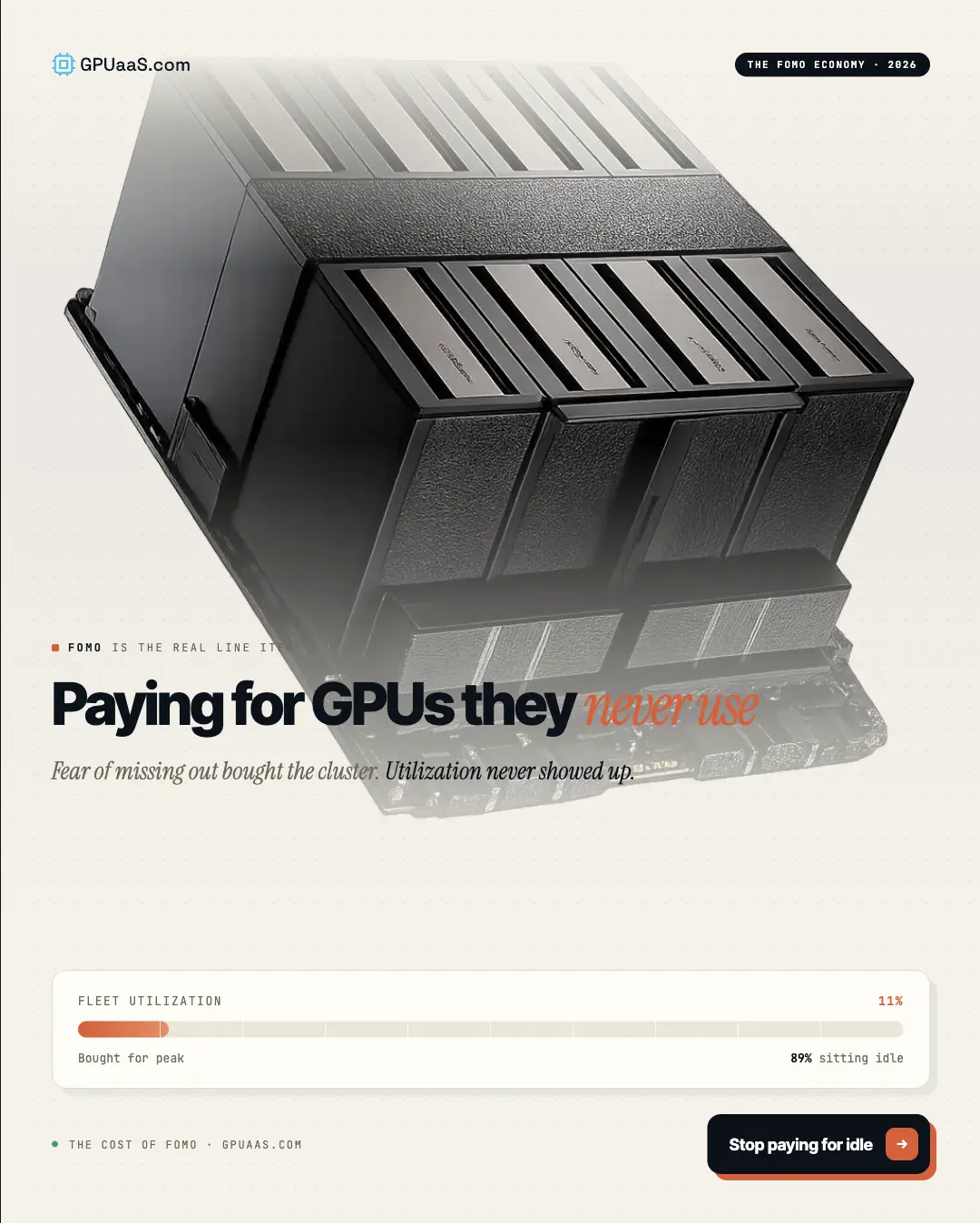
Enterprises provision 20 times more GPU capacity than they actively use, driven by scarcity anxiety rather than validated need. Here is the mechanism behind the loop.
FOMO Is Why Enterprises Are Paying for GPUs They Do Not Use
GPUaaS.com Team
GPU Infrastructure
July 22, 2026
No items found.
An enterprise joins a hyperscaler waitlist for GPU capacity. Nothing happens for weeks. Then a call comes through. You asked for 48, I have 36, yours if you want them, but only on a one-year or three-year commitment, and three years is cheaper.
The decision gets made in that call. Not against a validated workload. Against the fear that saying no means waiting months for the next call.
Key takeaways
Average enterprise GPU utilization sits at 5% across 23,000 clusters. Organizations provision roughly 20x more capacity than they actively use at any moment (Cast AI, 2026)
A healthy utilization rate, per Cast AI's own benchmark, sits around 50%, ten times higher than what most enterprises are actually running
AWS raised H200 Capacity Block prices 15% in January 2026, the first GPU price increase since EC2 launched in 2006
A100 pricing, expected to soften as 2023's three-year reservations expired, has started rising instead. FOMO is spreading to older hardware generations
Overprovisioning and rising prices feed each other in a loop: scarcity anxiety drives overbuying, which tightens supply further, which justifies more overbuying
◆ ONE ALLOCATION, NEVER REVISITED
96 GPUs, 23% utilization, 31 idle replicas
One team allocated 96 GPUs running at 23% utilization, with 31 replicas sitting idle 22 hours a day. Nobody flagged it as a problem because nobody was watching the gap. The allocation happened once, during a crunch, and never got revisited after the crunch passed.
◆ BUYING BECAUSE IT'S AVAILABLE
Not because it's needed
The act of buying GPUs has stopped correlating with whether a team needs them. Cast AI's founder put it plainly: you don't buy them because you need them, you buy them because they were available. Provisioning becomes a reflex triggered by scarcity, not a decision triggered by a validated workload.
The scarcity feeding that reflex is partly real and partly self-inflicted. One bad outage and a team overprovisions. One missed reservation and a leader panic-buys capacity for the next twelve months. Nobody revisits the number once the crisis that triggered it has passed, so it just sits there, allocated, running at a fraction of capacity, indefinitely.
◆ A 20-YEAR PRICING TREND, BROKEN
Even older generations aren't getting cheaper
That reflex has started pushing prices in a direction they haven't moved in two decades. AWS raised H200 Capacity Block prices 15% in January 2026, the first time GPU prices have risen since EC2 launched in 2006. A100 pricing, which was expected to soften as 2023's three-year reservations expired, has started creeping back up instead. FOMO isn't staying contained to the newest hardware. It's spilling into generations that should be getting cheaper.
20x
how much more GPU capacity the average organization provisions compared to what it actively uses at any given moment
Cast AI 2026 State of Kubernetes Optimization Report, 23,000 clusters
The loop feeds itself. Overprovisioning keeps prices climbing. Rising prices make the fear of missing the next allocation window feel more justified. That justification drives the next round of overprovisioning. Nobody in the loop is being irrational given what they're looking at, and the loop keeps running anyway.
Large enterprises with existing hyperscaler relationships rarely worry about access at all. Their problem sits downstream of access, in not knowing how the capacity they already have is actually being used. A team can hold a validated hyperscaler relationship and a functioning three-year contract and still be running at 5% utilization on both, because access and usage are two completely separate problems that get managed as if they were the same one.
Breaking the loop doesn't require winning the access fight. It requires treating procurement and runtime as one connected decision instead of two separate budget lines. A team that knows its actual utilization number before the next allocation call comes in is negotiating from a position the FOMO-driven caller never has.
See what capacity actually costs against a validated need.
Get a quote within 24 hours. No buyer fees. For single GPUs, packet.ai handles self-serve access with 24/7 human support.
Cast AI's 2026 benchmark puts a healthy GPU utilization rate around 50%. The average enterprise measured across 23,000 clusters runs at roughly 5%, meaning most organizations are operating at a tenth of what would be considered efficient use of provisioned capacity.
Scarcity anxiety, not workload demand, drives most overprovisioning decisions. Long-term commitment structures common in GPU procurement mean teams often have one chance to secure an allocation, so they buy when capacity is offered rather than when a specific validated need exists, and the allocation is rarely revisited after the initial urgency passes.
Yes, for both new and older hardware generations. AWS raised H200 Capacity Block prices 15% in January 2026, the first GPU price increase since EC2 launched in 2006. A100 pricing, which was expected to decline as 2023's reservation terms expired, has begun rising as well, indicating scarcity-driven demand is affecting older tiers too.
Yes. Enterprises with established hyperscaler relationships rarely struggle with access to capacity, but that does not mean they use it efficiently. Access and utilization are separate problems, and a team can have a fully secured multi-year reservation while still running at 5% utilization because nobody is tracking the gap between allocated and actively used capacity.
Submit a workload spec and GPUaaS returns a competitive quote from a vetted provider within 24 hours, letting a team price capacity against an actual validated need rather than committing under scarcity pressure during a limited allocation window.
Last reviewed: 23 July 2026. Utilization and provisioning data from Cast AI's 2026 State of Kubernetes Optimization Report, 23,000 clusters. Pricing and procurement mechanics from VentureBeat's Q1 2026 AI Infrastructure and Compute Market Tracker and reporting on enterprise GPU hoarding patterns. Browse current GPU cluster availability on GPUaaS.com.