Blog ▸ B200 vs H100 vs H200: What the Price Difference Actually Tells You About Your Workload
GPU Infrastructure
Newer GPU generations are not always cheaper per token. Here is a decision framework matching model size, concurrency, and job type to the GPU that actually wins on cost per token.
B200 vs H100 vs H200: What the Price Difference Actually Tells You About Your Workload
GPUaaS.com Team
GPU Infrastructure
July 27, 2026
No items found.
A team serving a 13B model moved from H100 to B200 expecting lower costs. Their bill went up. The model never came close to using the extra memory or throughput they were now paying for.
A different team serving a 70B model on H100 was paying for two GPUs per instance because the model didn't fit on one. Moving to a single H200 cut their per-token cost by more than the sticker-price difference between the two chips.
Same direction of upgrade. Opposite financial outcome. The GPU generation isn't what determines cost-per-token. The workload is.
Key takeaways
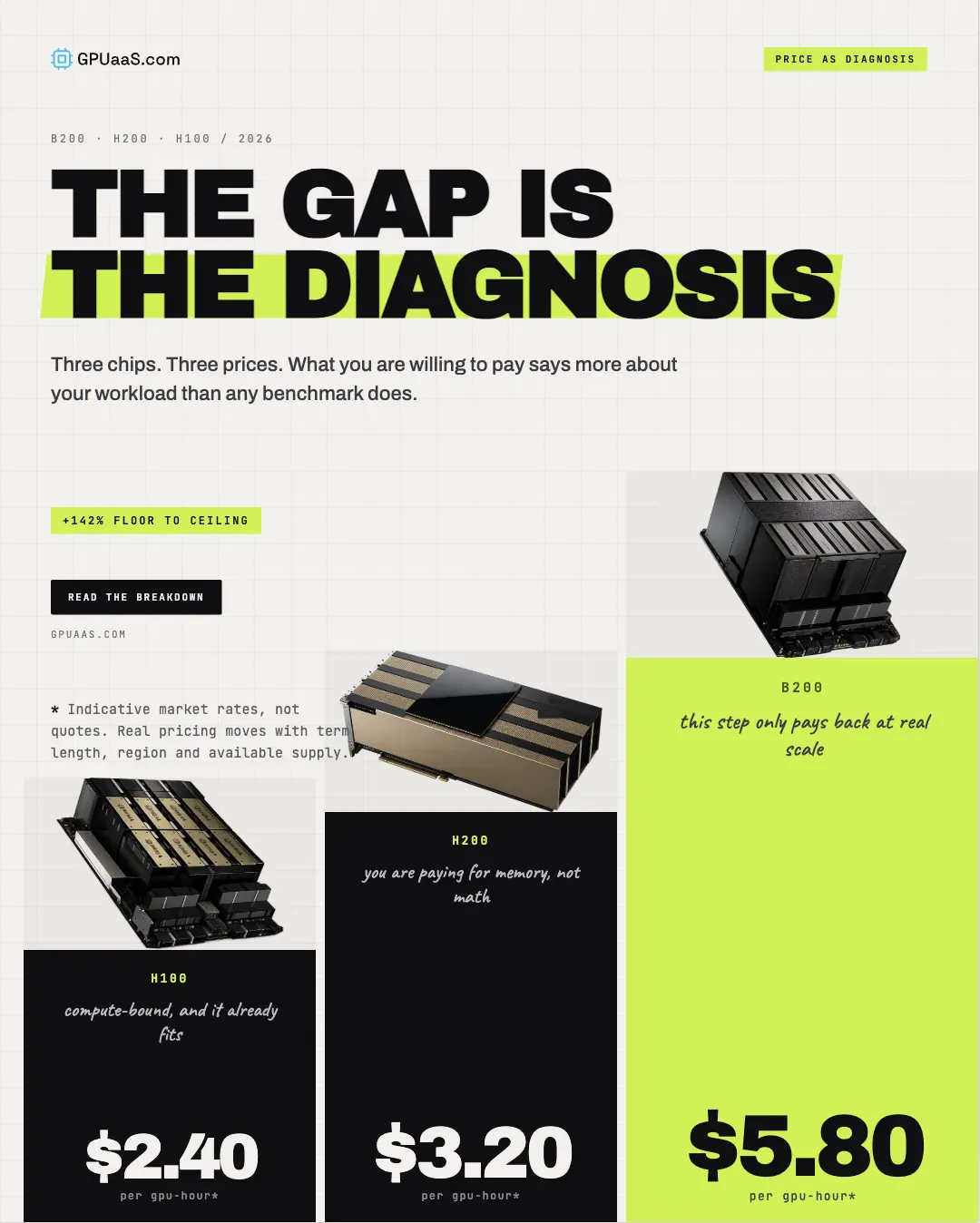
H100 cost per FP16 TFLOP runs $16-$20 at list price. B200 improves that to $8-$12, but only pays off if the workload can actually use the extra throughput
Models under roughly 30B parameters rarely benefit from moving off H100. They never saturate B200's extra bandwidth or FP4 precision
A 70B model needs ~140GB in FP16, more than one H100's 80GB. H200's 141GB fits it on one card, replacing two H100s rather than one
B200 delivers up to 47% higher output token throughput than H200 at peak concurrency on large models like Llama 4 Maverick
Software stack maturity moves cost-per-token independently of hardware. B200 cost per million tokens dropped from $0.11 to $0.02 in two months from software updates alone
◆ DOUBLE THE COMPUTE DENSITY, NOT ALWAYS DOUBLE THE VALUE
Paying for headroom that never gets touched
H100 cost per FP16 TFLOP runs $16 to $20 at list price. B200 improves that to $8 to $12 per TFLOP, roughly double the compute density for not much more than double the price. On paper, B200 looks like a clean upgrade for anything. In practice, that math only pays off if the workload can actually use the extra throughput.
A model under roughly 30B parameters rarely can. It fits comfortably in H100's 80GB, runs at full speed on Hopper's mature software stack, and never gets close to saturating B200's extra bandwidth or FP4 precision. Paying B200's higher hourly rate for a workload that can't use what B200 does differently is paying for headroom that never gets touched.
◆ WHERE THE H200 CROSSOVER SITS
Replacing two cards, not one
The crossover shows up clearly once a model needs more than one H100 to run at all. A 70B model in FP16 needs roughly 140GB of VRAM, more than a single H100's 80GB. Running it on H100 means two cards, doubling the hourly cost before a single token gets generated. H200's 141GB fits that same model on one card. The per-hour rate on H200 is higher than a single H100, but it's replacing two H100s, not one, and that's where the real cost-per-token improvement comes from.
◆ MATCHING WORKLOAD TO GENERATION
Workload
Best fit
Why
Models under 30B params
H100
Fits comfortably, never saturates newer hardware
70B models, single-card serving
H200
Fits on one card vs two H100s
Large models, high concurrency
B200
Up to 47% higher throughput vs H200 at peak load
Small fine-tuning jobs
H100
Job finishes fast regardless of chip, rate matters more than speed
◆ WHERE B200 ACTUALLY PULLS AHEAD
Bigger models, higher concurrency, and training time
B200 pulls further ahead only once the model gets bigger still, or once low-latency throughput becomes the actual bottleneck. Recent benchmarks on Llama 4 Maverick show B200 delivering up to 47% higher output token throughput than H200 at peak concurrency. On a genuinely large model running at high concurrency, that throughput advantage compounds into a real cost-per-token win despite B200's higher rate.
Training tells a similar story with different numbers. On raw throughput, B200 runs roughly 4x faster than A100 and 1.6x faster than H100 on LoRA fine-tuning benchmarks. That gap matters enormously for a large pre-training run where wall-clock time is the constraint. It matters far less for a small fine-tuning job that finishes in under an hour regardless of which chip it runs on, where the higher hourly rate just adds cost without meaningfully changing completion time.
$0.11 → $0.02
B200's cost per million tokens on a GPT-OSS-120B workload, a 5x drop in two months from software optimization alone, no hardware change involved
SemiAnalysis InferenceX benchmarks, April 2026
Software stack maturity moves these numbers independently of any hardware decision. A cost comparison run in January and the same comparison run in April can point to opposite conclusions purely because the software stack moved underneath the hardware.
None of this makes newer hardware a bad bet in general. It makes "newer" the wrong question. The right question is whether a specific workload's model size, context length, and concurrency actually use what the newer generation does differently, or whether it's paying a premium for capability it never touches. For the full spec-by-spec breakdown, see H100 vs H200 vs B200: which GPU to rent, and for B200-specific token economics, see B200 cost per million tokens, measured.
Get matched to the tier that fits your workload.
Get a quote within 24 hours, not just the newest hardware available. No buyer fees. For single GPUs, packet.ai handles self-serve access with 24/7 human support.
No. B200 improves cost per FP16 TFLOP over H100, but that only translates to lower cost per token if the workload can actually use the extra throughput and memory. A model under roughly 30B parameters typically runs just as well on H100 and never saturates what B200 does differently, making B200's higher rate a pure premium with no offsetting benefit.
A 70B model in FP16 needs roughly 140GB of VRAM, more than a single H100's 80GB, requiring two H100 cards to run at all. H200's 141GB fits the same model on one card. The comparison isn't one H100 versus one H200, it's two H100s versus one H200, which is where H200's cost-per-token advantage actually comes from.
On models large enough or concurrent enough to actually use B200's extra throughput. Benchmarks on Llama 4 Maverick show B200 delivering up to 47% higher output token throughput than H200 at peak concurrency, which compounds into a genuine cost-per-token advantage on large-scale, high-concurrency serving despite B200's higher hourly rate.
Yes, significantly. B200's cost per million tokens on a GPT-OSS-120B workload dropped from $0.11 to $0.02 within two months purely from TensorRT-LLM and inference framework updates, no hardware change involved. A cost comparison run a few months apart can point to a different conclusion purely because the software stack matured.
Submit a workload spec, model size, context length, expected concurrency, and GPUaaS matches it to the GPU tier that actually fits, rather than defaulting to whichever generation is newest or most heavily marketed.
Last reviewed: 28 July 2026. Cost-per-TFLOP data from Silicon Analysts' GPU Price/Performance Comparison, April 2026. Throughput benchmarks from Lyceum Technology's LLM Inference Tokens Per Second report and VESSL's A100/H100/B200 LoRA cost benchmark. Cost-per-token software optimization data from SemiAnalysis InferenceX benchmarks via NVIDIA Developer, April 2026. Browse current GPU cluster availability on GPUaaS.com.