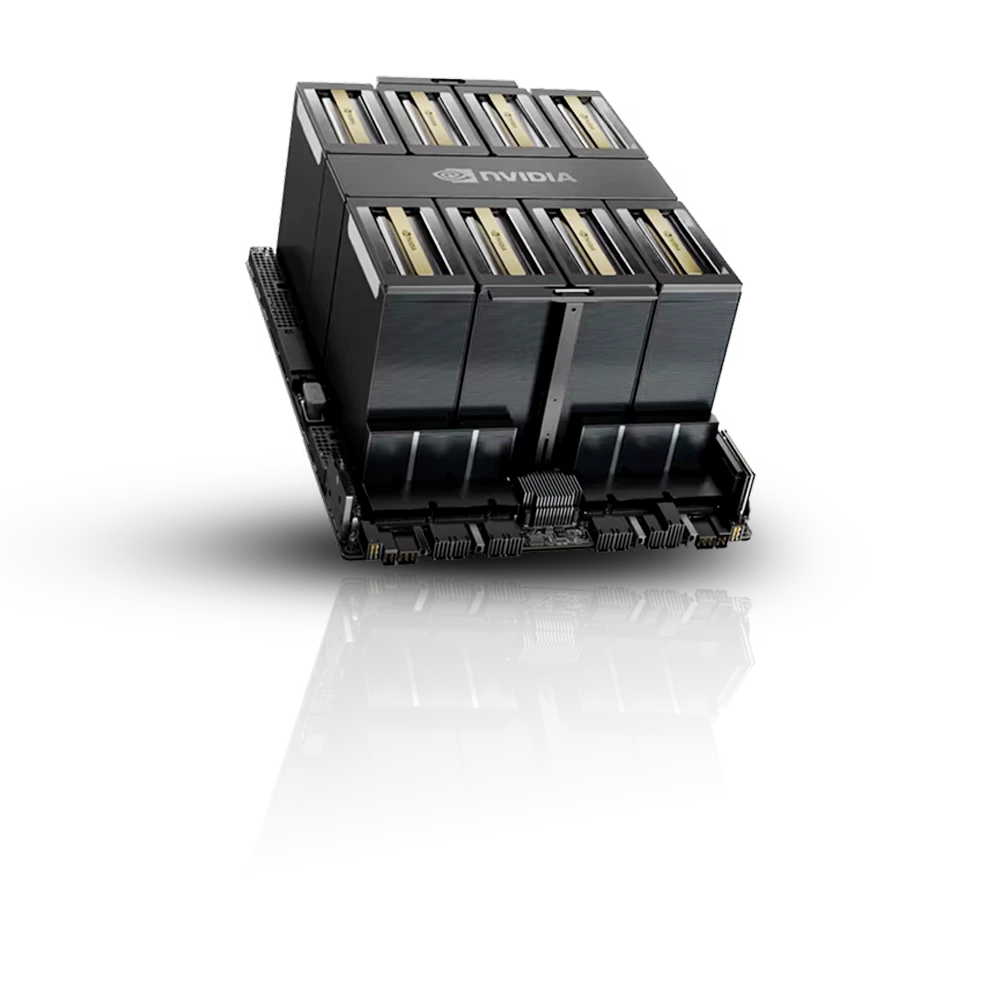
H200 changes the inference math in one specific way: it keeps H100's exact compute and power draw but adds 61GB of HBM3e memory and roughly 43% more bandwidth, so the gain shows up almost entirely in what a single card can hold and how fast it feeds tokens out, not in raw FLOPS. A 70B model that needed two H100s in tensor-parallel to leave headroom for KV cache often fits comfortably on one H200, and time-to-first-token drops by around 40% on long-context requests thanks to the bandwidth increase. For teams already running vLLM, SGLang or TensorRT-LLM on H100, the same engines and FP8 quantization path carry over directly to H200 with no re-architecture, which is why it's usually a drop-in upgrade rather than a new deployment decision. H100 for LLM inference remains the more cost-effective pick if your models comfortably fit in 80GB.
H200 and H100 share the same Hopper compute die, so the performance difference between them is entirely about memory: 141GB of HBM3e versus 80GB, and roughly 4.8 TB/s of bandwidth versus H100's 3.35 TB/s. Inference splits into two phases with different bottlenecks, a compute-bound prefill phase that processes the prompt and a memory-bandwidth-bound decode phase that generates tokens one at a time, and H200's bandwidth increase speeds up both, cutting time-to-first-token by roughly 40% on long-context requests specifically. The memory increase matters most for models near or above what comfortably fits in H100's 80GB: a 70B model that needed two H100s in tensor-parallel to leave real KV cache headroom for long conversations often fits on a single H200 instead, changing the cost-per-token math for that workload without requiring any change to the serving engine or quantization approach already in use.
H200 inference is placement-sensitive: prompts and responses are often personal data, so jurisdiction matters as much as latency. See H200 availability by country below.
Read the full guide to GPU cloud in this location →Wholesale rates against cloud list price for a 64-GPU cluster.
We connect you to our vetted partners. You contract directly with the operator running your nodes.
GPU model, count, placement and timeline. Add workload detail if you have it.
We find vetted partners with capacity that fits, in the jurisdiction you need.
Real quotes from partners who hold the capacity, not listings that may not exist.
You contract directly with the operator. We smooth the provisioning process.
Tell us the essentials. We'll line up real quotes from our vetted wholesale partners, and you contract directly with the operator.

GPUaaS.com connects enterprises with vetted GPU providers for large-scale compute at up to 30% lower cost than hyperscalers.


