Blog ▸ Shadeform Alternatives in 2026: Marketplace vs Matchmaking for Committed GPU Clusters
GPU Infrastructure
Shadeform is a good aggregator. The question is when aggregation is the wrong tool: the request size and term where an API stops finding capacity and a committed quote starts.
Shadeform Alternatives in 2026: Marketplace vs Matchmaking for Committed GPU Clusters
GPUaaS.com Team
GPU Infrastructure
October 13, 2026
No items found.
Shadeform is an aggregator: one API and one console over on-demand GPU instances from a few dozen clouds, with unified billing. The alternatives worth considering in 2026 depend on whether the job is spinning up instances by the hour, in which case SF Compute, Vast.ai and the neoclouds themselves compete directly, or committing to a dedicated cluster for six to twelve months, in which case a matchmaking network such as GPUaaS.com is a different tool for a different job.
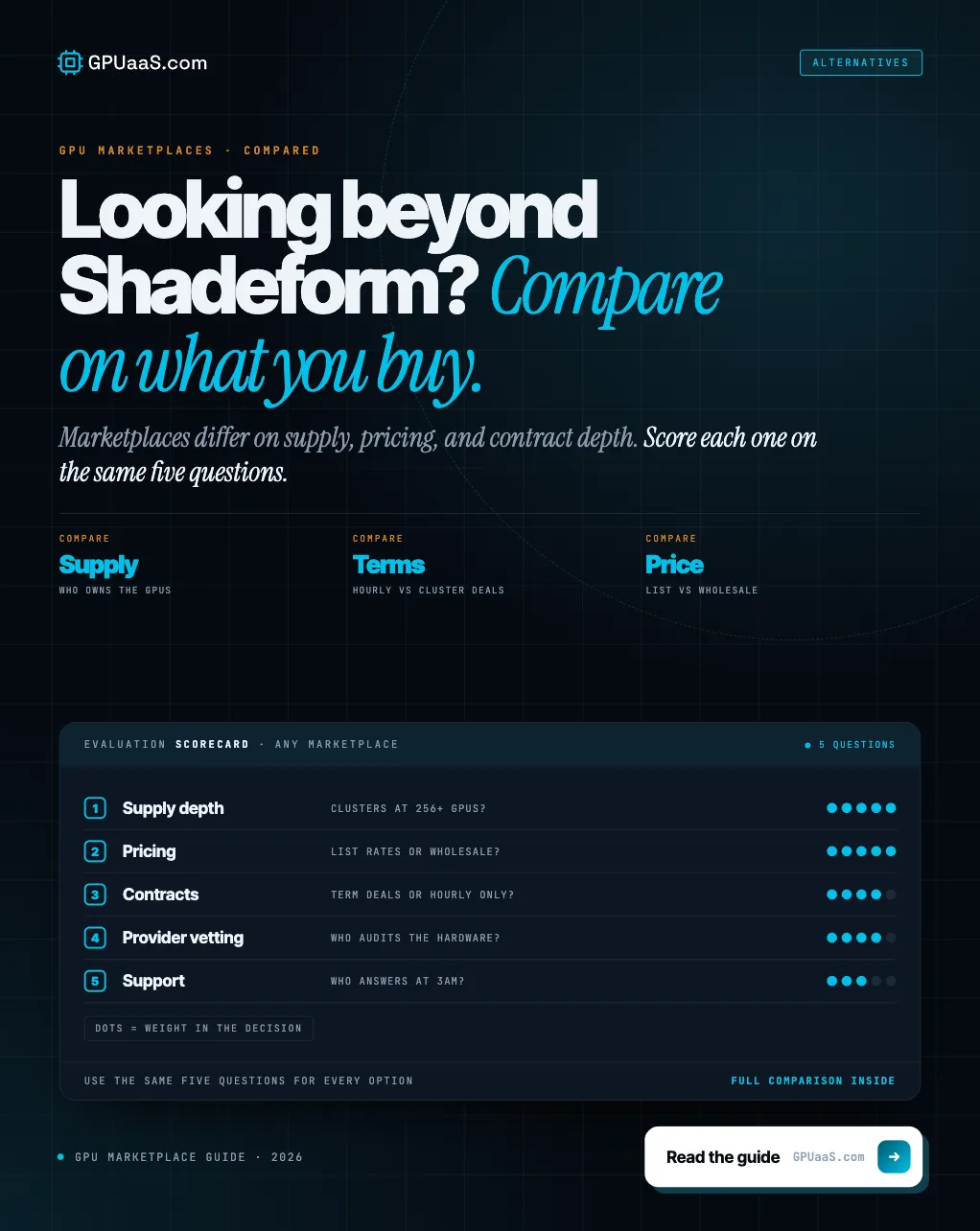
This is the first in a series of alternatives posts. The format is the same each time: a fair description of what the named product does well, where it fits, and then where a buyer's requirement outgrows it and what to use instead. Shadeform is a good product for the thing it does, and this post is not an argument that it is not. It is an argument about when the thing it does is the wrong thing.
Key takeaways
Shadeform aggregates on-demand GPU instances across many clouds behind one API, with a single bill. It is strongest for bursty, multi-cloud, hourly workloads
Aggregators resell the underlying cloud's on-demand rate. For H100 that sits around $2.50 to $5.00 per GPU-hour on the clouds they front in 2026
Committed clusters through the GPUaaS.com network quote at $2.50 to $3.00 for H100 SXM, $2.75 to $3.50 for H200 and $5.00 to $6.50 for B300, paid every hour of the term
The dividing line is contiguity and term. An API can find eight H100s now. It cannot guarantee 256 H100s on one InfiniBand fabric for a year
Five options are compared: Shadeform, SF Compute, Vast.ai, going direct to a neocloud, and GPUaaS.com. Each wins a different request
Most organisations end up using an aggregator for burst and a committed cluster for the floor. The two are not substitutes
◆ WHAT SHADEFORM IS
One API over many clouds, billed once
Shadeform sits on top of a few dozen GPU clouds, from hyperscaler regions to small neoclouds, and presents their on-demand inventory through one console and one API. A developer can see which cloud has an H100 available right now at what price, launch it, and pay Shadeform rather than opening an account with the underlying provider. Templates, SSH, and basic orchestration are built in. For a team running experiments across whatever is cheapest this afternoon, that is a real reduction in friction.
The pricing model is the underlying cloud's on-demand rate, passed through, sometimes with a margin and sometimes with a platform fee. The capacity is whatever those clouds have unsold at that moment. The commitment is hourly. Those three facts are what make it good at what it does, and they are also the boundary of what it does.
Shadeform does list reserved and multi-node options from some providers, and it would be unfair to say it is on-demand only. But the product is built around instance availability across clouds, and that is how most of its customers use it.
◆ FIVE WAYS TO SOURCE GPU COMPUTE, COMPARED
Option
Model
Best for
H100 pricing, 2026
Weak spot
Shadeform
Aggregator API over many clouds
Bursty, multi-cloud, hourly instances
Underlying on-demand, about $2.50 to $5.00
Large contiguous committed clusters
SF Compute
Exchange for short-term cluster blocks
Training runs of days to weeks on H100 or H200
Market-cleared, often below on-demand
Long terms, newest parts, residency
Vast.ai
Peer marketplace, spot and on-demand
Cheapest hourly single GPUs, interruptible jobs
Spot near $2.50, often lower
SLA, interconnect, enterprise terms
Direct to a neocloud
Own fleet, published and negotiated rates
Buyers who have picked a provider and want a relationship
On-demand about $5.00; committed negotiated
One provider's capacity and regions only
GPUaaS.com
Matchmaking network, committed clusters
Dedicated 8 to 512+ GPU clusters, 3 to 24 month terms, any region except China and Taiwan
$2.50 - $3.00 SXM committed
Hourly burst, single GPUs (packet.ai covers those)
Descriptions from each product's public documentation, October 2026. Pricing from published rate cards and the GPUaaS.com October 2026 benchmark; on-demand and committed are different products and the comparison is directional.
◆ WHERE AN AGGREGATOR STOPS
An API can find eight GPUs now. It cannot promise 256 on one fabric for a year.
The aggregator model works by exposing unsold inventory. That inventory is, by construction, the capacity nobody has committed to, scattered across clouds and regions, in the quantities each cloud happens to have free. For one to sixteen GPUs on a given afternoon that is plenty. For a 256-GPU training cluster that has to be contiguous, InfiniBand-connected and held for twelve months, it is the wrong search space entirely. That capacity is not unsold; it is allocated by a provider to a buyer on a contract, and it does not appear in an on-demand API because nobody is offering it by the hour.
The price follows the same logic. An aggregator passes through the on-demand rate, which for H100 on the clouds it fronts runs around $2.50 to $5.00 per GPU-hour in 2026 depending on the cloud. The committed band through the GPUaaS.com network is $2.50 to $3.00 for H100 SXM, and it is paid on every hour of the term by a buyer who has given up the right to spin down next week. The two-price market covers why those are different products at similar numbers.
The third thing an aggregator cannot do is the human part. A committed cluster request involves interconnect topology, power and density at the facility, SLA terms, replacement policy, residency documentation and a three-party contract. None of that is an API call, which is why the four business models post puts aggregators and matchmaking networks in different categories rather than treating one as a better version of the other.
8 vs 256
the request size where the right tool changes. Below it, an aggregator API is faster. Above it, on a term, nobody is offering the capacity by the hour and the search space is wrong
GPUaaS.com market analysis, October 2026
◆ THE OTHER THREE
SF Compute, Vast.ai and going direct
SF Compute runs an exchange for short-term blocks of cluster time, typically H100 and H200, where buyers bid for contiguous capacity over days or weeks and the market clears the price. It is the closest thing to an aggregator for training runs rather than instances, and for a two-week run on 64 H100s it is often the cheapest option available. It is less suited to twelve-month terms, to the newest Blackwell parts, and to residency-constrained requests, because the exchange is optimised for liquidity rather than for a specific facility.
Vast.ai is the floor of the market: a peer marketplace where anyone from an individual with a 4090 to a data center with H100 racks lists capacity, and spot clears near $2.50 for H100 and often well below. For interruptible single-GPU work it is hard to beat on price. What it does not offer is an SLA, a guaranteed fabric, or enterprise contract terms, and a later post in this series covers what enterprise buyers lose on a marketplace in detail.
Going direct to a neocloud such as CoreWeave, Lambda or Nebius means picking a provider and negotiating with them. That suits a buyer who already knows who they want and values the relationship. It limits the request to that provider's fleet and regions, and it means getting one quote rather than several, which the market intelligence post argues is the most expensive habit in GPU procurement. The top 10 providers post covers the direct options.
◆ WHEN MATCHMAKING FITS
A spec in, several quotes out, one contract, dedicated capacity
GPUaaS.com is the other end of the spectrum from an aggregator API. A buyer submits a spec: GPU, count, term, region if residency requires it, interconnect if training requires it. The request is routed to 20+ vetted partners who quote inside the published band within a few hours. The buyer picks, and the contract runs between the provider, GPUaaS.com and the buyer. The capacity is dedicated, the term is fixed, there are no buyer fees, and the minimum is an 8-GPU node. Capacity can be sourced in any region except China and Taiwan, and presold against a future delivery date.
That is slower than an API by hours and faster than a direct negotiation by weeks, and it produces something an aggregator cannot: several quotes on the same committed spec, side by side, from providers who have already been vetted on interconnect, facility, support and residency. The how it works page has the mechanics and the October benchmark has the bands.
Most organisations end up with both. An aggregator or marketplace for burst and experiments, a committed cluster for the production floor. For single GPUs and token-metered inference, packet.ai covers the part of the market an aggregator serves, from the same provider network.
Outgrown the API? Get committed cluster quotes.
Submit a spec and quotes come back within a few hours from 20+ vetted partners, around 30% below hyperscaler rates. No buyer fees. 8-GPU node minimum.
For hourly multi-cloud instances: SF Compute for short training blocks, Vast.ai for the cheapest interruptible single GPUs, or going direct to a neocloud. For dedicated committed clusters of 8 to 512+ GPUs on three to twenty-four month terms, a matchmaking network such as GPUaaS.com, which is a different category rather than a direct substitute.
It is built for on-demand instances across clouds, which is excellent for one to sixteen GPUs on short notice. A 256-GPU contiguous InfiniBand cluster held for twelve months is not unsold inventory and does not appear in an on-demand API, so that request belongs with a provider or a matchmaking network that sources committed capacity.
An aggregator exposes unsold on-demand inventory from many clouds through one API, billed hourly at the underlying rate. A matchmaking network routes a committed spec to vetted providers who quote inside a published band, and the resulting contract is dedicated capacity for a fixed term between the provider, the network and the buyer. One is for burst; the other is for the floor.
Aggregators pass through on-demand rates, around $2.50 to $5.00 per GPU-hour for H100 in 2026 depending on the cloud. Committed H100 SXM clusters through GPUaaS.com quote at $2.50 to $3.00, paid on every hour of the term. The committed number is lower or level, and it buys dedicated capacity rather than whatever is free this afternoon.
Most organisations do. A committed cluster covers the predictable production floor at the lowest guaranteed rate, and an aggregator or marketplace covers burst, experiments and overflow by the hour. The mistake is running the floor on hourly capacity, which pays the flexibility premium every hour for flexibility that is never used.
An API launch is minutes. Committed quotes through GPUaaS.com come back within a few hours of a submitted spec, from several vetted providers, and provisioning follows in days to weeks depending on region and whether the capacity is live or presold. That is hours slower than an API and weeks faster than negotiating directly with one provider.
Last reviewed: 14 October 2026. Product descriptions from Shadeform, SF Compute and Vast.ai public documentation, October 2026. On-demand and spot pricing from published rate cards and marketplace listings. Committed cluster bands from the GPUaaS.com October 2026 benchmark. Products change; confirm current features before deciding. Browse current GPU cluster availability on GPUaaS.com.