Blog ▸ Older GPUs Are Not Obsolete, They Are Repriced: A 2026 Value-Tier Map
GPU Infrastructure
A100 pricing held steady after end of life. RTX PRO 6000 rose 87% with no hardware change. L40S is holding value while newer parts soften. What each value tier actually owns.
Older GPUs Are Not Obsolete, They Are Repriced: A 2026 Value-Tier Map
GPUaaS.com Team
GPU Infrastructure
August 27, 2026
No items found.
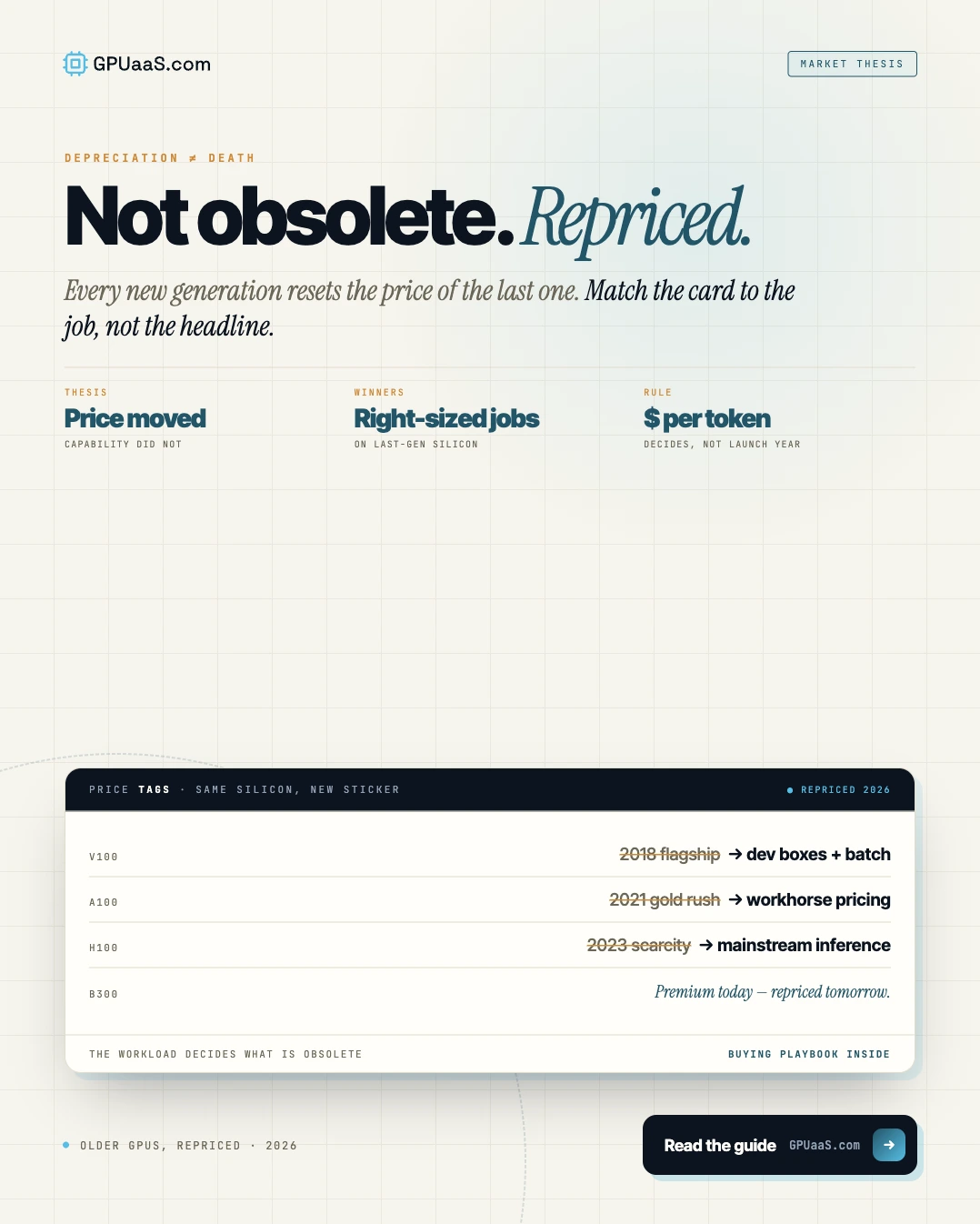
Three older GPUs, three price movements in 2026, none of them downward in the way a depreciation schedule predicts.
The A100 was discontinued in January 2024. Its rental pricing has held steady since rather than falling. The RTX PRO 6000 launched at $8,565 in March 2025 and listed between roughly $13,000 and $16,000 by August 2026, up 55 to 87% with no hardware change. The L40S is holding most of its secondary-market value while A100 and H100 hardware flows into resale channels and softens.
Key takeaways
Older GPU pricing is set by how constrained the current generation is, not by how old the part is. Even V100 pricing has bumped upward
Two clocks run separately: the capability clock (FP8 support) and the deprecation clock (the vendor support list). Conflating them is where planning goes wrong
Each value tier owns a specific constraint rather than a performance band: A100 for FP64 and MIG, L40S for cost per token, RTX PRO 6000 for single-card capacity without a facility change
None is a cheaper H100. Treating the value tier as a discount rack produces workload mismatches
For renters, channel matters more than generation. The spread between the cheapest and most expensive A100 hour exceeds the A100-to-H100 gap at one provider
◆ THE DEPRECIATION ASSUMPTION BROKE
Scarcity upstream pushes demand backward
The assumption that older silicon gets cheaper as newer silicon arrives broke this year. Worth understanding why, because the mechanism decides what to do about it.
The price of an older GPU in 2026 is set by how constrained the current generation is, not by how capable the older part is. Blackwell supply is tight, HBM and GDDR7 are both constrained, and demand that cannot get current-generation capacity pushes backward into whatever will run the workload. That pushes older-tier prices up, not down. Even V100 pricing has seen an upward bump, and Volta launched in 2017.
So the useful question stopped being how old a card is. It became what the card can still do, and what the market is charging for that specific capability right now.
◆ TWO CLOCKS, NOT ONE
Capability and deprecation move at different speeds
Two clocks run separately here, and conflating them is where most planning goes wrong.
The capability clock is the precision floor. FP8 is the real line in the current generation of tooling. The L40S has it, at 724 TFLOPS. The A100 does not, and tops out at BF16 for training and INT8 for inference. That single gap matters more than the four years between the two architectures, because everything built after 2023 assumes low-precision throughput is available. An A100 and an L40S can rent for similar hourly rates and still not be the same tier.
The deprecation clock is the vendor support list, and it moves far more slowly than either marketing or resale pricing suggests. NVIDIA AI Enterprise Infra 8.1, released May 2026, removed V100 and Volta from its supported GPU list. Ampere was not removed. The Infra 4.10 LTSB branch reached end of life in July 2026. That is what deprecation actually looks like when it happens, and it is checkable on each release rather than inferred from vibes.
Jensen Huang described the A100 fleet publicly on 13 August 2026 as mission-capable from 2020 through 2029. CoreWeave has committed to renting A100 through 2029. A nine-year service life on a part discontinued in year four.
◆ THE 2026 VALUE-TIER MAP
Tier
Owns
Cannot do
A100 80GB
FP64 at 19.5 TFLOPS, MIG 7-way partitioning, 30B-70B at ~2 TB/s
FP8, permanently
L40S 48GB
Lowest cost per token ($0.023/M), image generation, embeddings, FP8
NVLink, MIG, 70B+ on one card
RTX PRO 6000 96GB
Largest single-card capacity, standard tower and wall outlet, consumer tooling
NVLink, bandwidth-bound work
◆ WHAT EACH TIER IS ACTUALLY FOR
Each owns a constraint, not a performance band
The A100 is the double-precision and multi-tenant option. FP64 Tensor Core performance of 19.5 TFLOPS makes it one of the few cloud-accessible GPUs suited to molecular dynamics, materials simulation, and computational fluid dynamics, where the newer inference-optimized parts do not compete. MIG partitions one card into seven isolated instances for multi-tenant serving. 80GB and roughly 2 TB/s of bandwidth cover models in the 30B to 70B range. What it lacks is FP8, permanently.
The L40S is the cost-per-token option. $0.023 per million against the H100's $0.026, achieved by being cheaper per hour by a wider margin than it is slower per token. Its strongest cases are the least discussed ones: image generation, where 48GB handles SDXL at any standard resolution and Flux.1 to 1080p at a rate comparable to H100 for a fraction of the hourly cost, and embedding endpoints, where a single card serves millions of embeddings per hour at low utilization. It has FP8. It has no NVLink and no MIG.
The RTX PRO 6000 is the single-card capacity option, and the one that requires no facility change. 96GB, more than an H100, at roughly half the bandwidth. Llama 3.3 70B fits at FP8 with room for KV cache. It runs in a standard tower on a normal wall outlet, works with standard drivers and consumer tooling, and needs none of the liquid cooling or 14 kW power budget a current-generation server system demands. It also has no NVLink, which ends any multi-card ambition.
+87%
the RTX PRO 6000's list price increase between March 2025 and August 2026 with no hardware change, the clearest single illustration that older-tier pricing no longer tracks age
NVIDIA marketplace listings via Tech Insider, August 2026
◆ NOT A DISCOUNT RACK
Where the mismatch comes from
The pattern across all three is that each one owns a specific constraint rather than a general performance band. Double precision and partitioning. Cost per token. Single-card capacity without infrastructure.
None of them is a cheaper version of an H100. Treating the value tier as a discount rack is what produces the mismatch where a team ends up on an A100 for a workload that needed FP8, or on an L40S for something that needed tensor parallelism.
◆ BUYING VERSUS RENTING
The used discount is priced risk, and channel beats generation
The practical consequence for anyone buying rather than renting: used discounts are real but they price in support risk. Used A100 units trade at roughly 40 to 60% off with no warranty and limited driver support. That gap is not free money, it is the market pricing the possibility that the support list changes.
And for anyone renting, channel matters more than generation. The spread between the cheapest and most expensive A100 hour is wider than the gap between an A100 and an H100 at a single provider. Choosing the tier correctly and then renting it badly leaves more money on the table than choosing the wrong tier and renting it well.
Get quoted against the constraint that actually binds.
Not the tier that looks cheapest on paper. No buyer fees. For single GPUs, packet.ai handles self-serve access with 24/7 human support.
Older-tier pricing is set by how constrained the current generation is. Blackwell supply is tight and HBM and GDDR7 are both limited, so demand that cannot reach current-generation capacity pushes backward into older parts. Even V100 pricing has bumped upward, and Volta launched in 2017.
Match the constraint, not the price. A100 for double-precision scientific work or MIG multi-tenancy. L40S for lowest cost per token, image generation, and embeddings. RTX PRO 6000 for the largest single-card capacity without a facility upgrade. None substitutes for the others.
Watch the NVIDIA AI Enterprise supported GPU list on each Infra release. Infra 8.1 in May 2026 removed V100 and Volta. Ampere was not removed. That list is a checkable signal, unlike resale pricing or marketing positioning.
For current tooling, largely yes. The L40S supports FP8 at 724 TFLOPS while the A100 tops out at BF16 for training and INT8 for inference. That gap matters more than the years between the architectures, because most software built after 2023 assumes low-precision throughput is available.
Used A100 units trade at roughly 40 to 60% off but carry no warranty and limited driver support. That discount is the market pricing the possibility that the support list changes. Renting avoids that exposure and keeps the channel question open, which is where more of the savings actually sit.
Last reviewed: 28 August 2026. A100 pricing, service-life statements, and support lifecycle detail from Thunder Compute, Akash, and NVIDIA AI Enterprise end-of-life notices. L40S cost-per-token and workload data from Cyfuture and Spheron comparisons. RTX PRO 6000 pricing history from NVIDIA marketplace listings via Thunder Compute and Tech Insider. Secondary market observations from PCSP's used GPU server buying guide and Hashrate Index's used GPU market analysis. Browse current GPU cluster availability on GPUaaS.com.