Blog ▸ RTX PRO 6000 for AI Workloads: Where Workstation-Class Actually Wins
GPU Infrastructure
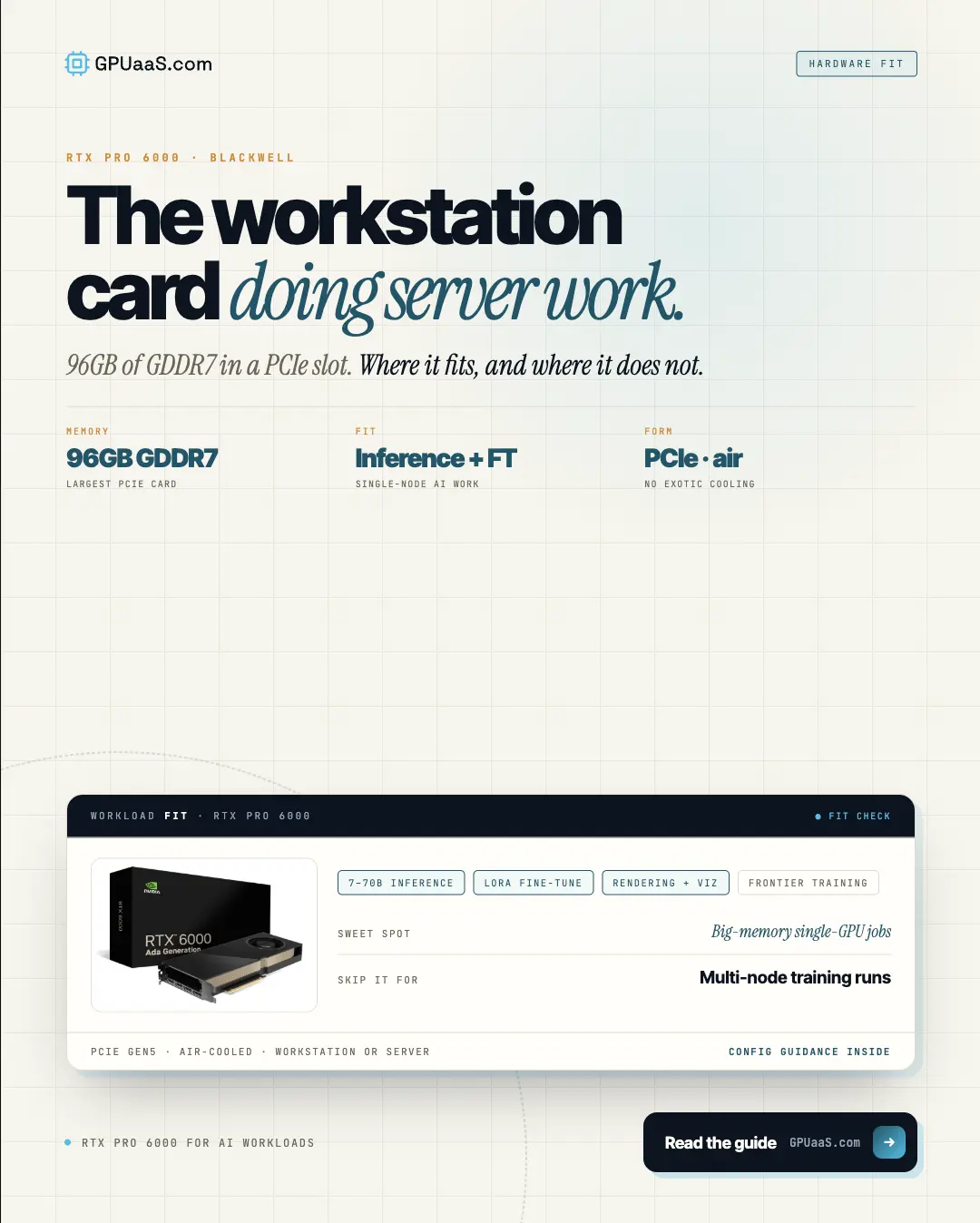
The RTX PRO 6000 has more VRAM than an H100 at roughly half the bandwidth and no NVLink. That trade defines a narrow lane where it has no real competitor below the H100 price tier.
RTX PRO 6000 for AI Workloads: Where Workstation-Class Actually Wins
GPUaaS.com Team
GPU Infrastructure
August 25, 2026
No items found.
The RTX PRO 6000 Blackwell carries 96GB of VRAM. An H100 carries 80GB.
It also runs at 1.79 TB/s of memory bandwidth, roughly half the H100's. That figure is identical to the RTX 5090, because both cards use the same GB202 die on a 512-bit bus. The PRO 6000 gets a fuller configuration, 24,064 CUDA cores against the 5090's 21,760, and four times the memory.
Key takeaways
More VRAM than an H100 (96GB vs 80GB) at roughly half the memory bandwidth. That single trade defines where this card wins
Llama 3.3 70B at FP8 fits with ~26GB left for KV cache. No sharding, no tensor parallelism, no multi-GPU orchestration
No NVLink. Multi-GPU runs over PCIe 5.0, making this a single-GPU part that happens to be large rather than a training-cluster building block
Launched March 2025 at $8,565 MSRP. By August 2026 listing between roughly $13,000 and $16,000 with no hardware change, driven by the GDDR7 shortage
Median cloud rate $2.20/GPU/hr as of 30 August 2026, up 9% over 90 days and 20% over twelve months
◆ RTX PRO 6000 AGAINST H100
Spec
RTX PRO 6000
H100
Memory
96GB GDDR7 ECC
80GB HBM3
Bandwidth
1.79 TB/s
3.35 TB/s
Multi-GPU
PCIe 5.0 x16, no NVLink
NVLink 900 GB/s, to 256 GPUs
Power
600W (300W Max-Q)
700W
Infrastructure
Standard tower, wall outlet
Data center
Precision
5th-gen Tensor, native FP4
4th-gen Tensor, FP8, TMA
Sources: NVIDIA product pages, Thunder Compute RTX PRO 6000 pricing guide, OpenMetal RTX PRO 6000 vs H100 analysis, 2026
◆ CAPACITY WITHOUT BANDWIDTH
The trade that defines the card
More capacity than a data center part at consumer-grade bandwidth. That single trade decides everything about where this card wins and where it does not.
Where it wins is single-GPU residency. Llama 3.3 70B at FP8 fits with roughly 26GB left over for KV cache, enough for moderate batch sizes at standard context lengths. Qwen 2.5 32B fits at FP16. gpt-oss 120B runs at around 193 tokens per second. No sharding, no tensor parallelism, no multi-GPU orchestration for any of it.
◆ THE CASE MOST PEOPLE MISS
Vision-language models and QLoRA
Vision-language models are the case most people miss. LLaVA-34B and InternVL-38B need 40 to 70GB just to load weights, because the vision encoder sits alongside the language model. That makes them impractical on 24GB consumer cards and comfortable on 96GB.
QLoRA fine-tuning lands in a similar place. A 34B model fine-tunes on a single card. 70B becomes possible with gradient checkpointing. Neither requires a cluster.
◆ NO FACILITY UPGRADE REQUIRED
Standard tower, normal wall outlet
The facility story is the part that separates this card from everything in the data center tier, and it is worth stating plainly next to what current-generation server hardware demands. The PRO 6000 fits a standard workstation tower and plugs into a normal wall outlet. 600W total board power on the Workstation Edition. The Max-Q variant caps at 300W with a blower cooler, same 96GB and same bandwidth, aimed at builds where power and heat are the binding constraint. Compare that against a B300 system pulling 14 kW and requiring direct liquid cooling.
Tooling compatibility follows from the same positioning. Standard NVIDIA drivers, Ollama, LM Studio, and the rest of the consumer AI stack work without enterprise driver packages or compatibility caveats. For a team that wants a large model resident locally without operating data center infrastructure, that matters more than a benchmark.
The card also does double duty. 752 Tensor cores handle the matrix math, 188 RT cores handle ray-traced rendering. AI development during the week, rendering when a deadline demands it. Few AI-focused parts serve both.
◆ THE LIMITS ARE STRUCTURAL
A single-GPU part that happens to be large
There is no NVLink. Multi-GPU communication runs over PCIe 5.0 x16. For distributed training across cards, that is a serious handicap against an H100's 900 GB/s NVLink scaling to 256 GPUs. The PRO 6000 is a single-GPU part that happens to be large, not a building block for a training cluster.
Bandwidth caps memory-bound inference. At roughly half the H100's throughput, decode-heavy workloads run slower per card regardless of how much VRAM sits idle. The H100 also has native TMA support that the PRO 6000 lacks. For large distributed training, B200 or H200 remain the right answer.
$8,565 → ~$16,000
the RTX PRO 6000's list price from March 2025 launch to August 2026, an increase of up to 87% in sixteen months with no hardware change, driven by the GDDR7 shortage
NVIDIA marketplace listings via Thunder Compute and Tech Insider, August 2026
◆ THE PRICE STORY CHANGED THE RECOMMENDATION
What makes the card useful is what makes it expensive
The card launched in March 2025 at an MSRP of $8,565. By August 2026 it was listing between roughly $13,000 and $16,000 depending on channel and source, an increase of 55 to 87% in sixteen months with no hardware change whatsoever.
The cause is the GDDR7 shortage. The PRO 6000 uses 96GB in a clamshell design, the largest VRAM capacity on any discrete card, which makes it acutely sensitive to GDDR7 supply constraints. The thing that makes the card useful is the thing making it expensive.
That pushes most teams toward rental, and rental has moved too. Median on-demand pricing sat at $2.20 per GPU-hour as of 30 August 2026, up about 9% over 90 days and about 20% over twelve months. The range across providers runs from roughly $0.66 to $3.03 per hour. Reservations start near $0.48 per month on the cheapest verified listings. Across 256 listings from 38 providers, 169 were verified in stock, and packet.ai appears among the cheapest verified availability.
◆ THREE VARIANTS, NOT INTERCHANGEABLE
Ask which one is being quoted
Three variants exist and they are not interchangeable. Workstation Edition at 600W, Max-Q Workstation Edition at 300W with a blower, and Server Edition which is passively cooled in a data center form factor. Most cloud availability is Server Edition. Anyone quoting a PRO 6000 rate should be asked which one.
The honest summary: this card wins when a single large model needs to stay resident on one GPU, in a normal room, on normal power, with normal drivers. It loses whenever the workload wants to span cards or is bound by bandwidth rather than capacity. That is a narrow lane, and inside it the PRO 6000 has no real competitor below the H100 price tier.
Get a quote for the tier that actually fits.
Workstation-class or something larger. No buyer fees. For single GPUs, packet.ai handles self-serve access with 24/7 human support.
For different things. The PRO 6000 has more VRAM (96GB vs 80GB) but roughly half the memory bandwidth and no NVLink. It wins on single-GPU residency of large models without data center infrastructure. The H100 wins on memory-bound inference and any workload spanning multiple cards.
Llama 3.3 70B at FP8 fits with roughly 26GB left for KV cache. Qwen 2.5 32B fits at FP16. gpt-oss 120B runs at around 193 tokens per second. Vision-language models like LLaVA-34B and InternVL-38B, which need 40 to 70GB just to load, fit comfortably.
The GDDR7 shortage. The card uses 96GB in a clamshell design, the largest VRAM capacity on any discrete card, which makes it acutely sensitive to GDDR7 supply constraints. It launched at $8,565 in March 2025 and listed between roughly $13,000 and $16,000 by August 2026 with no hardware change.
Poorly. There is no NVLink, so multi-GPU communication runs over PCIe 5.0 x16 rather than a high-bandwidth fabric. Against an H100's 900 GB/s NVLink scaling to 256 GPUs, that is a serious handicap. For distributed training, B200 or H200 are the better fit.
Workstation Edition runs at 600W. Max-Q Workstation Edition caps at 300W with a blower cooler, keeping the same 96GB and same bandwidth. Server Edition is passively cooled in a data center form factor and accounts for most cloud availability. Worth confirming which one a quote refers to.
Last reviewed: 26 August 2026. Specification data from NVIDIA product pages and Thunder Compute's RTX PRO 6000 Blackwell pricing guide, August 2026. H100 comparison from OpenMetal's RTX PRO 6000 vs H100 inference analysis. Cloud pricing distribution and provider counts from GetDeploying's RTX PRO 6000 cloud pricing index, checked 30 August 2026. List price history from NVIDIA marketplace listings via Tech Insider, August 2026. Model fit and QLoRA figures from Spheron and Newegg Insider RTX PRO 6000 analyses. Browse current GPU cluster availability on GPUaaS.com.