Blog ▸ One Node Is Enough: What It Takes to List With GPUaaS.com
GPU Infrastructure
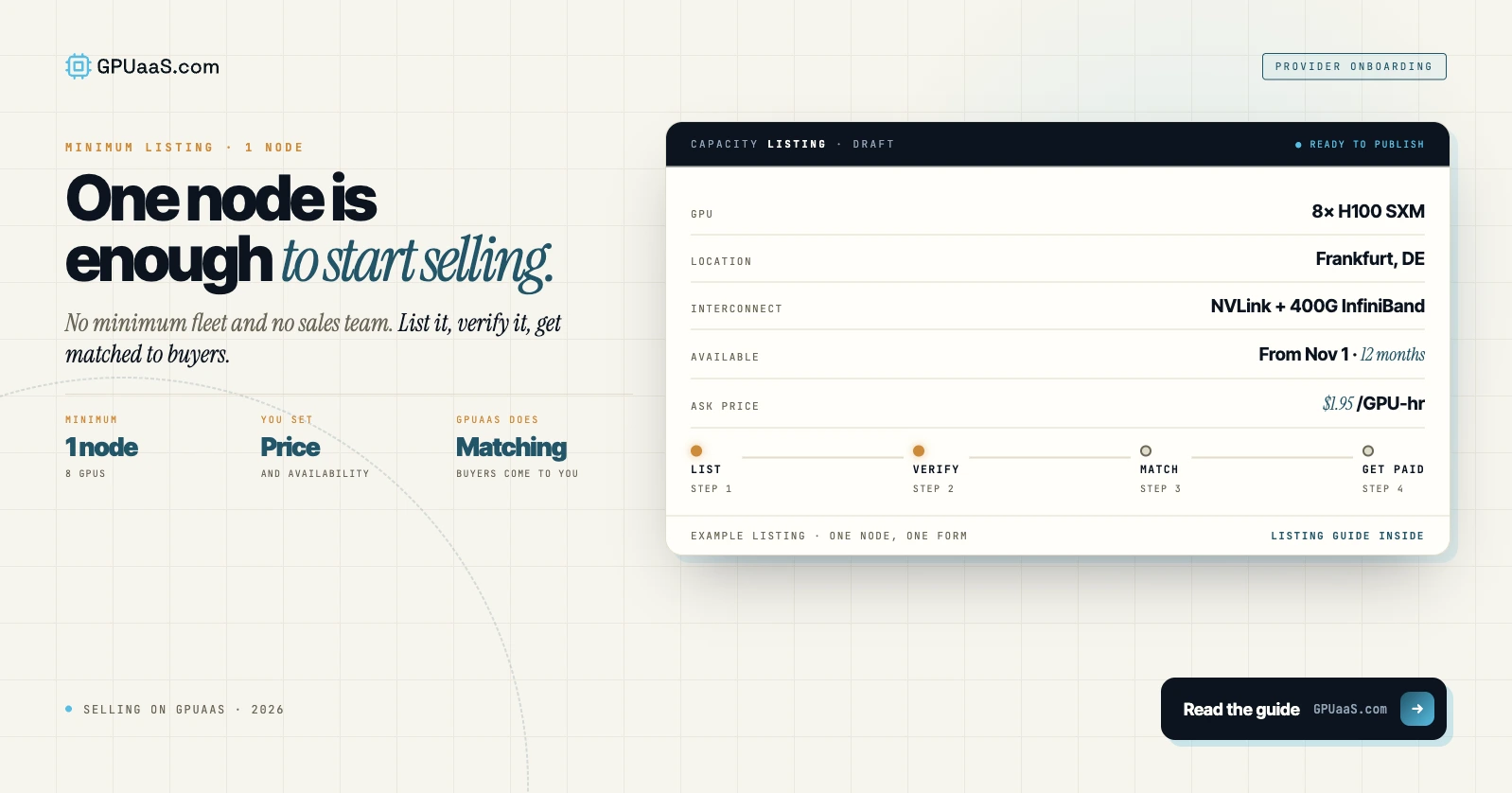
The most common reason a provider never applies is thinking they are too small. One 8-GPU node is the minimum, the form is five fields, and small listings fill first.
One Node Is Enough: What It Takes to List With GPUaaS.com
GPUaaS.com Team
GPU Infrastructure
October 6, 2026
No items found.
One 8-GPU node is enough to list with GPUaaS.com. There is no minimum fleet size beyond that, no cost to apply or list, and quoting starts as soon as the capacity is confirmed.
The most common reason a provider does not apply is the belief that they are too small to matter. A single HGX node in a colocation cage, a research cluster with spare cycles, a regional operator with two racks: all of these get asked about more often than their owners expect, because buyers request small committed clusters far more often than large ones. This post covers what the minimum actually is, what the form asks for, what happens in the first week, and what a provider is expected to have ready.
Key takeaways
The minimum listing is one 8-GPU node. RTX-class cards are listed by GPU count rather than node count
There is no cost to apply, list, or stay listed. GPUaaS.com earns on deals that close, not on listings
The form takes a few minutes: what you have, where it is, how it is connected, when it is available, and who to contact
Capacity that has not landed yet can be listed with a future available date. Buyers commit against it
Quotes are expected back within hours of a matched request. Speed of response decides most matches
The contract runs between the provider, GPUaaS.com and the buyer. Providers keep their hardware, their facility and their operations
◆ THE MINIMUM
One node, and why that is enough
The 8-GPU node is the minimum because it is the unit buyers request in. An HGX H100, H200, B200 or B300 node with its NVLink domain intact is what a fine-tuning job, a small inference deployment or a benchmark run actually needs, and a provider with exactly one of those is in the same request queue as a provider with forty. For RTX PRO 6000, RTX 5090 and RTX 4090 the unit is the GPU, and a small PCIe fleet lists by card count.
Small listings fill faster than large ones, not slower. The October demand snapshot shows RTX PRO 6000 requests arriving as one or two nodes from teams that want to start this week, and the committed H100 and H200 asks skew to 8 to 32 GPUs rather than hundreds. A provider with one node is competing for the most frequent request type on the platform.
Partial clusters are fine. A provider with 64 GPUs who wants to keep 48 for internal work and list 16 can do exactly that, and the listed 16 fills on its own terms. Listing does not commit the rest of the fleet.
◆ THE FORM
What we ask, and why each question is there
The provider application asks for five things. First, what you have: GPU model, form factor (SXM or PCIe), and how many. Model and form factor decide which requests you match, and count decides how many you can take at once. Second, where it is: region at minimum, country if residency is part of your pitch. Buyers with data residency requirements search by jurisdiction, and a listing that says "EU" without a country misses them.
Third, how it is connected: NVLink within the node is assumed on HGX systems, so the question is the fabric between nodes. InfiniBand or Ethernet, and at what speed. This is the first thing a multi-node buyer checks and the most common reason a quote is passed over. If you only have one node, say so; single-node requests do not care.
Fourth, when it is available. Live now, or a date. Capacity that is on order can be listed against its delivery date and buyers planning a quarter ahead will commit to it, which is covered in how to sell GPU capacity without building a cloud business. Fifth, who to contact and how fast they respond. The name on the form is who gets the request, and that person needs to be able to say yes to a quote without a committee.
That is the whole form. It does not ask for pricing, because pricing happens per request against the current benchmark bands, and it does not ask for financials, references or exclusivity. There is nothing to sign at this stage.
8
GPUs. The minimum listing on GPUaaS.com, and the unit most committed requests arrive in
GPUaaS.com provider requirements, October 2026
◆ THE FIRST WEEK, DAY BY DAY
When
What happens
What you do
Day 0
Form submitted
Nothing further. Five fields, a few minutes
Day 1 to 2
Someone from the supply team gets in touch to confirm what was listed
Confirm the spec, interconnect, location and available date. Answer the vetting questions below
Day 2 to 5
Capacity is enlisted and matched against open requests
Watch for the first matched request. It may arrive the same day if the spec is in demand
First request
A buyer spec is routed to you: GPU, count, term, region, interconnect
Quote within hours. Term length first, then the rate, then any conditions
On acceptance
Three-party contract between you, GPUaaS.com and the buyer
Provision access. You run the hardware, the facility and support as before
Typical sequence for a new provider on GPUaaS.com, October 2026. Timing depends on how quickly the spec is confirmed and whether a matching request is already open.
◆ WHAT VETTING CHECKS
The questions a buyer would ask anyway
Vetting exists so that buyers can commit to capacity from a provider they have never met. It is not an audit. The questions are the ones a careful buyer asks on a first call: does the hardware exist and match the spec, is the facility a real data center with contracted power and cooling, what are the support hours and the replacement policy for a failed GPU, what uptime can be committed, and where does the data physically sit. A provider who can answer those in writing is vetted. One who cannot yet is helped to get there.
The point of writing them down before the first request is speed. Every one of those questions comes back on every quote, and a provider who answers from a document quotes in an hour while one who answers from memory quotes in a day. The three questions most providers cannot answer covers the ones that lose deals most often.
A small provider is not held to a lower standard than a large one on these, and does not need to be. One node in a proper facility with a named support contact and a written replacement policy is a cleaner listing than forty nodes with none of that.
◆ WHAT YOU KEEP
Hardware, facility, operations, and the relationship with your own customers
Listing changes nothing about how a provider runs. The hardware stays on your books, in your facility, under your operations team. GPUaaS.com does not take custody of anything, does not put software on the nodes as a condition of listing, and does not ask for exclusivity. Capacity listed here can be listed elsewhere, and can be pulled back for internal use between contracts.
What changes is who finds the buyer and who handles the matching. The request arrives qualified: a real spec, a real term, a real budget, from a buyer who has already been through the demand side of the process. The provider quotes, and if accepted, provisions. The contract is between the provider, GPUaaS.com and the buyer, so a provider is never left chasing an unknown counterparty for payment.
The same hardware can also be offered as inference capacity through packet.ai, where it is sold as tokens rather than as a committed cluster. That suits capacity that is not fully booked and a provider who would rather earn on usage than on term. Both routes are open to a one-node provider.
One node is enough. List it.
Five fields, a few minutes, no cost to apply or list. Quoting starts as soon as the capacity is confirmed.
One 8-GPU node for data-center parts such as H100, H200, B200 or B300. RTX-class cards list by GPU count. There is no minimum fleet size beyond that, no cost to apply or list, and partial fleets can be listed while the rest stays in internal use.
No. There is no cost to apply, no listing fee, and no charge for staying listed between contracts. GPUaaS.com earns on deals that close. A provider who lists and never receives a matching request pays nothing.
Five things: GPU model, form factor and count; region or country; inter-node interconnect (InfiniBand or Ethernet and speed); available date, which can be in the future; and a contact who can respond to requests quickly. It does not ask for pricing, financials, references or exclusivity.
Yes. Capacity on order can be listed against its delivery date. Buyers planning a quarter ahead commit against a stated available date when the terms are clear, which means hardware can arrive with a contract already attached to it.
No. Listed capacity can be listed elsewhere and pulled back for internal use between contracts. The hardware stays on your books, in your facility, under your operations. What you commit to is the capacity in a signed contract, for the term in that contract.
Within hours. Buyers receive quotes within a few hours of submitting a spec, so a provider who takes two days to respond is usually quoting a request that has already matched elsewhere. Having interconnect, support hours, replacement policy and residency written down before the first request is what makes an hour possible.
Last reviewed: 7 October 2026. Listing requirements and onboarding sequence from GPUaaS.com provider operations, October 2026. Demand direction from the October 2026 demand snapshot. Apply to list GPU capacity on GPUaaS.com.