Blog ▸ Why Most GPU Providers Cannot Answer a Buyer's First Three Questions
GPU Infrastructure
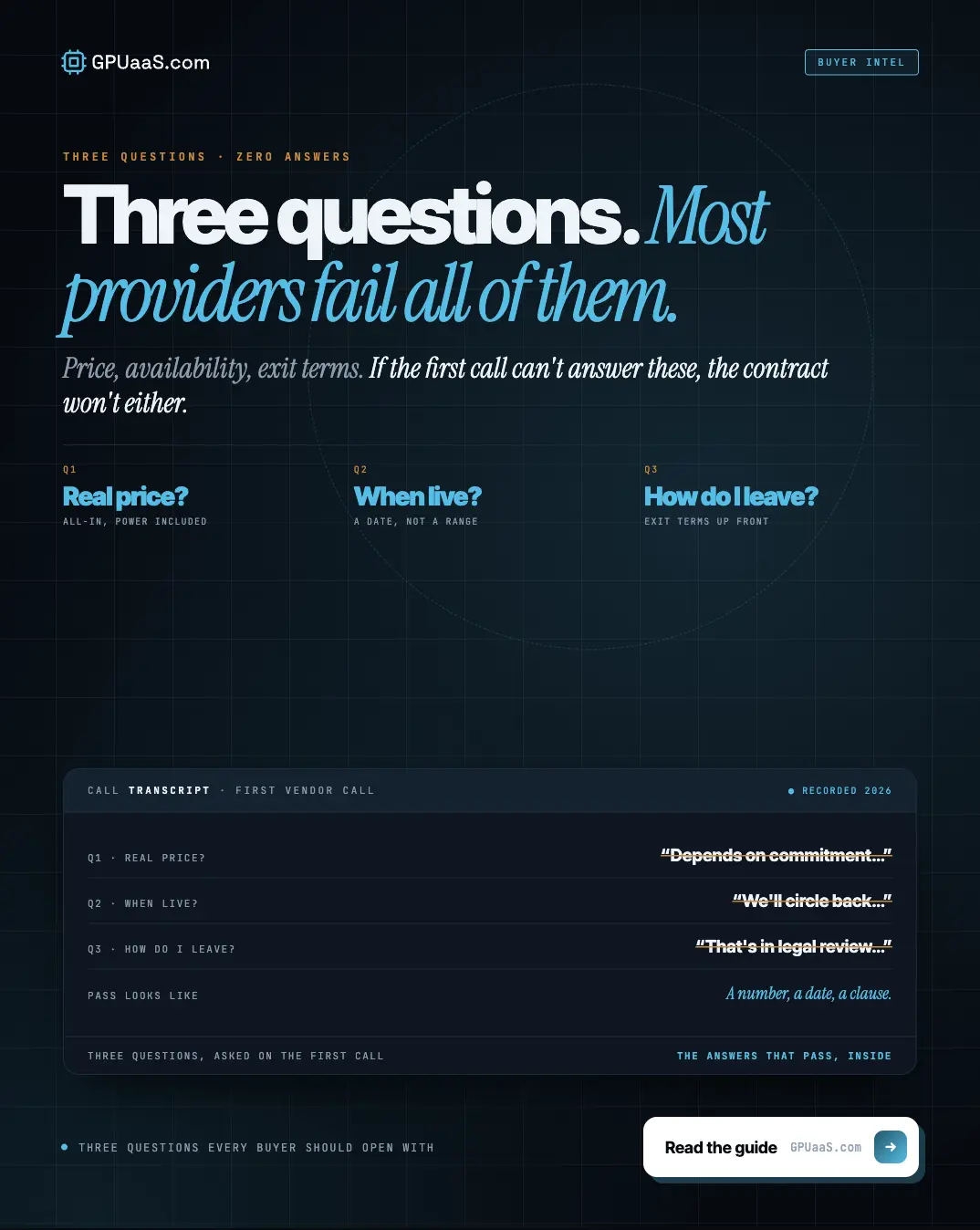
Fleet ownership, storage bandwidth at scale, and power position are the three questions buyers now ask first. Most providers handle at least one badly.
Why Most GPU Providers Cannot Answer a Buyer's First Three Questions
GPUaaS.com Team
GPU Infrastructure
August 31, 2026
No items found.
Gartner projects neoclouds will capture 20% of a $267 billion AI cloud market by 2030. That growth rate has outpaced the number of providers actually building owned fleets.
The category scaled fast enough that capital and brand building ran ahead of hardware ownership. Which means a large share of companies selling GPU capacity in 2026 are selling access to someone else's hardware, and buyers have started asking questions that make the difference visible.
Key takeaways
Fleet ownership, storage bandwidth at scale, and power position are the three questions buyers now ask first. Most providers handle at least one badly
Reselling is not the problem. Being unable to say plainly which layer of the stack you occupy is
Buyers now cross-check ownership claims against public data center announcements, fleet disclosures, and capex filings
Chips ship in a quarter. Substations do not. Interconnect studies run 18 to 36 months and that timeline does not compress
Surplus capacity from Meta Compute and SpaceX has given buyers the leverage to demand transparency rather than take what is available
◆ THE THREE QUESTIONS AND WHAT A GOOD ANSWER LOOKS LIKE
Question
Weak answer
Strong answer
Do you own the fleet?
"We have access to capacity"
Named locations, scale, or a plain statement that you aggregate
A provider that owns its hardware is usually specific about locations and scale. Not always, and that caveat matters, but the pattern holds often enough that vagueness reads as an answer.
The reseller layer is real and it is not a scandal. Massed Compute owns its fleet outright and supplies capacity to other neoclouds who resell it under their own branding, a position its founder has described as sitting beneath the rack-and-stack and support tiers buyers actually interact with. That is a legitimate business. Resellers frequently offer flexibility and access to capacity an owner-operator cannot match.
The problem is not reselling. The problem is a provider that cannot say plainly which it is. Buyers are now asking in writing and cross-checking answers against public data center announcements, fleet disclosures, and capital expenditure filings where the company is public. An evasive answer to a question with a paper trail behind it is worse than an honest "we aggregate."
◆ QUESTION TWO
What does the storage layer actually deliver at scale?
Storage ownership and adjacency now matter about as much as compute ownership, and this is the question that catches the most providers off guard. NVMe scarcity and data gravity have become the hidden costs in badly vetted infrastructure contracts.
A buyer running a 128-GPU job wants a peak read bandwidth number. Not a tier name, not a vendor logo. A number, measured, at that scale. Providers who cannot produce one are usually not hiding anything, they simply never measured it, because nobody asked until recently and the storage was procured as a line item rather than as part of the compute product.
That gap closes with one benchmark run and a documented result. It is the cheapest credibility a provider can buy.
◆ QUESTION THREE
Chips ship in a quarter. Substations do not.
Providers without existing power purchase agreements or completed grid interconnects are waiting on interconnect studies that run 18 to 36 months, and that timeline does not compress for anyone.
This is why some late-2024 entrants will struggle to deliver on 2026 commitments regardless of how much GPU allocation they hold. The chips were never the constraint. Buyers doing serious diligence have figured this out, and a provider that can speak concretely about its power position, PPAs, and interconnect status separates itself immediately from one that talks only about hardware.
18-36 months
how long grid interconnect studies run for providers without an existing power position, a timeline that does not compress regardless of GPU allocation held
wetheflywheel AI Compute and Neocloud Providers 2026 vendor comparison
◆ THE FOURTH QUESTION, ARRIVING FAST
Manufacturer equity and revenue-share arrangements
Buyers have started asking whether a provider has equity or revenue-share arrangements with a GPU manufacturer. It is a material disclosure because it affects how pricing gets set. CoreWeave's IPO filings made this concrete, showing NVIDIA as both a significant customer and a significant shareholder. Providers without such arrangements can say so clearly and get credit for it. Providers with them are better off disclosing than being discovered.
◆ WHY VAGUE ANSWERS STOPPED WORKING
Buyers finally have alternatives
The market conditions that let vague answers pass are ending, which is the part worth internalizing.
Capacity is concentrating behind a small number of owner-operators. CoreWeave expanded its Meta agreement to $21 billion in April 2026, and Nebius holds Meta commitments reported as high as $27 billion. At the same time, Meta Compute and SpaceX have both started selling surplus capacity. That combination gives buyers something they did not have during the shortage years: the option to shop several providers and demand ownership transparency rather than taking whatever is available.
Pricing spread reinforces it. H100 SXM rates across tier-one providers vary by a factor well over 1.5x, with CoreWeave's rate running 1.6x Crusoe's and 1.8x Lambda's. A premium is defensible when it buys guaranteed multi-year capacity and real service levels. It is not defensible on brand alone once a buyer can see the spread.
Gartner's guidance to enterprises has two halves. Diversify beyond hyperscalers, and tighten technical controls and risk management around newer providers. Buyers have enthusiastically adopted the first half. The second half is arriving now, and it arrives as questions.
For a provider, the practical position is straightforward. Know which layer of the stack you sit in and say it. Measure your storage bandwidth at realistic scale and publish the number. Be able to describe your power position without hedging. None of that requires owning more hardware. It requires having answers ready before someone asks. For the buyer-side view of the same diligence, see the vendor evaluation checklist.
Go through vetting once, not once per buyer.
List capacity and get matched with buyers whose requirements you already meet. For single-GPU and month-to-month demand, packet.ai handles self-serve access with 24/7 human support.
No. Reselling is a legitimate model, and resellers often provide flexibility and access to capacity an owner-operator cannot match. The problem is being unable to state plainly which layer of the stack you occupy, particularly when buyers can cross-check against public filings and data center announcements.
Because NVMe scarcity and data gravity have become the hidden costs in poorly vetted contracts, and storage adjacency now matters roughly as much as compute ownership. A tier name or vendor logo does not answer it. A measured peak read bandwidth figure at 128-GPU scale does.
Chips can be delivered inside a quarter. Grid interconnect studies run 18 to 36 months for providers without an existing power purchase agreement or completed interconnect. That is why some providers holding significant allocation will still struggle to deliver on commitments.
Yes. It is a material disclosure affecting how pricing is set, and buyers have started asking. Providers without such arrangements can say so clearly and get credit. Providers with them are better positioned disclosing than being discovered, as CoreWeave's IPO filings demonstrated.
Because they finally have alternatives. Surplus capacity entering the market from Meta Compute and SpaceX, alongside a visible spread in H100 rates across tier-one providers, gives buyers the option to shop several providers rather than accept whatever is available.
Last reviewed: 1 September 2026. Fleet ownership analysis and vetting questions from DataStorage.com's neocloud vetting guide, July 2026, including podcast commentary from Massed Compute founder Sunny Smith. Gartner market projection and enterprise guidance via DataStorage.com. Power and interconnect timelines from wetheflywheel's AI Compute and Neocloud Providers 2026 vendor comparison. Pricing multiples from American Compute's neocloud unit economics data, 2,326 pricing observations across 8 providers, July 2022 to March 2026. Manufacturer financing disclosure analysis from Spheron's NVIDIA neocloud backstop financing report, July 2026. Apply to list GPU capacity on GPUaaS.com.