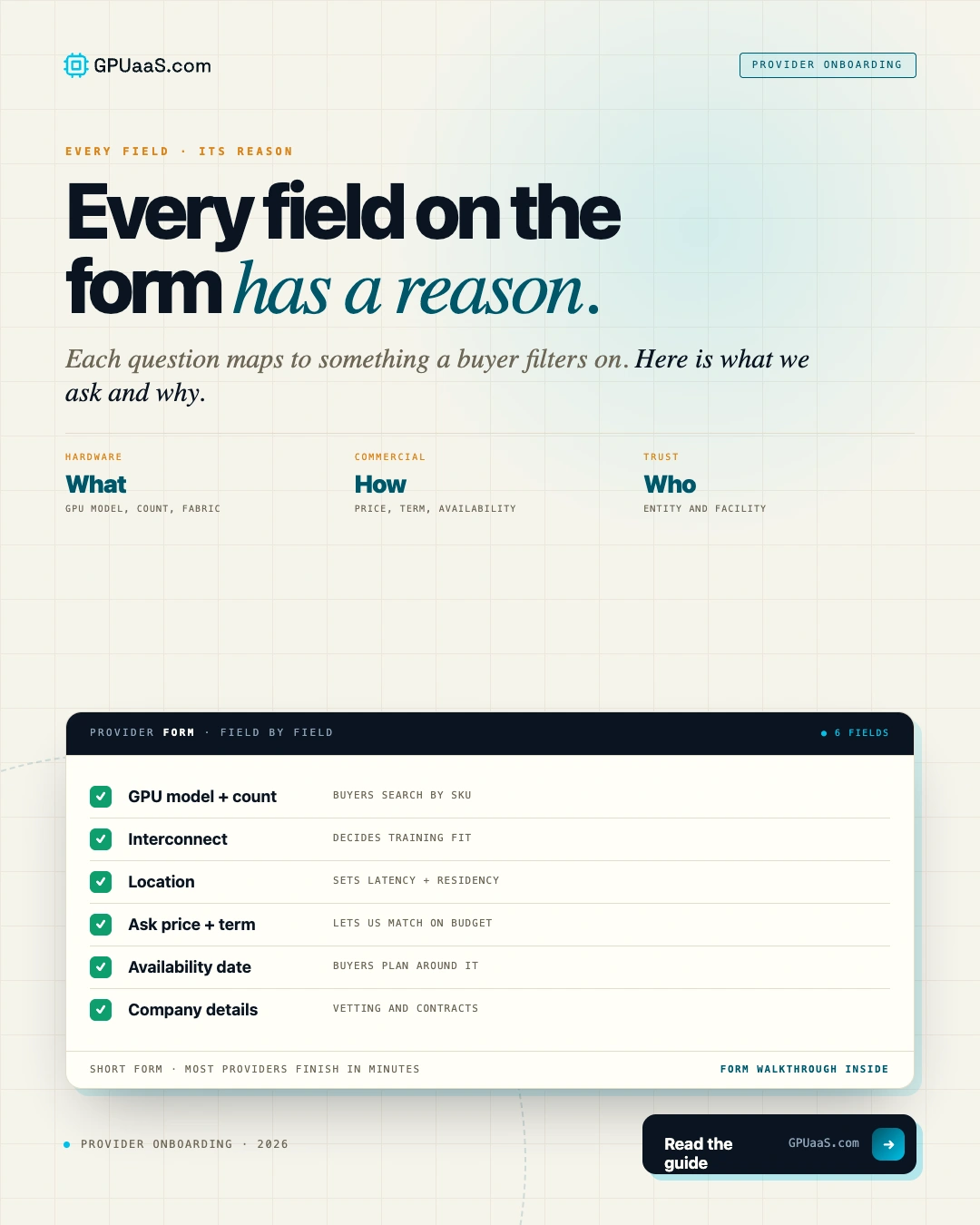
The provider application takes about three minutes, and seven of its answers decide how quickly your capacity can be matched.
This walkthrough goes through the form section by section, explains why each question is asked and says what to have ready before you start. Every application is reviewed by a person, with a response in 1 to 2 business days, so precise answers save a round of follow-up.
- The form has five sections: your details, company and facility, GPU inventory, contract terms and additional information
- Baseline requirements are 8-GPU nodes of enterprise NVIDIA hardware, a dedicated datacentre, a 99.5%+ uptime SLA, InfiniBand or high-bandwidth networking and 24/7 technical support
- Capacity can be available now, within two weeks, within 30 days, within 60 days or as a future pipeline
- There is no fee to apply or list, and providers set their own rates
- Applications are reviewed manually and answered within 1 to 2 business days
- The free-text box is the best place for interconnect, cooling, power density and support details
Before you start
Have five things to hand: your GPU models and counts, the facility location, the interconnect type, the date capacity becomes available and the contract terms you can support. If you know the rack power density and the support hours, note those too, because they go in the last box and buyers ask about them early.
Check the baseline requirements first, since they save an application that would not go forward. The page asks for minimum 8-GPU nodes of enterprise NVIDIA hardware, a dedicated datacentre environment, either colocation or owned, 99.5% or better uptime SLA capability, InfiniBand or high-bandwidth inter-node networking and 24/7 technical support. Capacity should be available now or within 30 days.
Section one: your details
First name, last name, work email and job title are required, and phone number is optional. The work email matters because the team replies to it, and a personal address makes it harder to confirm who is applying on behalf of which company. The job title tells the reviewer whether they are speaking to someone who can commit capacity or someone who will need to escalate.
Add a phone number if a quick call would help. For capacity with a near delivery date, a call often settles in ten minutes what an email thread would take two days to cover.
Section two: company and facility
Company name, operator type and primary facility location are required, and the company website is optional but worth including. The website lets the reviewer confirm the operation is real and see what you already tell your own customers.
Operator type is a dropdown: owned datacentre, colocation operator, hyperscaler or reseller, independent cloud provider, HPC or research centre, or other. Pick the one that describes who runs the hardware. A research centre selling spare cycles and a colocation operator hosting someone else's GPUs are different arrangements with different contract questions, and the answer routes the application to the right conversation.
Primary facility location should be as specific as you can make it: city and country rather than a region. Buyers care about where capacity physically sits for data residency, latency and power reasons, and many requests specify a country. The detail in this field is what lets a Japan or Singapore request find the right listing.
Section three: GPU inventory
This is the section that matters most. GPU models available is a multi-select: B200, H200, H100 SXM, H100 PCIe, A100, RTX PRO 6000, B300 or other Blackwell, and other enterprise hardware. Tick everything you hold, because a request is matched against what you declared.
Total GPUs available is a range rather than an exact count: 8 to 63, 64 to 255, 256 to 1,023, 1,024 to 4,095 or 4,096 and above. The ranges exist so that a provider does not have to disclose a precise fleet to apply, and so that the reviewer can see whether your scale fits typical requests. A single node is enough to start, and smaller listings often fill faster because more requests fit them.
Node configuration asks how many GPUs sit in each node. Eight per node is the standard for HGX-class systems. If yours differs, use the additional information box to say how.
Capacity availability is the field providers most often get wrong. The options are available now, within two weeks, within 30 days, within 60 days or a future pipeline of 60 days and beyond. Choose honestly. Capacity can be listed ahead of delivery, and buyers planning a training run commit early when the date is clear, but a date that slips after a buyer has planned around it costs the provider credibility.
Section four: terms
Supported contract terms is a multi-select covering hourly billing, monthly commitment, annual commitment and multi-year reservation. Tick what you can genuinely support. Committed cluster demand skews towards annual and multi-year terms, because a buyer pricing certainty gets a lower rate on a longer commitment. Providers who support several terms can be matched against more requests.
Providers in the network set their own rates, and the team provides market context to help them price competitively. For a worked method for finding your own floor, see how to price your GPU capacity for committed buyers.
Section five: additional information
The free-text box is not a formality. It is where the details that make a listing specific belong: interconnect type and speed, cooling method, rack power density, storage, support hours, replacement policy, certifications and any constraint on delivery.
A short, factual paragraph does more than a long marketing one. For example: eight H200 nodes, InfiniBand NDR, liquid-cooled racks at 40 kW, 24/7 support with a four-hour replacement commitment, available within three weeks. A reviewer reading that can move straight to matching.
The last question asks how you heard about GPUaaS.com, with options for Google search, LinkedIn, referral, hosted.ai, an industry event or other. It tells the team which channels are working and costs you a click.
What happens after you submit
A person on the team reviews every application. If something needs clarifying, they get in touch before approval rather than rejecting the form. You will hear back within 1 to 2 business days. By submitting, you agree to be contacted by GPUaaS.com, which is operated by hosted.ai, about your application, and the form states that your data is not shared with third parties.
Once capacity is listed it is quoted against buyers already searching for something similar, and buyers are told quotes come back in under 24 hours, so speed of response is the thing asked of a provider in return. The network has 20+ vetted providers and more than $1 billion in GPU deals closed through it.
Common mistakes
Understating availability dates is the first, because slipped dates damage trust faster than honest later ones. Leaving the free-text box empty is the second, since interconnect and power details are what buyers ask first. Ticking models you do not yet hold is the third. And applying with capacity that does not meet the baseline, usually the interconnect or the 8-GPU node minimum, wastes a review cycle for both sides.
The wider argument for listing at all is in how to sell GPU capacity without building a cloud business, and the single-node route is covered in why one node is enough.
Apply to list your capacity.
Three minutes, reviewed by a person, answered in 1 to 2 business days. There is no fee to apply or list.
Apply as a providerFrequently asked questions
How long does the provider application take?
About three minutes. The form has five sections covering your details, company and facility, GPU inventory, contract terms and additional information.
What are the baseline requirements?
Minimum 8-GPU nodes of enterprise NVIDIA hardware, a dedicated datacentre environment, 99.5%+ uptime SLA capability, InfiniBand or high-bandwidth inter-node networking, 24/7 technical support and capacity available now or within 30 days.
Does it cost anything to apply or list?
No. There is no fee to apply or list.
How long until I hear back?
Every application is reviewed manually, with a response in 1 to 2 business days. The team will get in touch if they need additional details before approval.
Can I list capacity that is not available yet?
Yes. The availability field includes within 60 days and a future pipeline option, and future-dated capacity can be listed ahead of delivery.
Last reviewed: 29 October 2026. Form fields, baseline requirements, review timing and network figures from the GPUaaS.com provider application page. Example specification is illustrative. Apply to list GPU capacity on GPUaaS.com.