



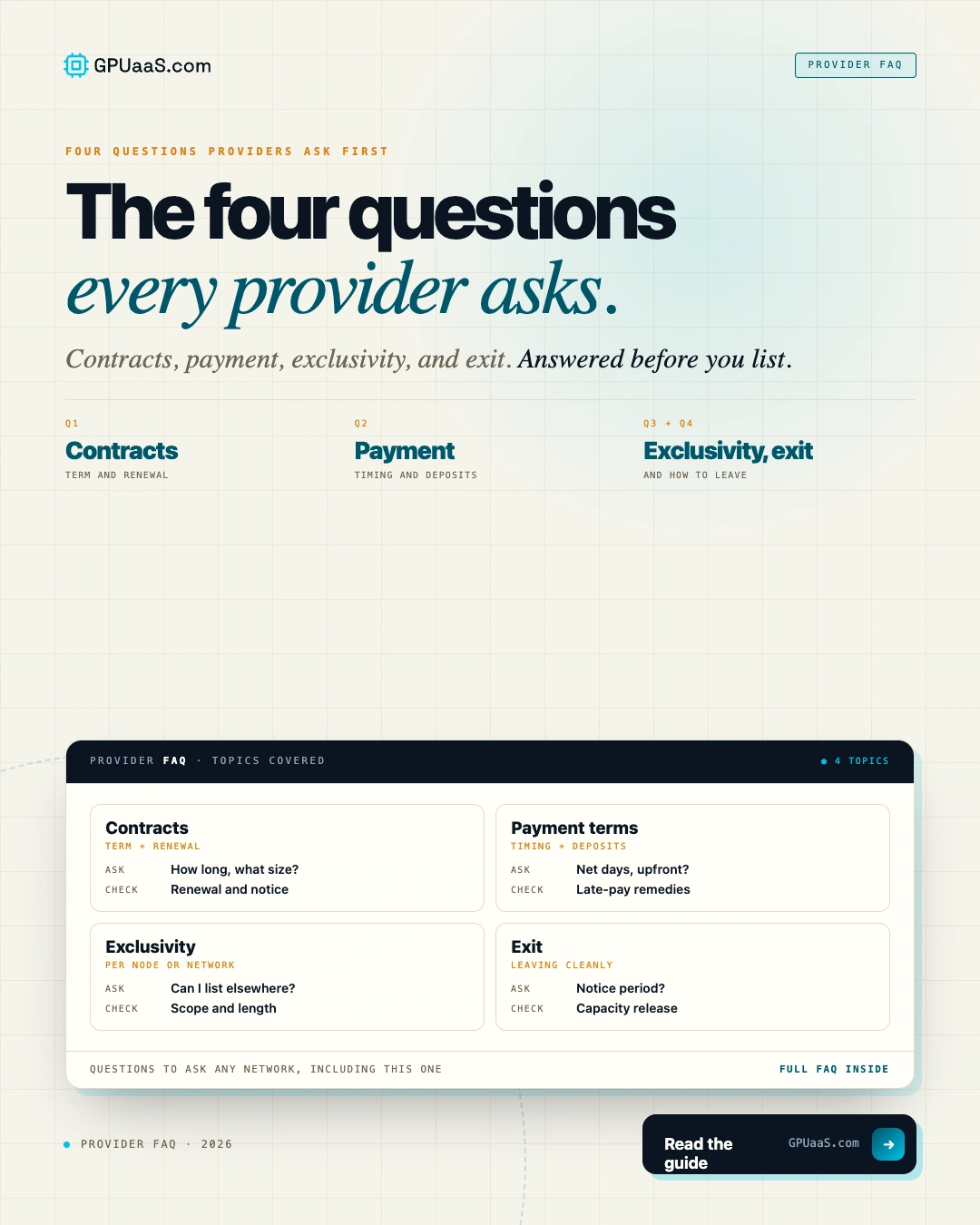
Some of what a provider needs to know before listing is published. The rest is in the contract, and the questions that matter most are about money and leaving.
This FAQ separates the two. It starts with what is fixed and public about listing on GPUaaS.com, then covers the contract terms a provider should settle in writing before signing anything: payment, exclusivity, exit and the clauses that quietly move risk. It is general guidance and not legal advice.
- There is no fee to apply or list, providers set their own rates and applications are reviewed in 1 to 2 business days
- A committed deal is a contract between the provider, GPUaaS.com and the buyer
- Payment timing, exclusivity and exit terms are set in the contract and should be confirmed in writing, not assumed
- Ask for payment terms in days, an invoicing process and a dispute procedure before delivery, not after
- Treat exclusivity as a trade of rate for guaranteed volume, and exit as a set of dates and costs
- Write down who bears each risk: failure, delay, early termination and price change
What is fixed and public
Does it cost anything to apply or list? No. There is no fee to apply or list.
Who sets my rates? Providers in the network set their own rates, and the team provides market context to help them price competitively. A method for finding your own floor is in how to price your GPU capacity for committed buyers.
How long until I hear back? Every application is reviewed manually, with a response in 1 to 2 business days. The team will get in touch if they need additional details before approval.
What are the baseline requirements? Minimum 8-GPU nodes of enterprise NVIDIA hardware, a dedicated datacentre environment, 99.5%+ uptime SLA capability, InfiniBand or high-bandwidth inter-node networking, 24/7 technical support and capacity available now or within 30 days.
Can I list capacity that is not available yet? Yes. Capacity can be listed with a future available date and matched against requests that already exist.
Who is the contract with? It runs between the provider, GPUaaS.com and the buyer. After signing, the buyer and provider work together directly on delivery and operations, with GPUaaS.com remaining part of the arrangement.
How fast do buyers get quotes? Buyers are told quotes come back in under 24 hours, and the network has 20+ vetted providers.
What the contract settles
The application page does not specify payment timing, exclusivity or exit mechanics, and a provider should not assume them. Those are set in the contract. The sections below say what to ask for, so that nothing important is left to a default.
Payment terms
When am I paid? Ask for payment timing in days, counted from a defined event such as invoice date or month end. Market practice for capacity contracts ranges from monthly in arrears to partial prepayment, and the difference matters for cash flow. A 64-GPU cluster at $2.50 per GPU-hour bills about $115,000 a month, so thirty extra days of payment delay is a large working-capital burden.
How is usage measured? For a committed cluster the billable hours are normally the committed hours, regardless of utilization, but the contract should say how downtime credits are netted off and who calculates them.
What about disputes and late payment? Ask for a dispute window, an escalation path and a rule for undisputed amounts, which should be paid on time even while a dispute runs. Ask about interest on late payment and what suspension rights exist if a buyer stops paying, because a provider holding capacity for a non-paying customer is losing revenue daily.
Currency and tax? State the invoicing currency, who bears exchange risk and how withholding and sales taxes are handled across borders, since the buyer, the provider and the network may sit in three different jurisdictions.
Exclusivity
Am I limited to one network? The application page does not state an exclusivity requirement, and the answer for a given deal belongs in writing. Many providers list in more than one place, and the discipline that makes it safe is in listing capacity on multiple networks.
When is exclusivity worth accepting? Only in exchange for something written down: a volume commitment, a priority position or a better rate. Ask how long it lasts, what happens if volume does not arrive and whether it covers all capacity or only the capacity under a specific contract. Time-box it and keep the right to leave. Exclusivity without a volume commitment moves all the risk onto the provider.
What about non-solicitation? Check whether a clause stops you from dealing directly with a buyer you met through the network after the contract ends, and for how long. These clauses are common and reasonable, and the scope and duration should be stated plainly.
Exit
Can I withdraw listed capacity? Listed capacity that is not under contract can normally be withdrawn, and a good routine is to take capacity down everywhere the day a contract is signed elsewhere. Ask for the notice needed and confirm that uncommitted quotes lapse at a stated date.
What happens to a signed contract if I want out? A committed contract is a promise to deliver for a term. Ask whether early termination is permitted, on what notice and at what cost, and what happens to a buyer's workload if capacity is withdrawn. Buyers plan around contracted capacity, and a provider that cannot deliver is in breach. The buyer-side view of an exit is in what happens when a provider exits mid-contract.
What happens at the end of the term? Ask whether the contract renews automatically, whether the renewal rate is fixed or reset, and how much notice is needed to change terms. A rate fixed for three years can look generous or costly depending on where the market goes, and a renewal that resets at the market rate is a different risk.
Clauses that quietly move risk
| Clause | Why it matters | What to ask |
|---|---|---|
| SLA credits | Sets the cost of a miss | Tiers, cap, how calculated, who decides |
| Liability cap | Limits exposure on a large failure | Cap as a multiple of fees, carve-outs |
| Delivery date | Delay can trigger penalties | Remedies for late hardware or facility works |
| Price changes | Costs move during a long term | Fixed, indexed or reviewable, and when |
| Force majeure | Power and supply events | What counts, and whether fees pause |
| Data and audit | Buyer data sits on your hardware | Wipe on exit, access rights, audit scope |
A pre-signing checklist
Before signing, confirm in writing: payment timing and method, the dispute procedure, any exclusivity and its duration, termination rights and notice on both sides, the renewal mechanism, the SLA and its credit cap, the delivery date and the consequence of missing it, the rules on price change and the handling of buyer data at the end. If a point is ambiguous, ask for it to be stated, not assumed.
It also helps to have your own SLA and facility sheets ready, since the contract will reference them. The preparation is covered in SLA basics for GPU providers and what a GPU buyer will ask your facility.
Apply to list your capacity.
One node is enough to start. There is no cost to apply or list, and applications are reviewed by a person.
Apply as a providerFrequently asked questions
Is there a fee to list GPU capacity?
No. There is no fee to apply or list, and providers set their own rates.
Who is the contract with?
It runs between the provider, GPUaaS.com and the buyer. After signing, buyer and provider work together directly on delivery and operations.
Where are payment terms and exclusivity set?
In the contract, not on the application page. A provider should confirm payment timing, any exclusivity and exit terms in writing before signing.
Should I accept exclusivity?
Only in exchange for a written volume commitment, for a limited period, with the right to leave. Without a volume commitment it moves all the risk onto the provider.
What should I check about exit?
Notice and cost of early termination, what happens to a buyer's workload, the renewal mechanism and how buyer data is wiped at the end.
Last reviewed: 11 November 2026. Public listing terms from the GPUaaS.com provider application page. Payment, exclusivity and exit guidance is general and not legal advice, and the arithmetic is illustrative. Contract terms for any deal are set in the contract and should be confirmed in writing. Apply to list GPU capacity on GPUaaS.com.



