Blog ▸ GB300 and What Comes After Blackwell: Reading the Roadmap Without Overbuying
GPU Infrastructure
Rack power runs from 40 kW to 600 kW across four announced GPU generations. Facilities gate deployment more often than chips do. How to read the roadmap without overbuying.
GB300 and What Comes After Blackwell: Reading the Roadmap Without Overbuying
GPUaaS.com Team
GPU Infrastructure
August 20, 2026
No items found.
Hopper-era racks drew about 40 kW. GB200 and GB300 NVL72 draw 120 to 130 kW, liquid-cooled only. Vera Rubin racks target roughly 5 times GB300 performance at roughly 5 times the power, close to 600 kW.
The chips are not the constraint. The building is.
Key takeaways
Rack power runs 40 kW (Hopper) to 130 kW (GB300) to roughly 600 kW (Rubin Ultra). Facility planning gates deployment more often than chip availability
Rubin Ultra's 1TB-per-package target needs HBM4 16-high stacks that no manufacturer had validated specs for as of April 2026. That is an open dependency on the generation many teams plan to wait for
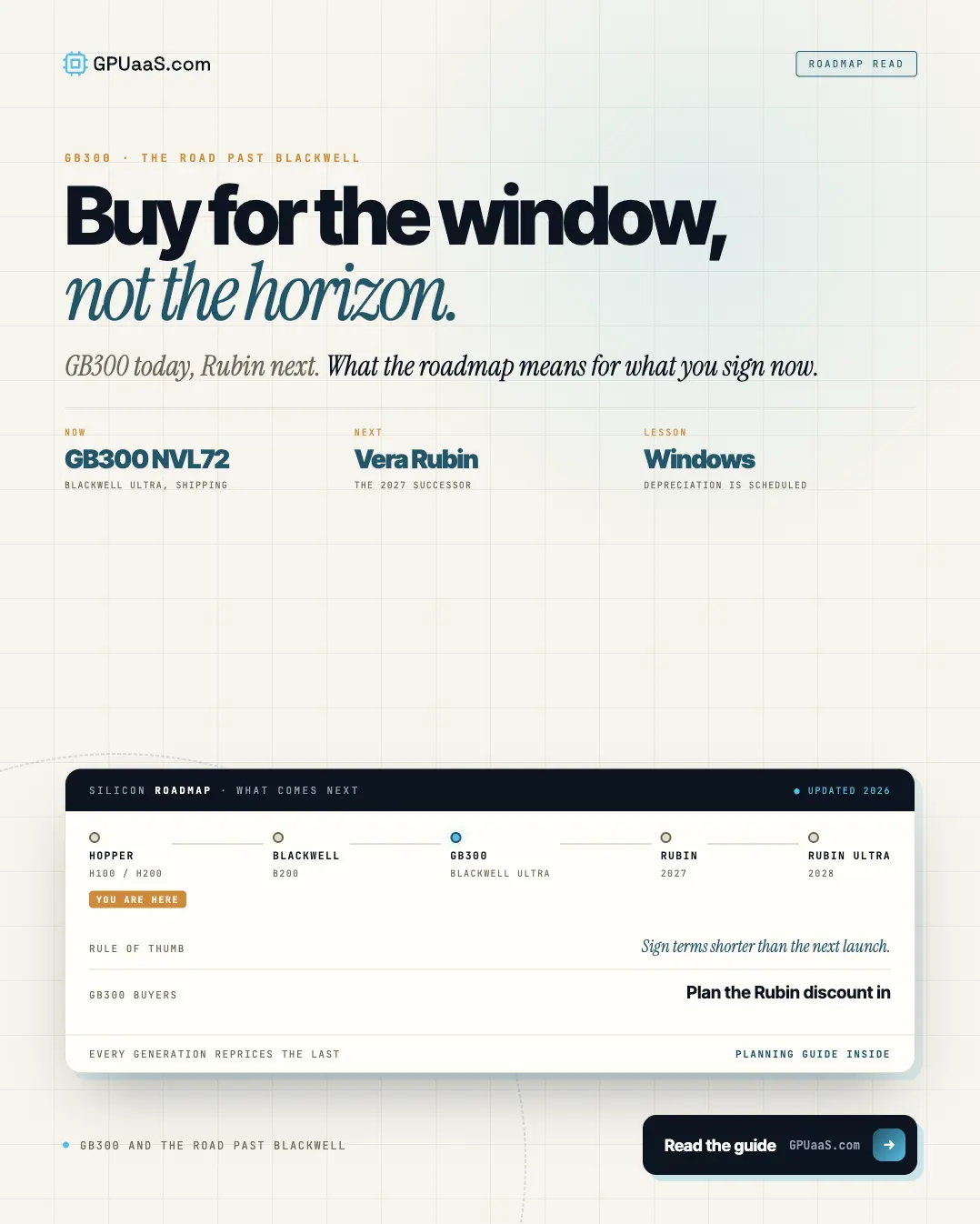
Blackwell is a 2 to 3 year platform, not a stopgap. Blackwell-class silicon carries the buying window through at least 2027
Waiting is not free. Workloads deferred to wait for better hardware do not get cheaper, they just do not run
CUDA stays backward compatible across generations, so migration cost sits in facilities and contracts rather than in code
NVIDIA now publishes four generations forward. Blackwell now, Rubin in the second half of 2026, Rubin Ultra in the second half of 2027, Feynman in 2028. Huang has described it as the first time a technology company announced four generations of anything. The cadence moved from biennial to annual in response to hyperscalers refreshing their in-house silicon every year.
That transparency is genuinely useful and it creates a specific trap. A roadmap this detailed invites teams to plan procurement around chips that do not exist yet, while the actual gate on deployment sits in facility power and cooling that takes far longer to change than a purchase order.
◆ WHAT RUBIN ACTUALLY BRINGS
Large numbers, and one real architectural shift
The Rubin numbers are large. VR200 carries 288GB of HBM4 at 22 TB/s and delivers roughly 50 PFLOPS of FP4 compute, against B300's 15. NVIDIA puts VR200 NVL72 at 3.3 times the inference performance of GB300 NVL72. Token costs for agentic workloads drop toward a tenth of Blackwell, and mixture-of-experts training is claimed to need a quarter of the GPU count. R100 samples in Q4 2026 with volume production in Q1 2027.
Vera Rubin NVL144 CPX goes further, 8 exaflops per rack, 100TB of fast memory, 1.7 PB/s aggregate bandwidth, 7.5 times GB300 NVL72. The CPX part is a Context Processing eXtension built for million-token workloads, with memory tuned for the prefill stage while standard Rubin racks handle decode. Splitting prefill and decode across different hardware is a real architectural shift rather than a spec bump.
◆ THE OPEN DEPENDENCY ON RUBIN ULTRA
Memory technology not yet in production
Rubin Ultra has a dependency worth knowing before anyone plans a 2027 deployment around it. Reaching 1TB per package requires HBM4 16-high stacks, sixteen DRAM layers instead of twelve. NVIDIA requested delivery by Q4 2026. As of April 2026, no manufacturer had published validated specifications for that configuration. The timeline depends on memory technology that is not yet in production. That is an open risk, not a rumor, and it sits on the generation many teams are being told to wait for.
40 → 600 kW
the rack power trajectory from Hopper-era systems to Rubin Ultra, a 15x increase across roughly five years, which is why facilities rather than chips gate most deployments
ModulEdge Vera Rubin data center impact analysis, 2026
◆ POWER DECIDES WHAT SHIPS
800 VDC exists because the old distribution cannot carry it
The power trajectory is the part that actually decides what a team can deploy and when. 800 VDC exists because 600 kW to 1 MW racks are not feasible on conventional 415 or 480 VAC distribution. It carries over 150% more power through the same copper. A facility that cannot deliver that, or cannot take all-liquid cooling, does not get to run Rubin Ultra regardless of what is on the purchase order or how good the roadmap looks.
This is why facility planning rather than chip availability gates most deployments now, and it is the single most common thing missing from roadmap-driven procurement conversations.
◆ BLACKWELL IS NOT A STOPGAP
And waiting is not free
Blackwell is not a transition chip. It is a two to three year platform, and Blackwell-class silicon carries the buying window through at least 2027. Treating B200 and B300 as a stopgap until Rubin arrives misreads both the cadence and the deployment reality behind it.
Waiting is not free either, and this is where the roadmap does the most damage to clear thinking. Locking into large Blackwell commitments through 2027 does mean running through the early Rubin ramp without access to the newer hardware. It also means the workloads that would have run on Blackwell in the meantime simply do not run. Training and inference deferred to wait for a better chip do not get cheaper by waiting. They just do not happen.
◆ THE SOFTWARE RISK IS LOWER THAN THE HARDWARE RISK
Migration cost sits in facilities and contracts
The software risk is lower than the hardware risk, which is easy to miss. NVIDIA maintains backward CUDA compatibility across generations. Kernels written for Hopper run on Blackwell. That means the migration cost between generations sits in facilities and contracts rather than in code, and it is worth weighting those two very differently when assessing exposure.
Rubin does not arrive into an empty field. AMD's MI400 on CDNA 4 targets the same 2027 window with memory bandwidth projections comparable to Rubin's HBM4 specifications. Google continues refreshing TPUs annually. The accelerator market is projected past $250 billion by 2027. CUDA's ecosystem advantage remains real, and the per-spec competitive gap is narrower than it has been at any prior generational boundary.
The practical way to read a four-generation roadmap is to separate what it tells you from what it cannot. It tells you the direction of memory capacity, interconnect bandwidth, and power density, all of which are moving fast and in one direction. It does not tell you when a specific rack will be installable in a specific building, and that is the variable that actually sets the deployment date.
A cluster sized against a static spec fails in one of two directions. Over-fit to hardware that gets replaced, or under-exploit hardware already bought. Neither is fixed by studying the roadmap harder. For what B300 delivers today and how it is configured, see the B300 buyer's guide.
Get a quote against hardware that exists today.
With the generational question priced rather than guessed. No buyer fees. For single GPUs, packet.ai handles self-serve access with 24/7 human support.
Waiting is not free. Workloads deferred to wait for better hardware do not get cheaper, they simply do not run. Blackwell is a two to three year platform rather than a stopgap, and Blackwell-class silicon carries the buying window through at least 2027.
R100 samples in Q4 2026 with volume production in Q1 2027. Rubin Ultra is scheduled for the second half of 2027, though that timeline carries an open dependency on HBM4 16-high stacks that no manufacturer had validated specifications for as of April 2026.
Facility power and cooling. Rack power runs from roughly 40 kW in the Hopper era to 120-130 kW for Blackwell to around 600 kW for Rubin Ultra, which requires 800 VDC distribution and all-liquid cooling. Facilities that cannot deliver that cannot run the hardware regardless of availability.
NVIDIA maintains backward CUDA compatibility across generations, and kernels written for Hopper run on Blackwell. The migration cost between generations concentrates in facilities and contracts rather than in code, which is worth weighting differently when assessing exposure.
CPX stands for Context Processing eXtension, built for million-token workloads. Its memory is tuned for the prefill stage of inference while standard Rubin racks handle decode. Splitting prefill and decode across different hardware is an architectural shift rather than a specification increase.
Last reviewed: 21 August 2026. Roadmap cadence and VR200 specifications from NVIDIA's GTC 2026 keynote as reported by BIZON and Tech Insider. Rack power trajectory and 800 VDC detail from ModulEdge's Vera Rubin data center impact analysis and Introl's Vera Rubin infrastructure report. HBM4 16-high stack dependency from Labo LLM's NVIDIA roadmap analysis, April 2026. Generation timeline from VRLA Tech's NVIDIA GPU roadmap 2026-2030. All future-generation specifications are announced rather than shipped and should be re-verified before budget commitment. Browse current GPU cluster availability on GPUaaS.com.