Blog ▸ B300 SXM Enterprise Buyer's Guide 2026: Specs, Config, and What It Replaces
GPU Infrastructure
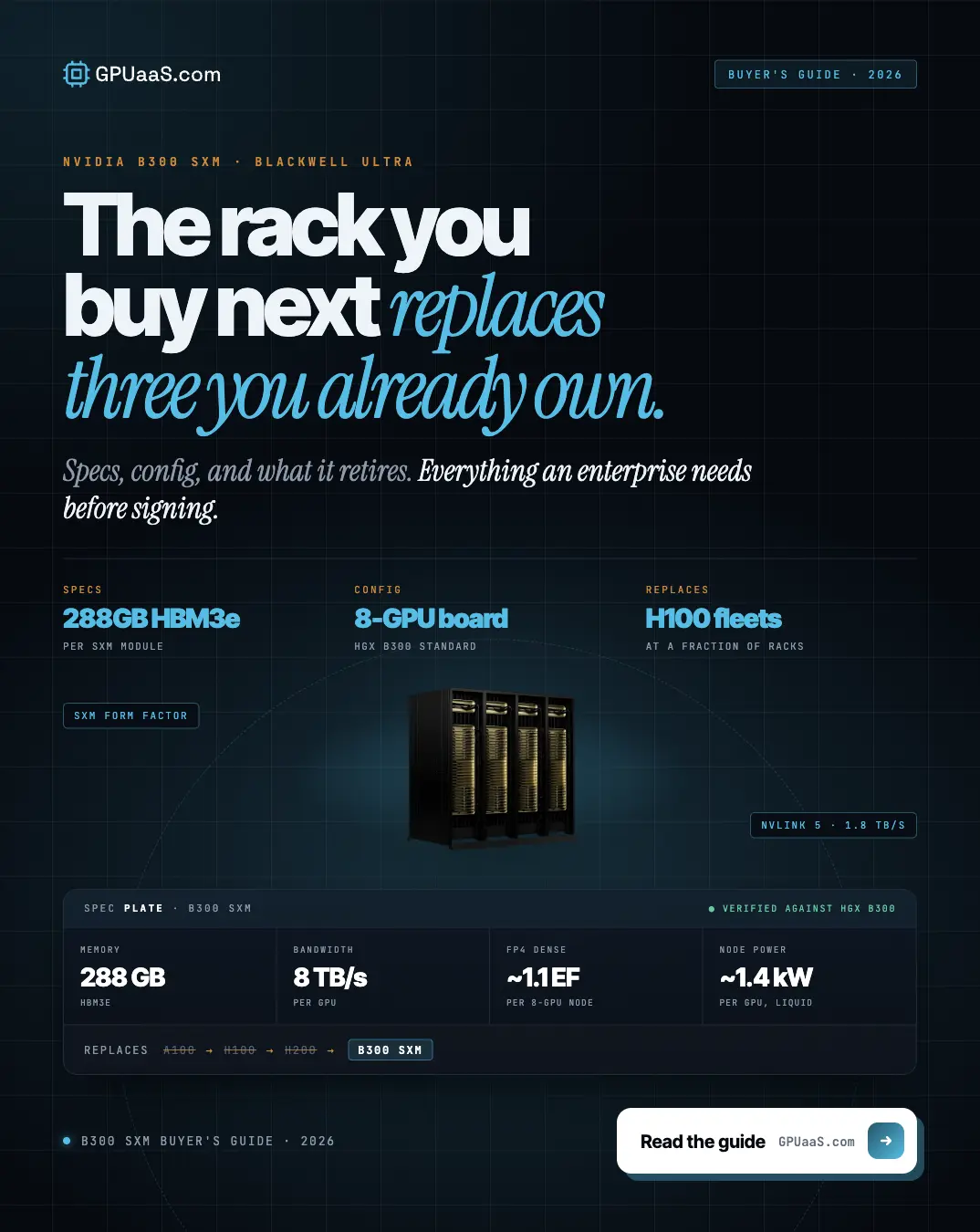
B300 carries 288GB HBM3e and 15 PFLOPS dense NVFP4, but FP8 throughput is identical to B200. Full specs, the three configuration options, power requirements, and what it replaces.
B300 SXM Enterprise Buyer's Guide 2026: Specs, Config, and What It Replaces
GPUaaS.com Team
GPU Infrastructure
August 17, 2026
No items found.
B300 carries 288GB of HBM3e at 8 TB/s. B200 carries 192GB. Both are built on the same 208-billion-transistor dual-die design.
Dense NVFP4 throughput: 15 petaFLOPS on B300 against roughly 9 to 10 on B200. Sparse FP4 throughput: 20 petaFLOPS on both, unchanged. FP8 dense throughput: identical on both.
Key takeaways
FP8 throughput is identical between B200 and B300. A stack that hasn't moved to NVFP4 gets memory capacity and nothing else from the upgrade
288GB HBM3e at 8 TB/s, 50% more than B200's memory, on the same 208-billion-transistor dual-die design
Attention throughput roughly doubles (10.7 vs 5 TeraExponentials/s), which matters most for long-context reasoning where softmax is the real latency cost
1,400W TDP per GPU. An 8-GPU system draws 11.2 kW before CPUs and networking. Direct liquid cooling is a requirement, not an option
Three configurations that are not interchangeable: DGX B300 (turnkey), HGX B300 (OEM baseboard), GB300 NVL72 (72-GPU liquid-cooled rack)
That last row is the one that decides whether B300 is worth buying. If a stack hasn't moved to NVFP4, B300's compute advantage does not reach the workload at all. The team is paying for memory and nothing else.
The attention path is the least-discussed difference and often the most useful one. Special function unit throughput for the exponentials inside softmax roughly doubles, 10.7 TeraExponentials per second against 5. On long-context reasoning workloads, softmax is frequently where the latency actually sits. A model doing multi-step reasoning over a long window feels this more than it feels raw FLOPS.
◆ GENERATIONAL POSITIONING
What the jump actually looks like from each tier
Against H200: 288GB versus 141GB, 8 TB/s versus 4.8 TB/s. Against H100: 3.6 times the memory, 2.4 times the bandwidth. NVIDIA puts Blackwell Ultra NVFP4 throughput at 7.5 times Hopper FP8.
Frontier-scale inference, tight inter-GPU communication
DGX B300 is the turnkey system. NVIDIA sells it directly or through partners and it requires installation by certified personnel. NVIDIA states DGX B300 delivers 1.5 times the dense FP4 performance and 2 times the attention performance of DGX B200.
HGX B300 is the baseboard. Same GPU performance as DGX. The buyer chooses CPU, cooling, and chassis. Generally more flexible and often cheaper.
GB300 NVL72 is the rack. One Grace CPU couples to two Blackwell Ultra GPUs through NVLink C2C, which allows direct memory sharing between CPU and GPU rather than routing over PCIe. Eight of these racks form a Blackwell Ultra DGX SuperPOD: 288 Grace CPUs, 576 B300 GPUs, 300TB of HBM3e, 11.5 exaFLOPS of FP4 compute.
14 kW
peak draw of an 8-GPU DGX B300, roughly twice what an equivalent H100 DGX system pulls, which is why direct liquid cooling is a requirement rather than an optimization
Spheron NVIDIA B300 Blackwell Ultra guide, 2026
◆ POWER IS WHERE MOST ON-PREM PLANS STOP
Liquid cooling is not optional at this density
1,400W TDP per GPU. An eight-GPU system draws 11.2 kW before CPUs and networking are counted. A DGX B300 at peak pulls roughly 14 kW, about twice what an equivalent H100 DGX system draws.
Air cooling is not viable at that density. Direct liquid cooling is a requirement, not an optimization. Supermicro's DLC-2 implementation on the 4U HGX B300 captures up to 98% of heat through liquid. A team running GPU workloads in a traditional air-cooled facility needs a cooling infrastructure upgrade before a B300 order makes sense, and rack power budget and PDU capacity both need verifying against that 14 kW figure first.
This is a substantial part of why cloud access to B300 is attractive even for teams that own hardware elsewhere. The provider absorbs the cooling and power problem entirely.
◆ NETWORKING HAS TO MATCH THE COMPUTE
An undersized fabric wastes the GPU you paid for
DGX B300 ships with eight ConnectX-8 SuperNICs delivering 800 gigabit networking. That figure is not a marketing number, it is a requirement. A fabric sized for a previous generation becomes the bottleneck the moment B300 compute is available behind it, and the GPU sits waiting on data it cannot receive fast enough.
This is the specific failure mode worth checking before any multi-node B300 deployment. Confirm the fabric, confirm whether it is non-blocking inside the pod, and confirm the storage layer can actually feed a job at the scale being planned. A B300 cluster on a fabric built for H100 throughput delivers a fraction of what the hardware is capable of, and the shortfall shows up as unexplained low utilization rather than an obvious error.
◆ THE SOFTWARE SIDE IS THE EASY PART
Same toolchain as B200
B300 uses the same toolchain as B200: CUDA 12.x, cuDNN 9.x, TensorRT-LLM. Code that runs on B200 runs on B300. The Transformer Engine handles precision selection automatically, adjusting between FP4 and FP8 to hold throughput up while keeping accuracy intact.
◆ WHAT B300 ACTUALLY REPLACES
Depends entirely on what you're running now
Coming from H100, the jump is 3.6 times the memory and two architecture generations, including NVFP4 and fifth-generation NVLink. That is a genuine platform change, not an incremental upgrade.
Coming from H200, the memory doubles and bandwidth nearly doubles. H200 was a memory upgrade on the Hopper die. B300 is a different architecture underneath.
Coming from B200, the honest answer is narrower. Same transistor count, same sparse FP4 throughput, same FP8 throughput, same toolchain. What changes is dense NVFP4 throughput, memory capacity, and attention performance. A workload that fits in B200's 192GB and hasn't adopted NVFP4 gets very little from the move.
The workloads B300 was actually built for are reasoning models, mixture-of-experts architectures, and long-context inference. Multi-step inference with search, verification, and tool use can demand up to 100 times the compute of a single-shot response. That pattern is what the doubled attention throughput and 288GB of memory are aimed at.
For current market rates and how B300 pricing compares to B200 on cost per hour, see B300 GPU pricing 2026. For sizing against a specific workload, see B300 cluster sizing.
Get a B300 quote matched to your workload.
Within 24 hours, against a spec rather than a rate card. No buyer fees. For single GPUs, packet.ai handles self-serve access with 24/7 human support.
288GB of HBM3e memory at 8 TB/s bandwidth, 15 petaFLOPS dense NVFP4, 20 petaFLOPS sparse FP4, 1,400W TDP, built on a 208-billion-transistor dual-die design. Attention throughput runs 10.7 TeraExponentials per second, roughly double B200.
Only if the workload uses NVFP4 or is memory-constrained. FP8 dense throughput and sparse FP4 throughput are identical between the two chips, and both share the same transistor count and toolchain. A workload fitting comfortably in B200's 192GB without NVFP4 adoption gains very little.
DGX B300 is NVIDIA's turnkey 8-GPU system requiring certified installation. HGX B300 is the 8-GPU baseboard that OEMs integrate into their own chassis, offering more flexibility on CPU and cooling choice. GB300 NVL72 is a liquid-cooled rack with 72 B300 GPUs and 36 Grace CPUs, built for frontier-scale inference.
Yes. At 1,400W per GPU, an 8-GPU system draws 11.2 kW before CPUs and networking, with peak system draw around 14 kW. Air cooling cannot dissipate that thermal output. Direct liquid cooling is required, and existing air-cooled facilities need an infrastructure upgrade before deployment.
No. B300 uses the same toolchain as B200, CUDA 12.x, cuDNN 9.x, and TensorRT-LLM. Code running on B200 runs on B300 without modification. Realizing B300's compute advantage does require the stack to use NVFP4, since FP8 throughput is unchanged between generations.
Last reviewed: 10 September 2026. Specification data from NVIDIA DGX B300 product documentation, Introl's NVIDIA Blackwell Ultra B300 infrastructure requirements report, Spheron's NVIDIA B300 Blackwell Ultra guide, GPUAdvisor's B300 spec sheet, and server-parts.eu Blackwell Ultra architecture analysis. Configuration and cooling data from Supermicro DLC-2 documentation. Get a B300 cluster quote on GPUaaS.com.