Blog ▸ A100 in 2026: What It Still Does Well and What It Costs Now
GPU Infrastructure
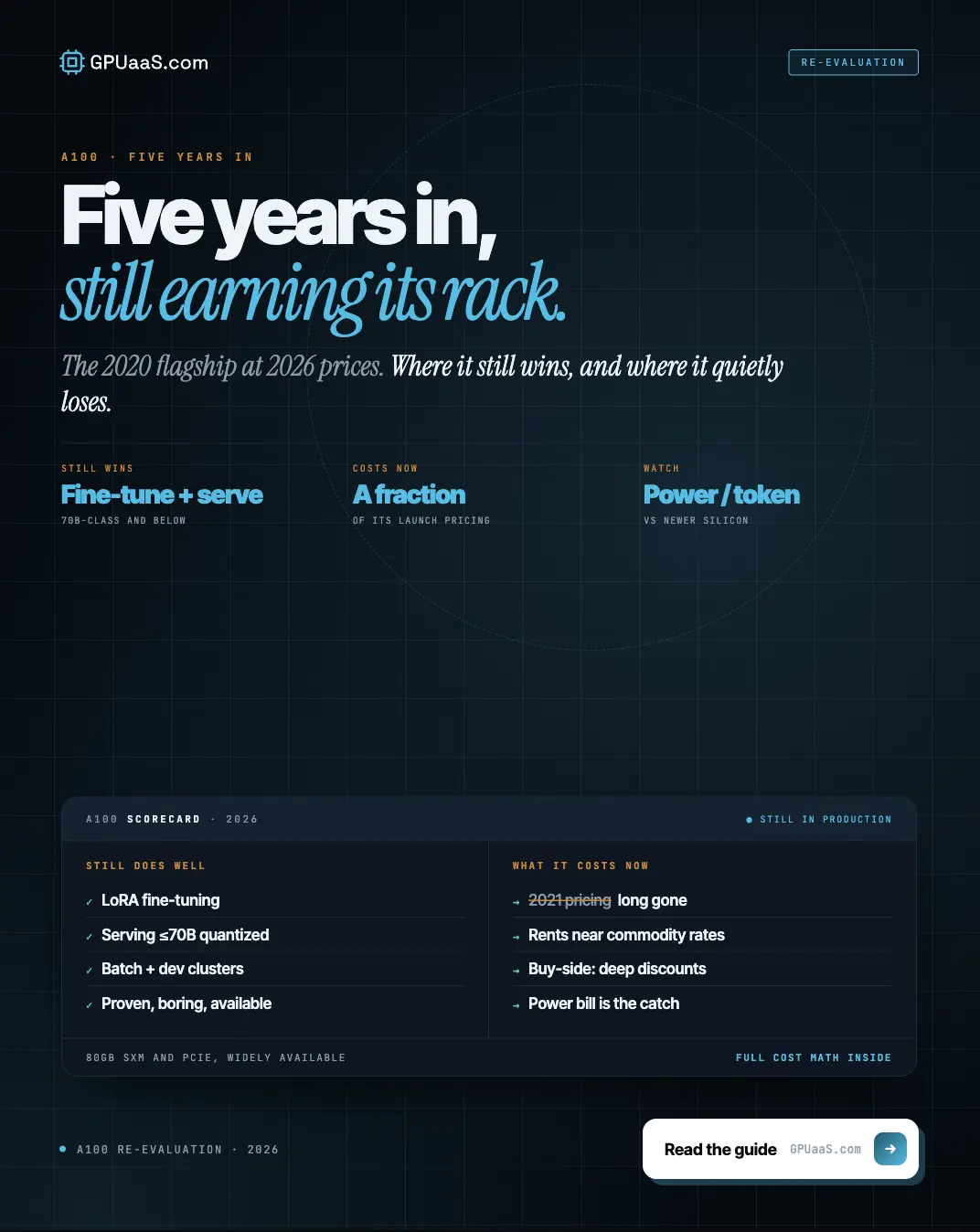
NVIDIA discontinued the A100 in January 2024. Rental pricing has held steady rather than falling, CoreWeave rents it through 2029, and FP64 still beats newer parts on scientific work.
A100 in 2026: What It Still Does Well and What It Costs Now
GPUaaS.com Team
GPU Infrastructure
August 24, 2026
No items found.
NVIDIA announced the A100's end of life in January 2024. All PCIe and SXM variants discontinued.
A100 rental pricing has held steady since, rather than depreciating. CoreWeave committed to renting A100 through 2029. On 13 August 2026, Jensen Huang described the A100 fleet as mission-capable from 2020 through 2029. A nine-year service life.
Key takeaways
End of life meant manufacturing stopped in January 2024. Rental pricing has held steady rather than falling, and CoreWeave has committed to renting A100 through 2029
Current rental runs roughly $1.09 to $5.07 per hour by channel. The spread between cheapest and most expensive A100 hour is wider than the A100-to-H100 gap at a single provider
FP64 at 19.5 TFLOPS makes A100 one of the few cloud-accessible GPUs for double-precision scientific computing, where even L40S does not match it
Used units trade at 40 to 60% off with no warranty and limited driver support. That discount is the price of support risk
Watch the NVIDIA AI Enterprise supported GPU list for the real deprecation signal. Infra 8.1 removed Volta in May 2026. Ampere has not been removed
◆ END OF LIFE DID NOT MEAN END OF DEMAND
The pricing did not behave as the phrase implies
End of life means manufacturing stopped. Renting did not stop, and the pricing has not behaved the way the phrase implies.
Current A100 rental: roughly $1.09 to $5.07 per hour by provider and channel. Rental prices for A100 and H100 have both been reported at all-time highs during 2026. Volta-based V100 pricing has also seen an upward bump. Scarcity in current-generation supply pushes demand backward into older parts, holding price up rather than pulling it down.
Akash marketplace, checked 16 August 2026: 222 A100 GPUs listed across seven independent providers.
◆ WHAT A100 COSTS IN 2026
Access route
Cost
Notes
Cloud rental
~$1.09-$5.07/hr
Range driven by channel, not hardware
New unit purchase
$5,000-$15,000
By form factor, as of March 2026
Used unit purchase
$2,000-$7,000
40-60% off, no warranty, limited driver support
Sources: Thunder Compute A100 guide (August 2026), March 2026 unit pricing data
◆ WHY A 2020 PART IS STILL IN SERVICE
CUDA keeps improving hardware that already shipped
CUDA backward compatibility is part of why the card keeps earning. The same toolchain keeps improving performance on Ampere silicon years after launch. Model-level optimization work has reduced the compute needed per workload rather than only shifting it to newer hardware.
◆ THE THING NEWER PARTS DO NOT DO
FP64 at 19.5 TFLOPS
FP64 Tensor Core performance: 19.5 TFLOPS. That makes A100 one of the few cloud-accessible GPUs suited to double-precision scientific computing. Molecular dynamics on GROMACS and NAMD, materials simulation on Quantum Espresso, computational fluid dynamics. Even L40S does not match it on these. A team running simulation rather than token generation is not choosing A100 as a compromise.
MIG partitions a single A100 into up to seven isolated instances. Each gets dedicated memory bandwidth, L2 cache, and CUDA cores. Each appears to the operating system as a separate device.
◆ THE CEILING IS HARD
No FP8, no Transformer Engine
The precision ceiling is hard. BF16 at 312 TFLOPS dense for training. INT8 and INT4 for inference quantization. No FP8, no Transformer Engine. Everything newer generations built around low-precision throughput is unavailable, and that gap widens each generation.
◆ TWO VARIANTS, AND THE CAPACITY TRAP
More memory does not mean faster
A100 ships in 40GB HBM2 and 80GB HBM2e configurations. The PCIe variant draws up to 300W through the slot and auxiliary connectors, with passive cooling that relies on server chassis airflow, which is part of why it integrates into existing infrastructure without a facility upgrade. That is a meaningful contrast with current-generation parts requiring direct liquid cooling.
The capacity trap is worth naming. An 80GB A100 running a 13B model sees no speedup over the 40GB variant. Memory bandwidth saturates long before capacity does, so paying for the larger card only helps when the model or the KV cache genuinely needs the headroom. Teams sizing on parameter count alone routinely overpay here.
Two form factors also exist at the system level. DGX A100 is the turnkey reference server with integrated CPUs and storage. HGX A100 is the OEM baseboard that Dell, HPE, and Supermicro build custom servers around. Most cloud A100 instances run on HGX-based infrastructure rather than DGX.
2020-2029
the A100 service window Jensen Huang described publicly on 13 August 2026, a nine-year lifespan on a part discontinued in January 2024
Jensen Huang public statement, 13 August 2026, alongside CoreWeave's commitment to rent A100 through 2029
◆ BUYING CHANGES THE RISK PROFILE
The used discount is priced support risk
Buying changes the risk profile. New A100 units listed $5,000 to $15,000 as of March 2026 by form factor. Used units trade at roughly 40 to 60% off, $2,000 to $7,000, with no warranty and limited driver support. That discount is the price of accepting support risk on a part NVIDIA stopped manufacturing two years ago.
There is a checkable precedent for how support actually ends. NVIDIA AI Enterprise Infra 8.1, May 2026, removed V100 and Volta from its supported GPU list. Those GPUs remain supported on the Infra 7.x LTSB branch for the remainder of that window. The Infra 4.10 LTSB branch reached end of life in July 2026. Ampere has not been removed. Watching the supported GPU list on each Infra release says more about A100's remaining runway than any vendor statement.
Hyperscalers disagree about how long this hardware lasts. Amazon shortened its GPU useful-life assumptions in the same quarter Meta extended them. Same technology, opposite conclusions.
The practical read for renting rather than buying: A100 is not a bargain-bin part and not obsolete. It is a supported, in-demand chip whose cost depends mostly on how it is rented. Channel matters more than generation, and the spread between the cheapest and most expensive A100 hour is wider than the gap between A100 and H100 at a single provider.
For the workload comparison against H100, including cost-per-job break-even math, the H100 vs A100 comparison covers that. What changed since is the market, not the silicon.
Get a current A100 quote, not a rate from six months ago.
Within 24 hours from a vetted provider. No buyer fees. For single GPUs, packet.ai handles self-serve access with 24/7 human support.
NVIDIA announced end of life in January 2024, discontinuing all PCIe and SXM variants. For renters that changed very little. Cloud availability remains strong, CoreWeave has committed to renting A100 through 2029, and rental pricing has held steady rather than depreciating.
Scarcity in current-generation supply pushes demand backward into older parts. Rental prices for both A100 and H100 have been reported at all-time highs during 2026, and even Volta-based V100 pricing has seen an upward bump. Discontinuation reduced supply without reducing demand.
Double-precision scientific computing. FP64 Tensor Core performance of 19.5 TFLOPS makes A100 one of the few cloud-accessible GPUs suited to molecular dynamics on GROMACS and NAMD, materials simulation on Quantum Espresso, and computational fluid dynamics, where even the L40S does not match it.
Used units trade at roughly 40 to 60% below new pricing, around $2,000 to $7,000, but carry no warranty and limited driver support. That discount is the price of accepting support risk on a part discontinued two years ago. Renting avoids that exposure entirely.
Watch the NVIDIA AI Enterprise supported GPU list on each Infra release. Infra 8.1 in May 2026 removed V100 and Volta, with those GPUs remaining supported only on the Infra 7.x LTSB branch. Ampere has not been removed. That list is a checkable signal rather than a vendor statement.
Last reviewed: 25 August 2026. End-of-life date and specification data from Thunder Compute's NVIDIA A100 guide, August 2026. Service-life statement and CoreWeave rental commitment reported 13 August 2026. Marketplace availability count from Akash's NVIDIA A100 GPU guide, checked 16 August 2026. Unit pricing from March 2026 market data. Support lifecycle detail from NVIDIA AI Enterprise end-of-life notices. Hyperscaler depreciation divergence from Hashrate Index's used GPU market analysis. Get an A100 cluster quote on GPUaaS.com.