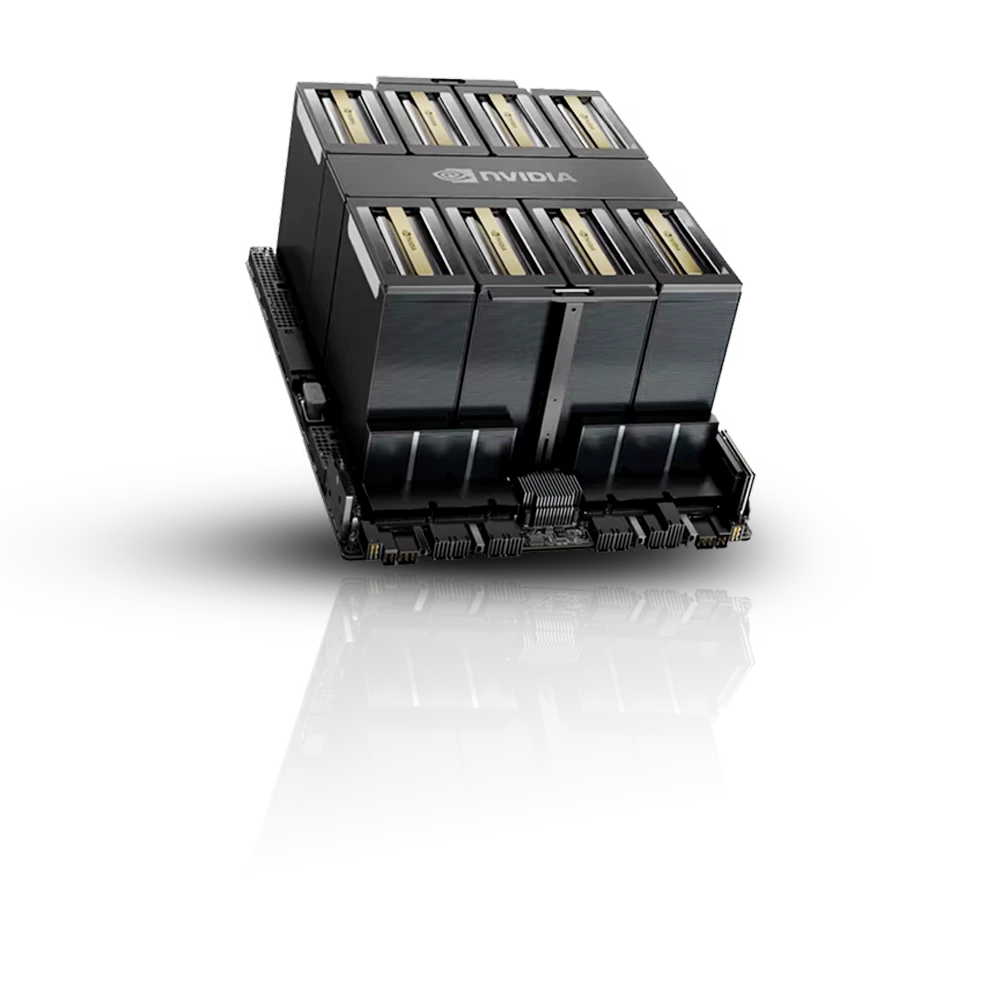
Fine-tuning starts from a pretrained model rather than random weights, which changes the resource math entirely compared to training from scratch. Most teams fine-tuning on H100 today use LoRA or QLoRA rather than updating every parameter: LoRA freezes the base model and trains small rank-decomposition matrices instead, cutting trainable parameters by 100x or more, while QLoRA adds 4-bit quantization of the frozen base model on top of that. The practical effect is that fine-tuning a 7B-70B model, which would need a multi-GPU cluster for full fine-tuning, often fits comfortably on a single H100 with LoRA. H100's 80GB of HBM3 and native FP8 support make it the common baseline for fine-tuning frameworks like Hugging Face PEFT and Axolotl. H200 for fine-tuning is worth the premium once your base model pushes past what comfortably fits in 80GB.
The core decision in fine-tuning is how much of the base model to actually touch. Full fine-tuning updates every parameter and needs optimizer state memory (roughly 4x parameter count for Adam) on top of the weights, gradients and activations, often forcing a multi-GPU setup even for mid-sized models. LoRA sidesteps this by freezing the base model and training only small adapter matrices injected into specific layers, typically cutting trainable parameters by 100x or more while keeping most of the base model's capability intact. QLoRA goes further, quantizing the frozen base model to 4-bit precision so an even larger base model fits in memory, with the adapters still trained at higher precision. On H100, this combination of 80GB HBM3 and native FP8 support means fine-tuning a 70B model with QLoRA is realistic on a single card, where full fine-tuning of the same model would need several.
Fine-tuning runs often use proprietary or sensitive training data, so where the GPU physically sits can matter as much as its specs. See H100 availability by country below.
Read the full guide to GPU cloud in this location →Wholesale rates against cloud list price for a 64-GPU cluster.
We connect you to our vetted partners. You contract directly with the operator running your nodes.
GPU model, count, placement and timeline. Add workload detail if you have it.
We find vetted partners with capacity that fits, in the jurisdiction you need.
Real quotes from partners who hold the capacity, not listings that may not exist.
You contract directly with the operator. We smooth the provisioning process.
Tell us the essentials. We'll line up real quotes from our vetted wholesale partners, and you contract directly with the operator.

GPUaaS.com connects enterprises with vetted GPU providers for large-scale compute at up to 30% lower cost than hyperscalers.


