Blog ▸ State of GPU Procurement Q3 2026: What We Observed, What Changed, What Comes Next
GPU Infrastructure
H100 prices spiked 40% then normalized. Blackwell split the market. Provider consolidation began on a real timeline. What actually happened in Q3 2026.
State of GPU Procurement Q3 2026: What We Observed, What Changed, What Comes Next
GPUaaS.com Team
GPU Infrastructure
August 13, 2026
No items found.
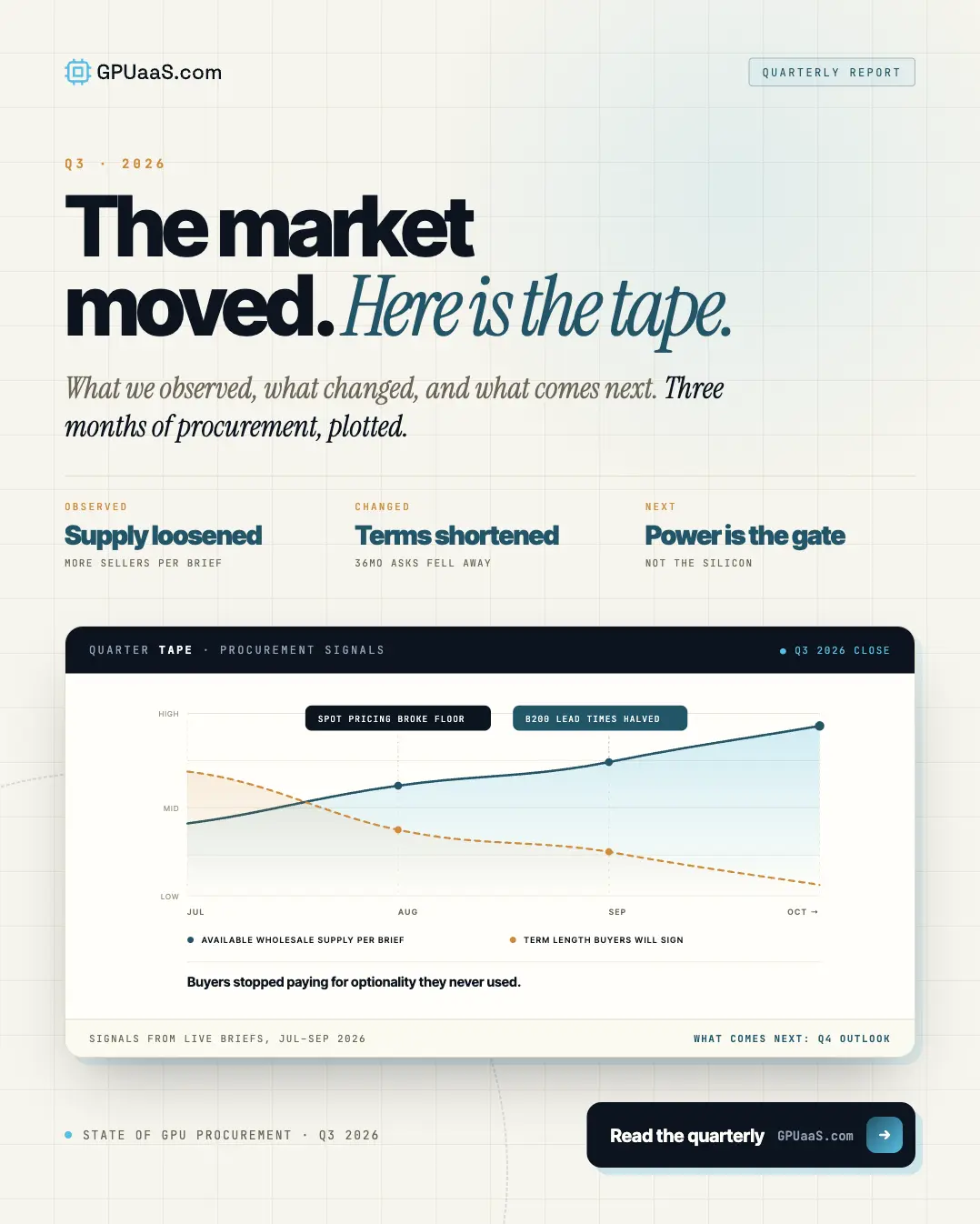
H100 rental prices rose roughly 40% between October 2025 and March 2026, driven by HBM memory shortages constraining production 30 to 70% and exploding inference demand. By early 2026, the market had absorbed that spike and settled into a $2.85 to $3.50 budget-tier range, a 64 to 75% decline from 2023 peaks above $8 an hour. Both of those things happened this quarter.
The market didn't move in one direction. It spiked, then normalized, and most single-point-in-time pricing claims from either side of that window are already stale.
Key takeaways
H100 rates spiked ~40% (Oct 2025-Mar 2026) then normalized to $2.85-$3.50/hr budget tier, a 64-75% decline from 2023 peaks
The two-tier pricing gap is wider than ever: AWS on-demand runs $6.88-$12.29/hr for H100, dedicated clouds median $4.17, specialist providers under $2.40
Most H100 and B200/B300 capacity is already pre-sold against 1-3 year commitments before it reaches any on-demand market
Blackwell split the market: H100/A100 are commoditizing while B200/GB200 stay supply-constrained, with on-demand pricing 42% above initial quotes in some channels
Provider consolidation has a real timeline now: initial exits in Q1-Q2 2026, enterprise renewal cycle pressure builds through Q3-Q4
◆ THE TWO-TIER GAP WIDENED THIS QUARTER
Same silicon, sorted by what's bundled on top
AWS charges roughly $6.88 to $12.29 per H100 GPU-hour on-demand. The median rate across dedicated GPU clouds sits around $4.17. Specialist providers push that lower still, RunPod's Secure Cloud at $2.39, some marketplace and long-tail listings under $1.50. That's not three prices for three different things. It's the same silicon, sorted by how much bundled service, brand recognition, and hyperscaler compliance certification sits on top of the raw hardware cost.
◆ THE "ELASTIC CLOUD" IS SHRINKING
Most capacity is already pre-sold
Reserved and committed pricing structures kept consuming more of the market this quarter. Most H100s and B200/B300s already in production are pre-sold against one-to-three-year financial commitments before that capacity ever reaches an on-demand marketplace. Neoclouds increasingly build capacity only after securing multi-year customer commitments, effectively pre-selling infrastructure before it physically exists. The public, elastic, on-demand GPU market most buyers picture is real, but it's the exception inside a market that has quietly reverted to something closer to long-term data center leasing.
◆ BLACKWELL SPLIT THE MARKET
Not just a new SKU, a genuine fork
Prior-generation hardware, H100 and A100, is becoming commoditized, available from dozens of providers at competitive rates that keep drifting down. Current-generation Blackwell hardware, B200 and GB200, remains supply-constrained, with on-demand pricing running 42% above initial quotes in some channels. That's a real strategic choice for any buyer sizing a workload right now: commoditized hardware at low unit cost running an older architecture, or premium-priced current hardware with meaningfully better performance-per-dollar on inference workloads that actually use what Blackwell does differently.
Consolidation began Q1-Q2, renewal pressure builds Q3-Q4
Utilization economics
Became the central survival variable for providers
$330K → $340K
the monthly swing on a real 1,024-GPU H100 cluster between 55% and 85% utilization, loss to gain, the same hardware and cost base throughout
American Compute 2026, via ModulEdge neocloud unit economics analysis
◆ UTILIZATION BECAME THE SURVIVAL VARIABLE
Why consolidation accelerated instead of slowing
Bare-metal gross margins run 55 to 65% before depreciation even enters the picture, which leaves almost no room to absorb sustained low utilization. Neoclouds sign multi-year take-or-pay contracts, borrow against those contracts, and then race hardware depreciation to the bank before the next generation arrives and resets the clock. That structure is exactly why provider consolidation accelerated this quarter rather than slowing down.
Provider consolidation is no longer a future risk this quarter, it's an observed pattern with a real timeline attached. Initial provider exits concentrated in Q1 and Q2 2026. The enterprise renewal cycle beginning in Q3 and Q4 is where the next wave of consolidation pressure shows up, as buyers with expiring contracts discover some of their original providers are no longer the same size, or no longer exist. Market structure is expected to solidify through 2027, which means the provider landscape a buyer signs with today may look meaningfully different by the time a multi-year contract comes up for renewal.
None of this changes the basic math a buyer should run before signing anything. Below roughly 30% utilization, renting still wins outright. Above roughly 75 to 80% sustained, owning starts to make sense. The market noise this quarter, the price spike, the Blackwell split, the consolidation wave, shifts the specific numbers inside that framework without changing the framework itself.
Get a quote reflecting where the market sits right now.
Not a rate card from six months ago. No buyer fees. For single GPUs, packet.ai handles self-serve access with 24/7 human support.
Both, at different points. Rates rose roughly 40% between October 2025 and March 2026 due to HBM shortages and inference demand, then normalized to a $2.85-$3.50/hr budget tier by early 2026, still a 64-75% decline from 2023 peaks above $8/hr.
Less than most buyers assume. Most H100 and B200/B300 capacity is pre-sold against one-to-three-year commitments before it ever reaches an on-demand market. Neoclouds increasingly build capacity only after securing multi-year customer commitments.
Not obsolete, but commoditizing. H100 and A100 are now available from dozens of providers at competitive, still-declining rates. They remain genuinely competitive for many workloads while Blackwell hardware stays supply-constrained and priced at a premium.
Because the provider landscape is actively consolidating. Initial exits concentrated in Q1-Q2 2026, with renewal-cycle pressure building through Q3-Q4. A provider signed with today may look different, in size or existence, by the time a multi-year contract comes up for renewal.
Submit a workload spec through GPUaaS.com and get matched with a vetted provider within 24 hours, reflecting real current market conditions rather than a static published rate.
Last reviewed: 14 August 2026. Pricing trend data from CompuX's GPU Pricing Trends 2026 report and IntuitionLabs' Data Center GPU Pricing 2026 index. Neocloud unit economics and utilization data from ModulEdge's Neocloud business analysis and American Compute's 2026 pricing observations. Consolidation timeline from Vultr's Great Neocloud Consolidation of 2026 analysis. Reserved capacity and pre-sale patterns from Cast AI's GPU Price 2026 Report. Browse current GPU cluster availability on GPUaaS.com.