Blog ▸ Why Most GPU Procurements Take Longer Than They Should (And the Fix Is Not More Budget)
GPU Infrastructure
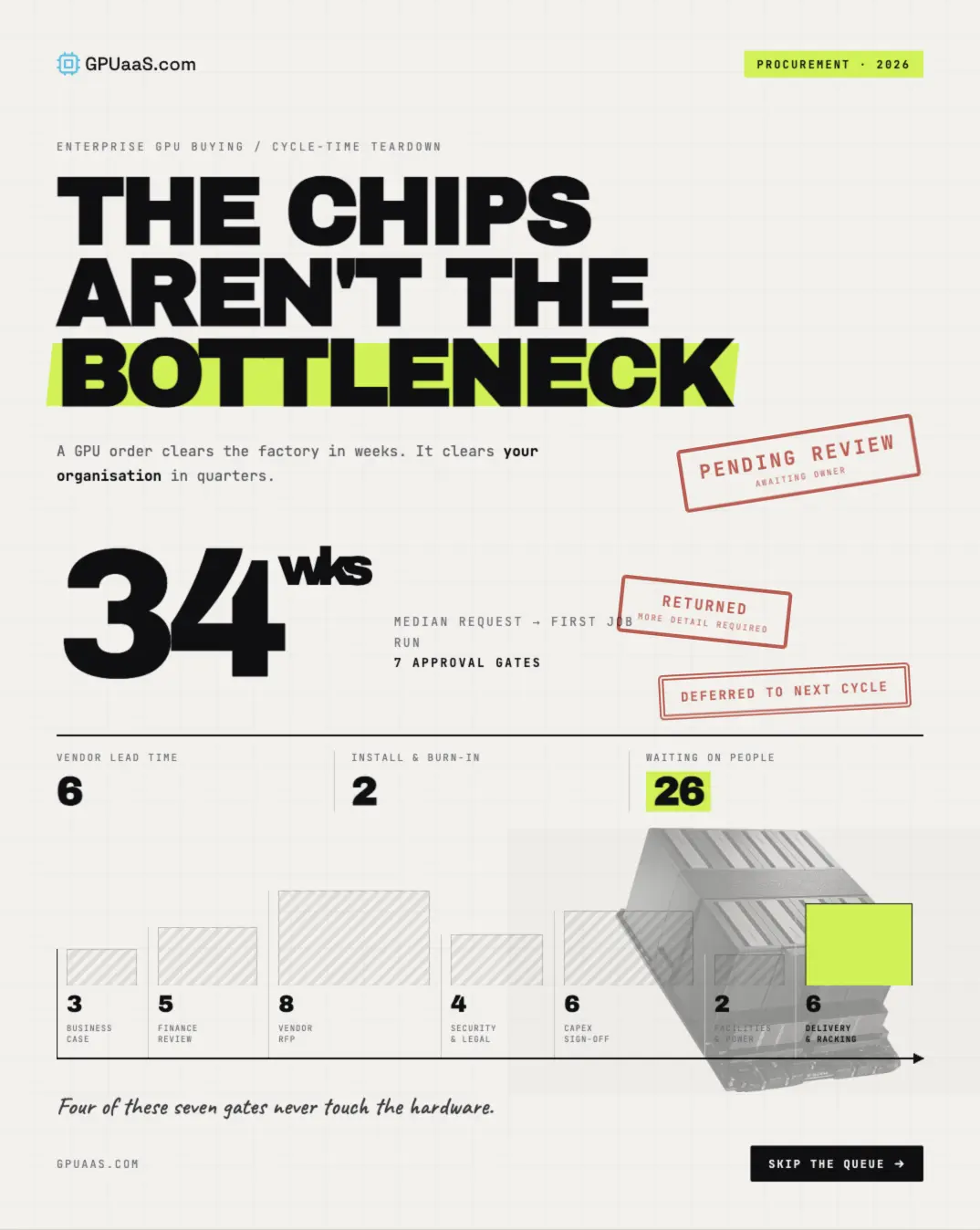
GPU procurement delays come from credit review, allocation queuing, unlisted capacity, and legal review, none of which show up in a quoted timeline. The fix is visibility, not more budget.
Why Most GPU Procurements Take Longer Than They Should (And the Fix Is Not More Budget)
GPUaaS.com Team
GPU Infrastructure
July 29, 2026
No items found.
A team was quoted four weeks for a dedicated GPU server. They planned around four weeks. At week ten, the hardware still wasn't racked.
Nobody lied about the timeline. The provider quoted the part they controlled and left out everything upstream of it.
Key takeaways
Credit and financial due diligence on dedicated GPU contracts can take 1 to 2 weeks, before any hardware allocation conversation even starts
Rack, power, cooling, and network coordination across facilities queues behind existing commitments if the exact configuration isn't pre-built
A meaningful share of real capacity never shows up in a standard RFQ, because it's never listed on any public marketplace in the first place
Legal review of egress terms, SLA language, and commitment penalties can add 2 to 3 weeks, especially with a new provider
The fix isn't more budget. It's compressing the distance between asking what's available and getting a real answer
◆ THE STEP NOBODY COUNTS
Credit check runs before the timeline starts
The credit check runs first. Almost nobody accounts for it in the plan. Dedicated GPU contracts carry real monthly spend. Providers run financial due diligence before committing capacity. That review alone can take one to two weeks. It happens before any hardware allocation conversation starts, not during it.
◆ ALLOCATION HAS ITS OWN QUEUE
Coordination, not a single lookup
After credit clears, allocation has its own chain. Confirming a specific rack has power, cooling, and network capacity isn't one lookup. It's coordination across facilities. If the exact configuration isn't already built, it queues behind whatever else that facility committed to first. The four-week quote usually assumes no queue exists.
◆ A COMMODITY PROCESS FOR A NON-COMMODITY MARKET
The RFQ cycle wasn't built for this
Most procurement teams still run a commodity buying process against a market that stopped behaving like a commodity. A standard RFQ goes out. Gets compared against three or four vendor responses. Moves through a six to twelve month planning and approval cycle. Built for a market where capacity sat on shelves waiting to be bought. Run against a market where a specific configuration can disappear in the time it takes to get budget sign-off.
The actual bottleneck sits earlier than most teams look. Not the check-writing step. Not usually the hardware itself. Not knowing what's available right now, at what rate, from which of a dozen providers, until someone runs the RFQ manually against each one and waits for replies one at a time.
◆ CAPACITY THE RFQ NEVER FINDS
Never listed, never visible to a standard process
A meaningful share of real capacity never shows up in that manual search. Providers with idle clusters they're not using internally quietly offer that capacity to external buyers. That inventory doesn't sit on any public marketplace. Doesn't respond to a standard RFQ. Never listed as available in the first place. A buyer running the traditional process can't find it. Not because it doesn't exist. Because the process was never built to look for it.
◆ LEGAL REVIEW, UNCOUNTED
Still in review while the clock keeps running
Contract review adds its own delay, rarely counted in the original timeline. Legal review of egress terms, SLA language, and commitment penalties can run two to three weeks on its own, especially the first time signing with a new provider. A team that assumed the four-week quote covered start to finish is often still in legal review in week five. The hardware step hasn't begun.
4 wks → 10 wks
the gap between a quoted deployment timeline and the actual timeline once credit review, allocation queuing, and legal review are counted
QuantaCloud dedicated GPU server deployment analysis, 2026
A number of large enterprises in finance and healthcare have started forming GPU procurement consortia. Pooling demand across organizations to negotiate priority access directly with cloud providers and hardware vendors. Instead of each buyer running its own slow individual process against the same constrained supply.
The teams shipping AI to production on schedule made one structural change most procurement teams haven't. They stopped treating GPU access as something the infrastructure team sorts out after the AI roadmap is already finalized. The access strategy has to be part of the AI strategy from the start.
That sequencing shift shows up concretely. The fastest teams complete credit and compliance review before a specific need exists, so it's not sitting in the critical path once a workload is ready. They pre-negotiate standard contract terms once, rather than re-litigating egress fees and SLA language every time a deal comes up. They keep live visibility into more than one provider's actual availability, instead of discovering what's real only after an RFQ goes out.
None of this is a budget problem. A team with an approved budget and a six-month RFQ cycle still loses to a team with the same budget and a same-day answer on what's actually available. The fix isn't spending more. It's compressing the distance between asking the question and getting a real answer, and removing the dependency steps sitting hidden upstream of the timeline anyone quotes.
Get a real answer in 24 hours, not a six-month RFQ.
Submit a spec, get a quote within 24 hours instead of running a manual RFQ process against providers one at a time. No buyer fees. For single GPUs, packet.ai handles self-serve access with 24/7 human support.
A quoted timeline usually covers only the part the provider directly controls. Credit and financial due diligence, facility coordination for power and cooling, and legal review of contract terms all sit outside that quote and can each add one to three weeks, none of which is typically included in the original estimate.
No. A team with a large approved budget running a six-month RFQ cycle still loses to a team with the same budget getting a same-day answer on real availability. The bottleneck is visibility and process speed, not the size of the budget behind the request.
A meaningful share of GPU capacity is held by providers with idle clusters open to external buyers, but that inventory is never listed on any public marketplace. A standard RFQ process only reaches providers who publish availability, missing this off-market capacity entirely.
A number of large enterprises, particularly in finance and healthcare, have started pooling demand across organizations to negotiate priority access directly with cloud providers and hardware vendors, rather than each buyer running its own individual procurement process against the same constrained supply.
Submit a workload spec and GPUaaS returns a quote from a vetted provider within 24 hours, including capacity that isn't publicly listed, compressing the manual RFQ step that normally takes weeks into a single submission.
Last reviewed: 30 July 2026. Deployment timeline data from QuantaCloud's dedicated GPU server deployment analysis, 2026. Procurement sequencing framework from Vamsi Talks Tech's GPU Supply Chain Crisis report, 2026. Consortium buying patterns from Windows News Enterprise AI Capacity Wall analysis, 2026. Browse current GPU cluster availability on GPUaaS.com.