Blog ▸ InfiniBand vs Ethernet in 2026: The Bottleneck Nobody Priced
GPU Infrastructure
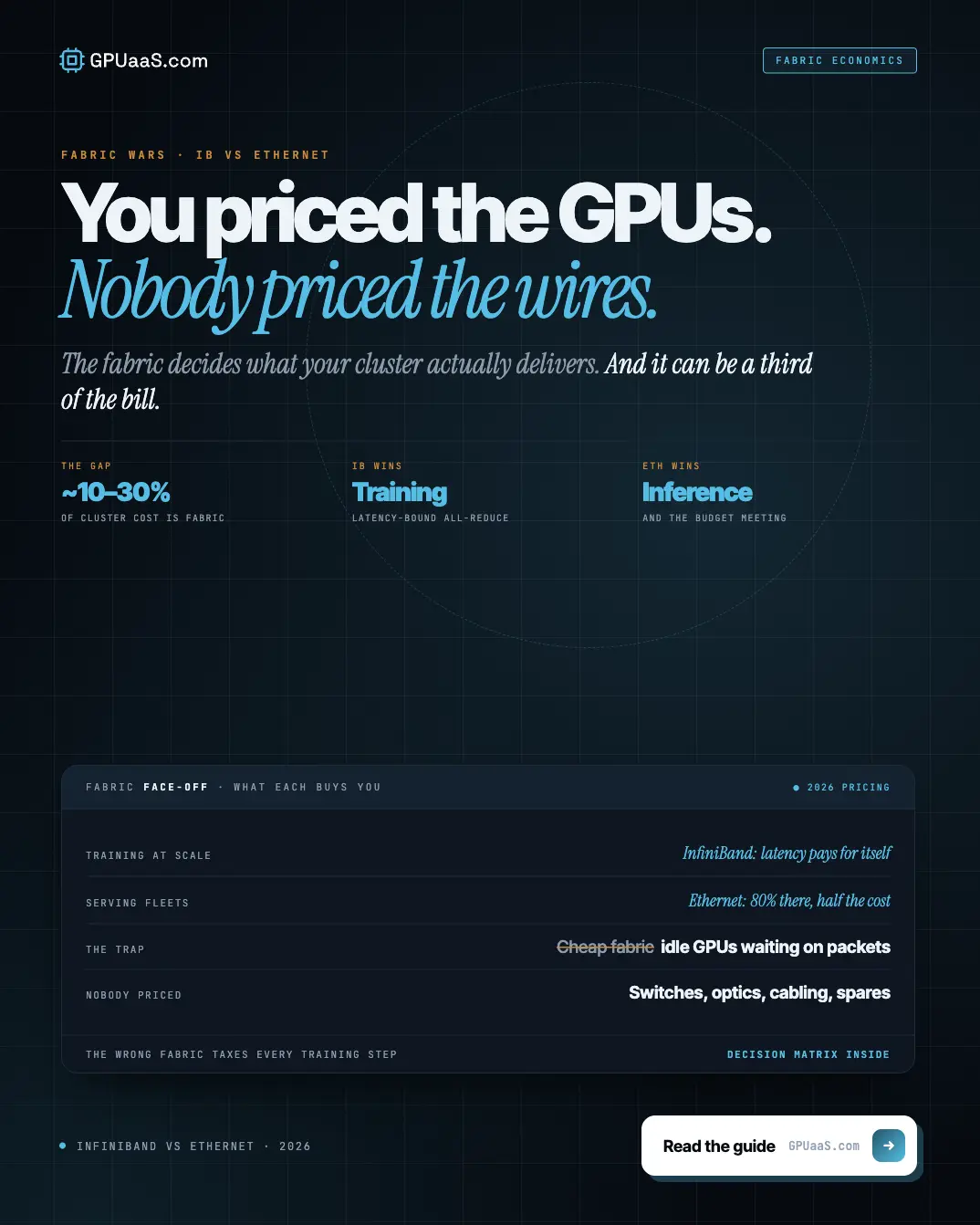
A 512-GPU cluster costs $2.24 million more on InfiniBand over three years. The gap is 5 to 15% on training and under 1.02% on inference.
InfiniBand vs Ethernet in 2026: The Bottleneck Nobody Priced
GPUaaS.com Team
GPU Infrastructure
September 9, 2026
No items found.
A 512-GPU cluster on InfiniBand costs roughly $4.61 million over three years. The same cluster on Ethernet costs roughly $2.37 million.
The $2.24 million difference funds 64 more H100s and the networking to run them.
Key takeaways
The bottleneck nobody prices is not the fabric. It is the measurement that tells you which fabric you need: what fraction of step time is communication
InfiniBand wins all-reduce by 20-25%, but tuned RoCEv2 delivers 85-95% of InfiniBand throughput across full training runs
For inference, an independent WWT test measured end-to-end delta at under 1.02%. The premium is very hard to justify on serving workloads
Meta trained its largest models on RoCE Ethernet across 24,000 GPUs, a scale the industry assumed required InfiniBand
Tail latency under contention, not average latency, determines AllReduce completion time, because the cluster waits for the last node
◆ THE MEASUREMENT THAT SETTLES IT
Not the fabric. The number nobody collects.
The performance gap that premium buys is 5 to 15% on typical training workloads. Whether that trade is worth making depends on one number most teams never measure: what fraction of step time their workload actually spends on communication.
That is the bottleneck nobody prices. Not the fabric. The measurement that tells you which fabric you need.
Worth noting those TCO figures come from Vitex, a vendor selling Ethernet networking gear, so read the exact numbers as directionally useful rather than neutral. The direction itself is corroborated widely: InfiniBand carries a premium in the range of $1.2 million on hardware and $1.4 million on three-year TCO at 512 GPUs.
◆ WHERE THE GAP IS, AND WHERE IT ISN'T
Measurement
InfiniBand NDR
Tuned RoCEv2
NCCL all-reduce, 8x H100
~350 GB/s
270-290 GB/s
Full training throughput
Baseline
85-95% of baseline
64+ GPUs, 100B+ models
15-20% better
Behind
8-32 GPUs, under 70B
Comparable
Comparable
Inference and generative serving
Baseline
Within 1.02%
End-to-end latency
~1 µs
1.5-2.5 µs
Switch hop latency
200-300 ns
Higher
Sources: Spheron GPU networking decision guide (April 2026), WWT independent test via Servnet UK analysis (August 2026), Vitex InfiniBand vs Ethernet TCO model
◆ A GAP ON ALL-REDUCE IS NOT A GAP ON TRAINING TIME
It only becomes one if all-reduce dominates the step
The raw performance difference is real and measurable. NCCL all-reduce on eight H100 SXM5 GPUs achieves roughly 350 GB/s of effective bus bandwidth on InfiniBand NDR 400G. The same cluster on 400GbE RoCEv2 gets 270 to 290 GB/s. That is a 20 to 25% gap on the collective operation itself.
But a 20 to 25% gap on all-reduce is not a 20 to 25% gap on training time. It only becomes that if all-reduce dominates the step. Most workloads it does not.
Across full training runs, properly tuned RoCEv2 delivers 85 to 95% of InfiniBand throughput. On 64-plus GPU clusters training 100B-plus parameter models, InfiniBand typically delivers 15 to 20% better throughput. On 8 to 32 GPU setups, or models under 70B, well-tuned RoCEv2 comes out comparable.
1.02%
the end-to-end performance delta between InfiniBand and Ethernet on real generative AI and inference workloads in independent testing, which makes the premium very hard to justify for serving
World Wide Technology independent test, cited in Servnet UK 800G AI fabric analysis, August 2026
◆ FOR INFERENCE THE PICTURE CHANGES COMPLETELY
The finding most likely to save someone money
An independent World Wide Technology test measured end-to-end performance delta on real generative AI and inference workloads at under 1%, specifically 1.02% in most cases. Spec-sheet microsecond gaps mostly do not translate into job completion differences on inference and generative serving.
If the cluster is serving rather than training, the InfiniBand premium is very hard to justify on performance grounds.
◆ WHY THE TRAINING GAP EXISTS
Flow control and routing, both closing
InfiniBand uses credit-based flow control, which is lossless by design. RoCEv2 achieves lossless behaviour through priority flow control and explicit congestion notification working together, tuned with DCQCN. Both are required. PFC alone produces head-of-line blocking. ECN alone produces packet drops at congestion. Getting that configuration right is real work, and getting it wrong is expensive: on a 1,024-GPU H100 cluster, every 1% packet drop costs roughly $250,000 in lost training time per week.
InfiniBand also has adaptive routing built into the fabric. Ethernet relies on ECMP and flowlet switching, which can create hotspots under static hashing. Adaptive load balancing on Tomahawk 4 and 5 silicon rebinds flows based on real-time congestion, and a well-run fabric can target above 90% utilisation. That is a design target rather than a measured guarantee, and worth treating as such.
◆ THE PROPERTY THAT MATTERS MOST GETS LEAST ATTENTION
Tail latency, not average latency
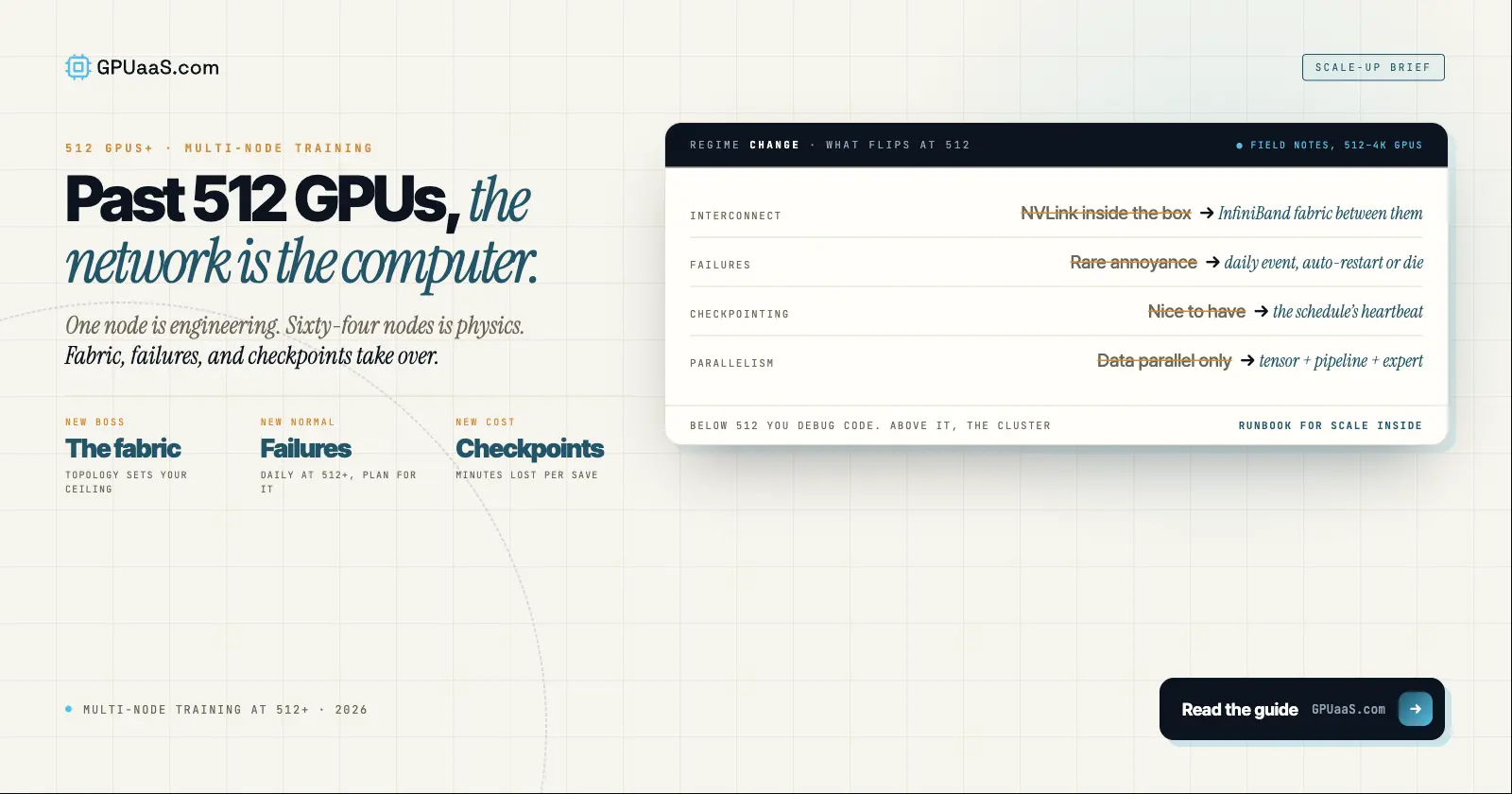
Tail latency under contention is what determines AllReduce completion time across thousands of GPUs, because the entire cluster waits for the last node to finish each synchronisation. Average latency is not the metric. The worst case is. This is the same mechanism that makes a single fail-slow node gate an entire 512-GPU training job, covered in multi-node training at 512 GPUs and above, and it is why InfiniBand's graceful behaviour during incast events shows up in job completion time rather than in benchmark averages.
◆ THE SCALE ARGUMENT HAS LARGELY COLLAPSED
24,000 GPUs on Ethernet
Meta has described training its largest models over a RoCE Ethernet fabric on a 24,000-GPU cluster. That is a size the industry previously assumed required InfiniBand. Meta, Microsoft, and AWS have all converged on RoCEv2, primarily for operational reasons rather than cost.
Those operational reasons are worth weighing properly. InfiniBand requires specialised operators, separate infrastructure, and a single-vendor supply chain. RoCEv2 runs on Ethernet and BGP that most infrastructure teams already operate. For a team without dedicated fabric engineers, that difference is larger than it looks on a spreadsheet.
Spectrum-X sits between the two and is worth knowing about. It combines Spectrum-4 switches with ConnectX-7 NICs and proprietary adaptive routing, closing roughly 80 to 90% of the gap with InfiniBand NDR on NCCL all-reduce while running standard 800GbE hardware. The adaptive routing benefits require both ends to be Spectrum-X, but the switches themselves interoperate with non-NVIDIA Ethernet gear.
◆ THE DECISION RULE
Measure the communication share first
Run NCCL benchmarks on the actual workload and measure what fraction of step time is communication. If communication is a small share, the fabric choice barely matters and Ethernet wins on cost by a wide margin. If communication dominates and the cluster is at frontier training scale with thousands of GPUs, InfiniBand's latency floor and incast behaviour justify the premium, because a small regression multiplied across a very large synchronised job costs more in wasted GPU-hours than the fabric premium.
If the workload is inference, the WWT result suggests the question is close to settled.
That benchmark run takes hours. The decision it informs runs into millions.
Get quoted on both fabric options against your workload.
Not the spec sheet. No buyer fees. For single GPUs, packet.ai handles self-serve access with 24/7 human support.
Yes, but by less than the all-reduce numbers suggest. InfiniBand NDR achieves roughly 350 GB/s on NCCL all-reduce against 270-290 GB/s for RoCEv2, a 20-25% gap on that operation. Across full training runs, tuned RoCEv2 delivers 85-95% of InfiniBand throughput, because all-reduce rarely dominates the step.
At 512 GPUs, roughly $4.61 million three-year TCO against $2.37 million for Ethernet, a $2.24 million difference that would fund 64 additional H100s. Those figures come from an Ethernet networking vendor, so treat them as directional, but the premium is corroborated broadly at around $1.2 million on hardware.
Much less than for training. Independent testing measured end-to-end delta on real generative AI and inference workloads at 1.02%. Microsecond gaps on spec sheets largely do not translate into job completion differences on serving workloads, so the InfiniBand premium is hard to justify there.
Yes. Meta has described training its largest models over a RoCE Ethernet fabric on a 24,000-GPU cluster, a scale previously assumed to require InfiniBand. Meta, Microsoft, and AWS have all converged on RoCEv2, primarily for operational rather than cost reasons.
NVIDIA's end-to-end Ethernet AI fabric, combining Spectrum-4 switches with ConnectX-7 NICs and proprietary adaptive routing. It closes roughly 80-90% of the gap with InfiniBand NDR on NCCL all-reduce while running standard 800GbE hardware. The routing benefits require both ends to be Spectrum-X, though the switches interoperate with non-NVIDIA gear.
Last reviewed: 10 September 2026. NCCL benchmark figures and Spectrum-X analysis from Spheron's GPU networking decision guide, April 2026. TCO model from Vitex Technology's InfiniBand vs Ethernet analysis, noting Vitex sells Ethernet networking hardware. Independent WWT test result cited via Servnet UK's 800G AI back-end fabric analysis, August 2026. Meta 24,000-GPU RoCE deployment and adaptive load balancing detail from IP Infusion's RoCE vs InfiniBand analysis, July 2026. Packet drop cost and lossless configuration requirements from NetPilot's RoCEv2 vs InfiniBand guide, April 2026. Tail latency and incast behaviour from Inflect's GPU cluster networking analysis, June 2026. Browse current GPU cluster availability on GPUaaS.com.