Blog ▸ Why GPU Deals Fail: The Most Common Mistakes in Enterprise AI Compute Procurement
GPU Infrastructure
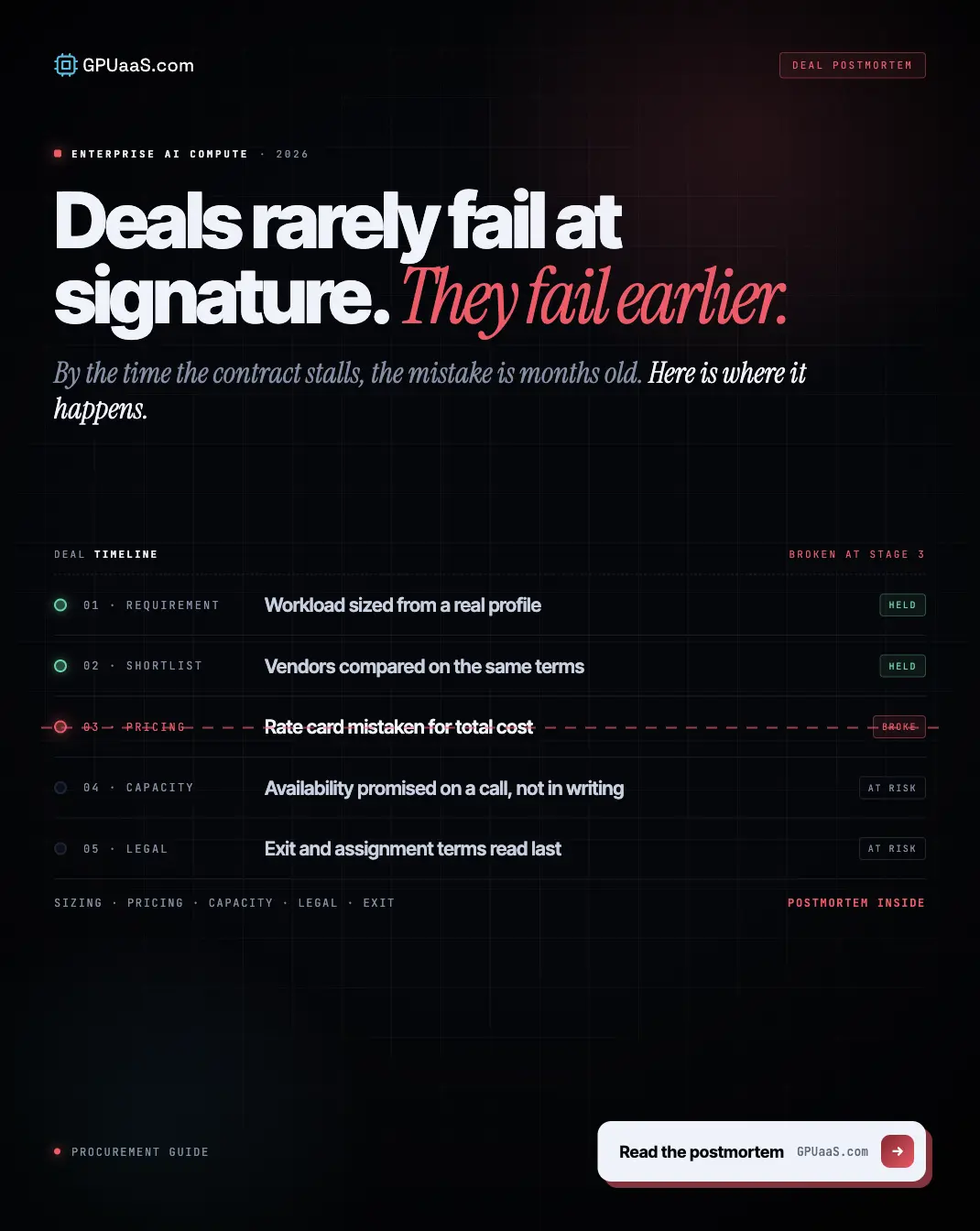
GPU deals fail after signing more often than during negotiation, from financing terms mismatched to hardware lifespan to SLA credits that read as full protection but are not.
Why GPU Deals Fail: The Most Common Mistakes in Enterprise AI Compute Procurement
GPUaaS.com Team
GPU Infrastructure
August 6, 2026
No items found.
A GPU cluster deal reached signature in October. 4-year amortization on the term sheet. The lender's credit model assumed the hardware would hold competitive value across that whole period.
It didn't. The next architecture reached general availability fourteen months later. By month eighteen, the financed hardware was running workloads at a cost-per-token disadvantage against newer capacity renting for less per hour.
Key takeaways
Standard infrastructure financing runs 3 to 5 years. A GPU generation holds a real competitive edge for roughly 2 to 3, a mismatch that quietly breaks deals financed against the longer number
A contract with no defined burst allowance means usage above committed baseline bills at open-market overage rates, sometimes 2 to 3x the negotiated price
Multi-vendor bidding typically cuts costs 15 to 20%. Negotiating hard against one vendor's number, with no benchmark, gives no way to know if that number was actually good
Standard SLA language, including Nebius's published terms, states the credit is the sole and exclusive remedy, not a starting point for a separate claim over a stalled run or missed launch
On-demand availability isn't covered by uptime SLAs at all. A provider with no capacity for a requested instance isn't in breach, even though the buyer's workload can't run
◆ THE FINANCING MISMATCH
Nobody was careless, the assumption was stale
Nobody on the credit committee was being careless here. Financing teams model asset life against historical depreciation curves, and GPU generations didn't used to turn over this fast. The problem is the assumption is stale, not that anyone was sloppy. Standard infrastructure financing runs 3 to 5 years. A GPU generation holds a real competitive edge for maybe 2 to 3. Price a loan against the longer number and the mismatch sits there quietly until the numbers stop working, usually around month eighteen, which is exactly when it did here.
◆ THE OVERAGE CLAUSE NOBODY NEGOTIATED
A normal ask most teams never make
The same deal had a second gap that only got noticed once the first one blew up the spreadsheet. No burst allowance in the overage clause. The first month usage spiked past committed baseline, the excess billed at open-market rates, two to three times what the contract paid on the committed hours. Nobody had asked for a defined burst percentage during negotiation. It's a normal ask. Most providers grant it. This team just never made it.
◆ THE UNBENCHMARKED QUOTE
A hard-won negotiation with no way to know if it was good
And a third thing, smaller but not nothing: they'd negotiated against one vendor's quote for six weeks and never benchmarked it against a second one. Multi-vendor bidding on comparable deals typically runs 15 to 20% cheaper. They walked away feeling like they'd won a hard negotiation. They had no way to know whether that was true.
◆ THE SLA CREDIT THAT ISN'T A CLAIM
Sole and exclusive remedy, read literally
A separate deal failed after signing for a reason that had nothing to do with negotiation at all, and this one's worth sitting with because it's genuinely counterintuitive. The buyer assumed their 99.9% uptime SLA meant the provider was on the hook if a job stalled. Standard industry SLA language, Nebius's terms among them, states it plainly: the credit is the sole and exclusive remedy. Not a starting point for a claim. The entire claim. A stalled training run, a missed launch date, a customer escalation triggered by the outage, none of it is separately recoverable. Run the math on what that credit is actually worth. An 8-GPU cluster running $15,000 a month, hit with a serious uptime miss, gets a 30% credit, roughly $4,500, refunded as future compute rather than cash.
The gap gets worse before it gets better. On-demand availability isn't covered by the uptime SLA at all. If a buyer requests an on-demand instance and the provider has no capacity, that's not downtime in the contract's eyes, even though the buyer's workload can't run. The SLA only protects hardware already provisioned. It offers zero protection against the broader capacity crunch that's often the actual reason a workload can't start on schedule.
$4,500
the typical SLA credit for a serious uptime miss on a $15,000/month 8-GPU cluster, roughly 30%, refunded as future compute, not cash, and the entire remedy available under most standard contracts
Spheron GPU Cloud SLA Guarantees 2026
◆ WHERE THESE DEALS ACTUALLY FAILED
Failure point
When it surfaces
Financing term vs. hardware lifespan
Around month 18, once resale/competitiveness gap opens
No burst allowance in overage clause
First month usage exceeds committed baseline
Single-vendor, unbenchmarked quote
Never surfaces, buyer never learns the true cost
SLA credit assumed to cover damages
First real outage during a critical run
On-demand capacity assumed SLA-covered
Workload can't start, no contractual recourse
None of these failures required bad luck. Each one required someone on the buying side to know a specific term to ask for, or to read a specific clause literally instead of assuming it meant something more generous than it said.
Get a quote structured around these terms from the start.
Not discovered after signing. No buyer fees. For single GPUs, packet.ai handles self-serve access with 24/7 human support.
Standard infrastructure financing runs 3 to 5 years, while a GPU generation holds a real competitive edge for roughly 2 to 3. A loan priced against the longer term can look fine at signing but stop making sense once the hardware falls behind newer, cheaper capacity, usually within the first 18 months.
A negotiated allowance, typically 10 to 20% above committed capacity, billed at a pre-agreed rate rather than open-market overage pricing. Without one, any usage spike above baseline can bill at 2 to 3 times the negotiated rate, and most providers will grant this term if a buyer simply asks for it.
Rarely in full. Standard SLA language states the credit is the sole and exclusive remedy, meaning a buyer cannot separately claim the cost of a stalled run or missed launch. On a $15,000/month cluster, a serious uptime miss might credit roughly $4,500 in future compute, well below the real cost of a failed multi-day training job.
No. Uptime SLAs only cover hardware already provisioned. If a provider has no capacity for a requested on-demand instance, that is not a breach of the uptime SLA, even though the workload cannot run. This gap offers no protection against broader capacity shortages.
Submit a workload spec and GPUaaS returns a competitive quote from a vetted provider within 24 hours, with terms structured against these known failure points from the start rather than discovered after signing.
Last reviewed: 7 August 2026. SLA remedy and credit structure data from Spheron's GPU Cloud SLA Guarantees 2026 guide and Lyceum Technology's GPU Cloud SLA Uptime Comparison 2026. Contract negotiation and overage clause data from Spheron's GPU Cluster Reservation Contracts negotiation guide. Financing and depreciation mismatch analysis from EnkiAI's Semiconductors & AI Chips 2026 report. Browse current GPU cluster availability on GPUaaS.com.