Blog ▸ What Smart Enterprises Are Doing Differently in GPU Procurement Right Now
GPU Infrastructure
Multi-provider strategy, shorter commitments, and workload-specific procurement paths are replacing single-vendor, multi-year GPU contracts. Here is the pattern.
What Smart Enterprises Are Doing Differently in GPU Procurement Right Now
GPUaaS.com Team
GPU Infrastructure
July 9, 2026
No items found.
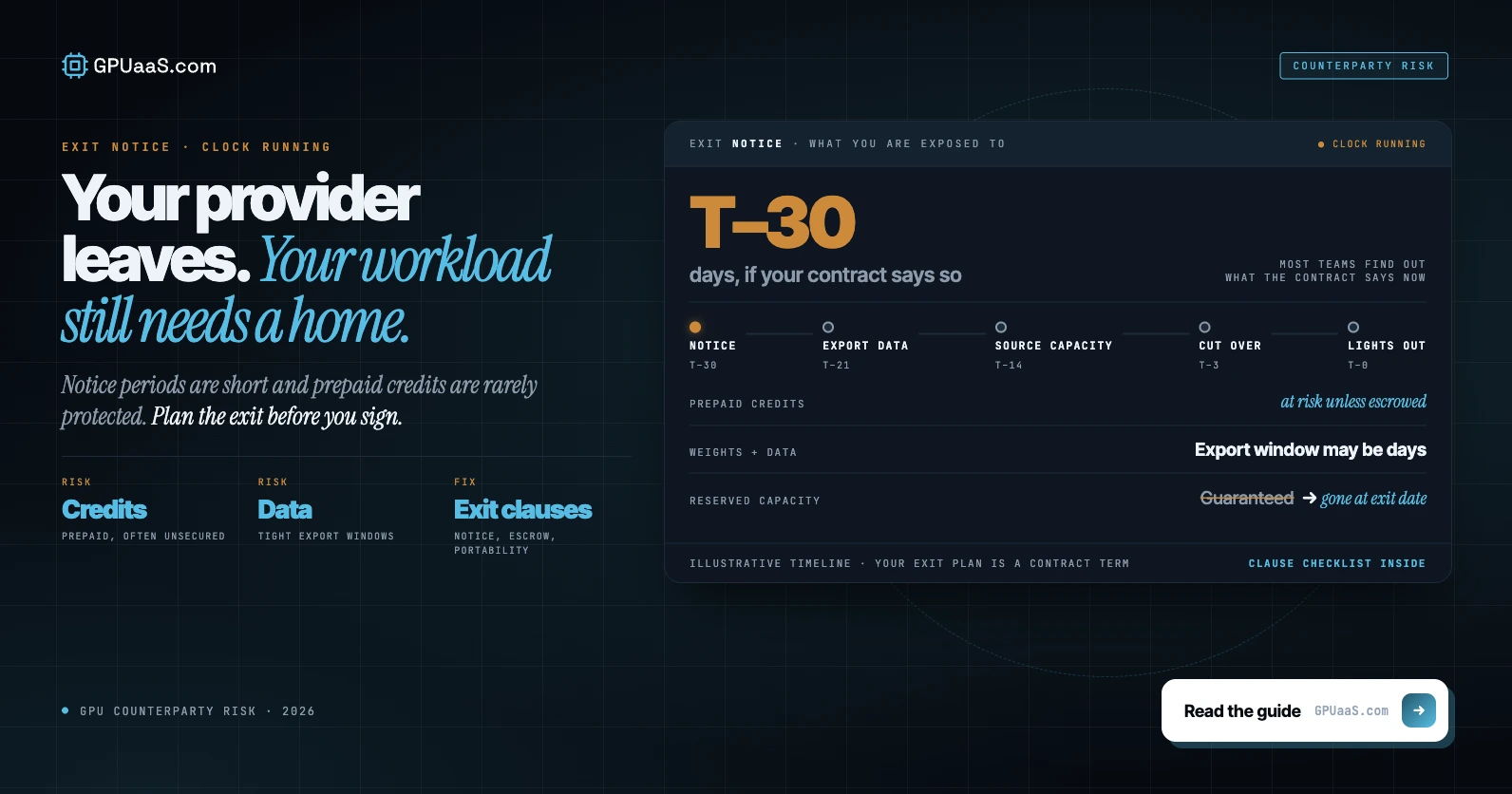
Two enterprise teams needed the same capacity in the same month. One had a single vendor relationship and a three-year contract signed against a forecast from 2024. The other had quotes from four providers on file, a 12-month cap on any single commitment, and separate procurement paths for training, inference, and burst work.
The first team spent six weeks trying to get their existing vendor to flex on terms that no longer matched their workload. The second team picked from four live quotes and moved in a week.
Same market. Same scarcity. Different starting position.
Key takeaways
All H100, H200, and B200 capacity coming online through late 2026 is already committed. A single long-term bet against last year's forecast does not flex when the workload changes
Twelve months is the practical commitment ceiling teams are negotiating toward now, not the three-year defaults common a year ago
The short end of the market has genuinely tightened. Providers are generally unwilling to sign under six months for H100 or H200 capacity in 2026
Training, inference, and burst compute have different ideal procurement paths. Running all three on one contract is a measurable cost most finance teams now track directly
Competitive bidding across multiple providers on the same spec reduces cost 15 to 20% against the first quote offered
◆ WHY ONE PATH NO LONGER WORKS
A mixed strategy against the split that actually exists
The old default was picking one path and locking in for years. That default breaks down in a market where H100, H200, and B200 capacity coming online through the rest of 2026 is already committed. A single long-term bet made against 2024's forecast doesn't flex when the workload changes, and workloads change constantly.
The teams doing this well aren't waiting for the market to loosen up. They're running a mixed strategy against the split that actually exists. Commodity providers for workloads that can live there. Committed capacity only for workloads that genuinely need the guaranteed window. Nobody's betting the whole budget on one lane.
Commitment length is where the pattern shows up most clearly. Twelve months is the practical ceiling teams are negotiating toward now, not the three-year defaults from a year ago. Below that ceiling, volume commitment floors and exit provisions matter more than the headline discount. Enterprise negotiation desks at the major clouds offer real numbers below published reserved pricing, but only for teams that ask, and asking requires knowing the published rate isn't the floor.
The commitment length conversation has a real complication worth naming honestly. The short end of the market has genuinely tightened. A year ago, monthly terms existed for premium GPUs. Now providers are generally unwilling to sign under six months for H100 or H200 capacity, because on-demand rental is close to sold out and providers would rather renew existing contracts than release capacity back to the open market. Twelve months isn't a target because shorter options got worse. It's a target because six months is close to the new floor, and going past twelve buys a discount at the cost of flexibility most teams don't actually need.
◆ PATTERN 2: WORKLOAD SEPARATION
Training, inference, and burst are not one resource pool
Most enterprise teams still run training, inference, and burst compute on the same cluster, the same contract, the same commitment terms. That consolidation made sense when GPU access was scarce enough that teams took whatever they could get. It stopped making sense once the cost of treating three different workload types as one resource pool became a line item finance actually notices. Training needs dedicated capacity reserved for the run itself. Inference needs smaller configurations scaled horizontally, placed near where requests originate. Burst work needs capacity that shows up for the job and disappears when it's done. Forward-looking teams aren't waiting for supply to ease before separating these. They're doing it now, because the cost of not separating them is already measurable.
◆ PATTERN 3: MULTI-PROVIDER RELATIONSHIPS
One quote is a price. Four quotes are leverage
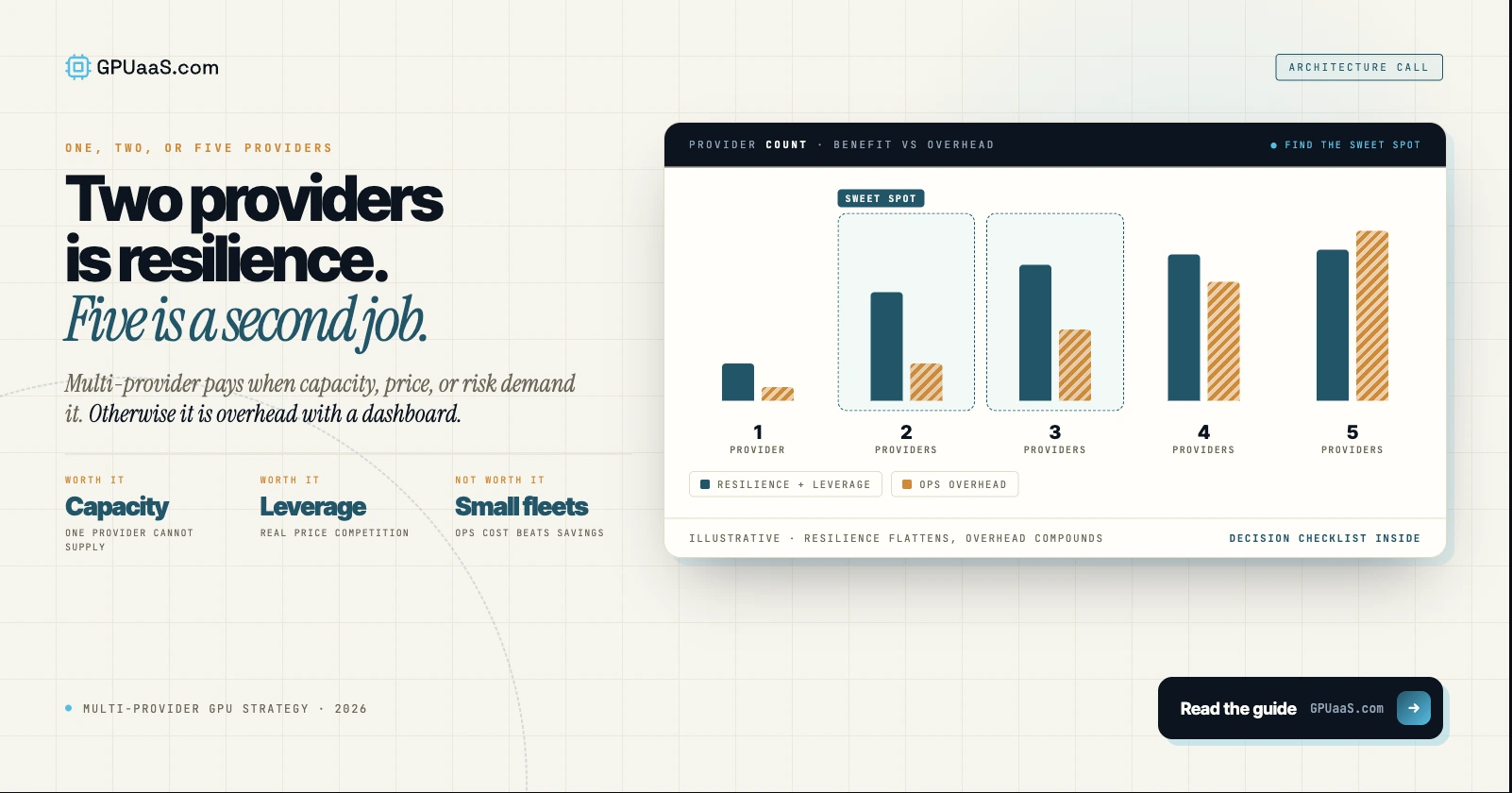
Multi-provider relationships are the third pattern, and they're the reason the second team in the opening story moved in a week instead of six. A quote from a single vendor is a price. Quotes from four vendors on the same spec are a negotiating position. Competitive bidding between providers has been shown to reduce costs 15 to 20% against the first number offered, and that number only exists if more than one provider is actually competing for the business.
15-20%
the typical cost reduction from competitive bidding across multiple GPU providers on the same workload spec, compared to accepting the first quote
Introl GPU Procurement Strategies report, 2026
◆ OLD DEFAULT VS. CURRENT PATTERN
Dimension
Old default
Current pattern
Commitment length
1-3 year lock-in
12-month ceiling, negotiated terms
Provider relationships
Single vendor
Multiple, competing quotes on file
Workload handling
One cluster for everything
Training, inference, burst split by need
Pricing approach
Accept published rate
Negotiate below list, competitive bid
None of this waits for the broader market to rebalance. Supply might catch up. Memory constraints might ease. Specialized inference silicon might pull demand off the tightest GPU tiers. All of that is possible and none of it is worth betting a 2026 budget on. What's certain is that the enterprises treating procurement and workload management as one connected problem, instead of two separate budget line items, are the ones not stuck holding a three-year contract that no longer fits.
Build the negotiating position, not just one relationship.
Submit a spec once, get quotes from multiple vetted providers within 24 hours. No buyer fees. For single GPUs, packet.ai handles self-serve access with 24/7 human support.
No, but the shortest options have gotten harder to secure. Providers are generally unwilling to sign under six months for H100 or H200 capacity in 2026, since on-demand rental is close to sold out. Twelve months is a practical ceiling to negotiate toward, balancing discount against flexibility, not a floor imposed by the market.
Each has different ideal infrastructure and commitment profiles. Training needs dedicated capacity for the run's duration. Inference needs smaller, horizontally scaled capacity near request origin. Burst work needs short-term access that releases when done. Running all three through one contract means overpaying on whichever workload doesn't match that commitment's shape.
Roughly 15 to 20% below the first quote offered, based on industry procurement data. That gap only materializes when more than one provider is genuinely competing for the business, which requires having multiple provider relationships and quotes in hand rather than negotiating with a single vendor in isolation.
Most enterprises benefit from having at least one alternative relationship in place, even if their primary provider remains the default choice. The value isn't necessarily in splitting spend evenly, it's in having a real negotiating position and a fallback option if the primary provider's terms or availability stop matching the workload.
Submit a workload spec once and GPUaaS returns quotes from multiple vetted providers within 24 hours, building a real negotiating position without having to run separate outreach and negotiation cycles with each provider individually.
Last reviewed: 10 July 2026. Market pattern data from VentureBeat's enterprise GPU utilization analysis, Compute Exchange Reserved GPUs Contract Length 2026 guide, Introl GPU Procurement Strategies report, and Axe Compute Enterprise GPU Strategy 2026 analysis. Browse current GPU cluster availability on GPUaaS.com.