Blog ▸ Batch Size, Quantization, Throughput: Three Levers That Beat New Hardware
GPU Infrastructure
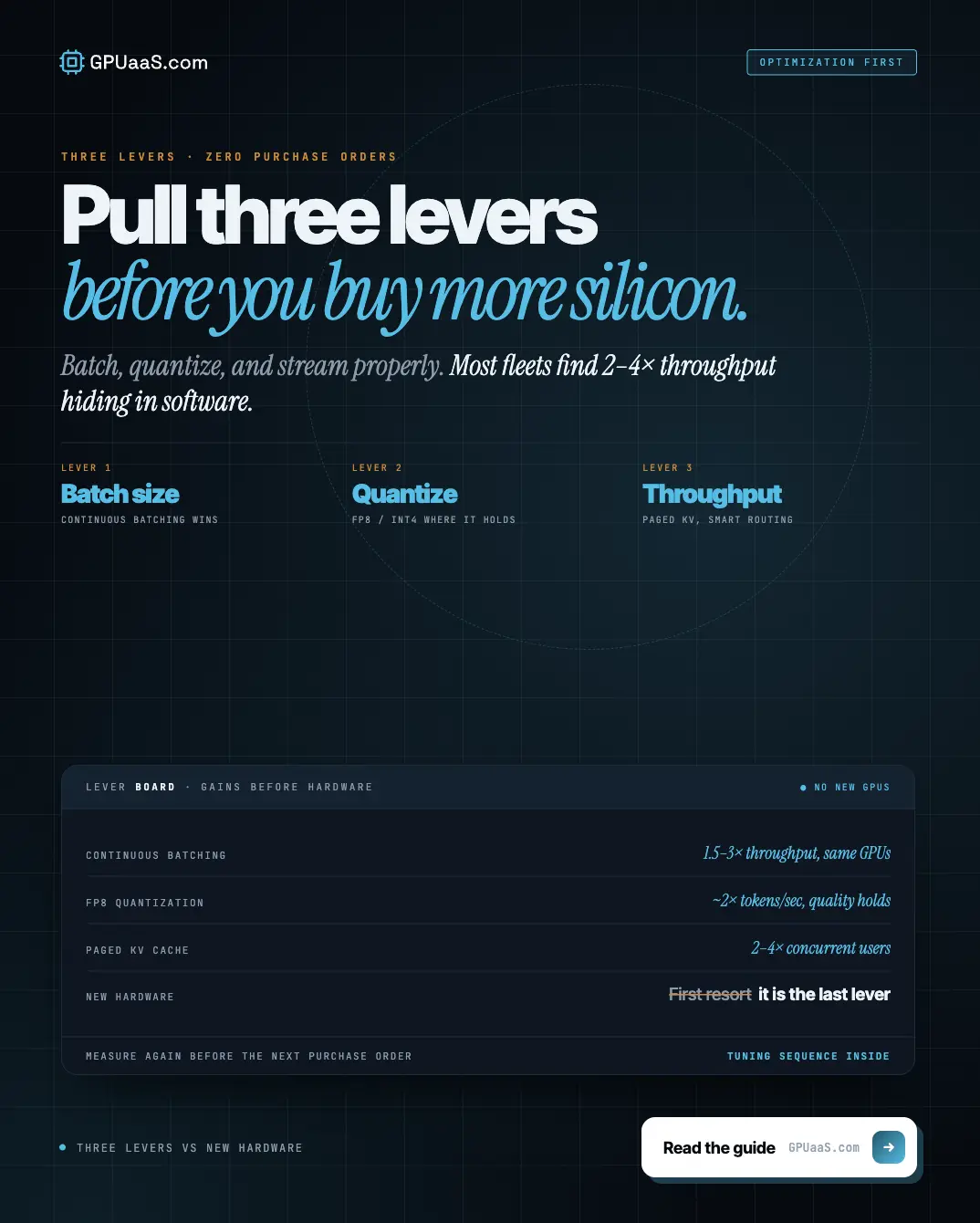
Batch size 1 to 64 on a single A100 delivers 26.6x throughput. Software levers routinely exceed a generational hardware jump, and they compound.
Batch Size, Quantization, Throughput: Three Levers That Beat New Hardware
GPUaaS.com Team
GPU Infrastructure
September 14, 2026
No items found.
On a single A100 running Llama 3 8B, moving from batch size 1 to batch size 64 increases throughput by 26.6 times at 2048-token length.
No hardware change. A configuration value.
Key takeaways
Batch size 1 to 64 on a single A100 delivers 26.6x throughput. That is larger than any generational hardware jump currently on offer
What caps batch size is memory, not compute. Every byte freed by quantization becomes batch capacity, so the two levers multiply
INT4 cuts memory 75%, enough to move a 70B model from two GPUs to one. That alone is a 50-75% reduction in serving spend
Speculative decoding is mathematically free, with output identical to standard decoding, but the gain collapses on unpredictable output
Quantization failure is silent. Nothing errors, answers just get worse, and without a fixed test set from real traffic there is no way to detect it
◆ WHAT EACH LEVER DELIVERS
Technique
Measured gain
Quality cost
Batch size 1 to 64
26.6x throughput
None, but latency rises
INT8 quantization
50% memory reduction
Typically under 1%
INT4 quantization
75% memory, up to 2.24x throughput
Workload dependent, must measure
Speculative decoding
1.5-3x on predictable output
Zero, output is identical
PagedAttention, prefix caching
2-4x throughput
None
Sources: LLM-Inference-Bench (Llama 3 8B, vLLM, single A100), QQQ quantization benchmarks on Llama 2 13B, MyEngineeringPath inference optimization analysis, March 2026
◆ WHY BATCHING IS THE LARGEST LEVER
Fixed costs happen once per batch, not once per request
Throughput rises with batch size until compute and memory saturate. The GPU processes more sequences at once, and fixed costs like kernel launch happen once per batch rather than once per request. Continuous batching, default in vLLM and TensorRT-LLM, admits new requests as slots free rather than waiting for a batch to drain. Static batching leaves the device idle whenever one sequence in a batch finishes early and the rest are still generating.
What caps batch size is memory, not compute. At 2048-token sequence length, KV cache growth can limit a batch to around seven sequences. Every byte freed elsewhere becomes batch capacity.
◆ QUANTIZATION RAISES THE BATCHING CEILING
The two levers multiply rather than add
INT8 quantization halves memory at typically under 1% quality loss. INT4 through AWQ or GPTQ cuts memory 75%, enough to move a 70B model from two GPUs to one. On a serving deployment that is a 50 to 75% reduction in GPU spend.
Throughput improves too. Benchmarked on Llama 2 13B, a well-implemented 4-bit scheme runs up to 2.24 times faster than FP16, 2.10 times faster than SmoothQuant, and 1.59 times faster than AWQ. The advantage grows with batch size rather than shrinking, and larger models benefit more than smaller ones.
The two levers multiply rather than add. Halving memory doubles the space available for batching, so quantization raises the ceiling on the first lever while lowering per-token cost. Teams applying both see gains well beyond either alone.
26.6x
throughput increase from moving batch size 1 to 64 on a single A100, a configuration change larger than any generational hardware jump currently on offer
LLM-Inference-Bench, Llama 3 8B on vLLM, 2048-token length
◆ THE ONE THAT COSTS NOTHING IN QUALITY
Speculative decoding, and where it collapses
Speculative decoding is mathematically free. A small draft model proposes tokens, the large model verifies them in one forward pass, and verification costs less than generation. Speedup runs 1.5 to 3 times and the output is identical to standard decoding.
The gain depends on output predictability. Structured data and templated responses give the draft model a high hit rate. Creative writing drives it down and the speedup approaches zero. Worth testing on production traffic rather than assuming.
PagedAttention and prefix caching deliver 2 to 4 times throughput and take a day or two to configure. Most modern serving stacks enable them by default, which is worth verifying rather than assuming.
◆ THE CHEAPEST LEVER OF ALL
Prompt length is billed on every request
Prompt optimization sits below all of these in effort and above most in return. Shorter system prompts reduce prefill cost on every single request, and prefix caching makes a shared system prompt close to free after the first call. Teams running a 2,000-token system prompt on every request are paying for it on every request.
◆ ORDER OF OPERATIONS
Applying the wrong technique produces effort without improvement
Cost, latency, throughput and quality are different problems with different fixes. Identify which one binds, apply the lowest-effort intervention that addresses it, measure again on the same evaluation suite, roll back if quality dropped.
◆ WHERE DISAPPOINTING RESULTS COME FROM
Quantization failure is silent
Quantizing without benchmarking on your own data is where most disappointing results come from. MMLU and HumanEval scores do not reflect a specific production workload. A model that holds up on academic benchmarks can degrade badly on domain-specific queries after quantization. Mathematical reasoning is particularly sensitive because quantization loses numerical precision directly. Models below 13B suffer proportionally more, having less redundancy to absorb the loss.
Quality evaluation needs a fixed test set drawn from real traffic before any of this starts. Without a baseline measured on the same set, there is no way to tell whether a 4-bit conversion cost anything, and the failure mode is silent. Nothing errors. Answers just get slightly worse in ways that surface as user complaints weeks later.
Traffic patterns shift and techniques mature. A quarterly revisit is enough.
◆ THE PROCUREMENT CONSEQUENCE
Buying more of the same configuration buys more waste
Before signing for more GPUs, the question worth answering is whether the current fleet runs at default batch settings in FP16. If it does, the available software gains likely exceed what the expansion delivers, at a fraction of the cost. A 26.6x throughput difference from a configuration value is larger than any generational hardware jump on offer.
This is the same pattern as a dashboard reporting 100% utilization on a fleet doing very little useful work. Capacity looks exhausted because the configuration is wasting it, and buying more of the same configuration buys more waste.
There is a provider-side version of this question too. A quote priced against default-configuration throughput assumes a number of GPUs that an optimized stack would not need. Running the optimization work before requesting the quote changes what gets ordered, not just what it costs.
None of this argues against upgrading hardware. It argues for exhausting the free levers first, because the measurement that tells you whether more GPUs will help is the same one that tells you whether the current ones are configured properly. For how that measurement changes cluster sizing, see B300 cluster sizing.
Get quoted against optimized throughput.
Not default settings. No buyer fees. For single GPUs, packet.ai handles self-serve access with 24/7 human support.
Benchmarked on Llama 3 8B on a single A100 at 2048-token length, moving from batch size 1 to 64 increases throughput 26.6 times. Fixed costs like kernel launch happen once per batch rather than once per request, and the GPU processes more sequences simultaneously.
Because batch size is capped by memory rather than compute. Halving memory usage through INT8 doubles the space available for batching, so quantization lowers per-token cost and raises the ceiling on the larger lever at the same time. The two multiply rather than add.
INT8 typically costs under 1%. INT4 is workload dependent and must be measured on your own traffic, since MMLU and HumanEval scores do not reflect a specific production workload. Mathematical reasoning is particularly sensitive, and models below 13B suffer proportionally more.
When output is unpredictable. The draft model's hit rate drives the gain, so structured data and templated responses see 1.5 to 3 times speedup while creative writing and novel reasoning approach zero. The output is mathematically identical either way, so there is no quality risk in testing it.
If the current fleet runs at default batch settings in FP16, yes. The available software gains likely exceed what an expansion delivers at a fraction of the cost. A quote priced against default-configuration throughput also assumes more GPUs than an optimized stack needs, so the optimization work changes what gets ordered rather than only what it costs.
Last reviewed: 15 September 2026. Batch size throughput scaling from LLM-Inference-Bench benchmarking of Llama 3 8B on vLLM, single A100. Quantization throughput comparisons from the QQQ quantization paper, benchmarked on Llama 2 13B against FP16, SmoothQuant, AWQ and Marlin under continuous batching and paged attention. Memory reduction figures, speculative decoding speedups, and combined cost reduction estimates from MyEngineeringPath's inference optimization analysis, March 2026. Continuous batching mechanics from Anyscale's LLM inference benchmarking, February 2026. Browse current GPU cluster availability on GPUaaS.com.