Blog ▸ DGX B300 vs HGX B300: What the Price Difference Actually Buys
GPU Infrastructure
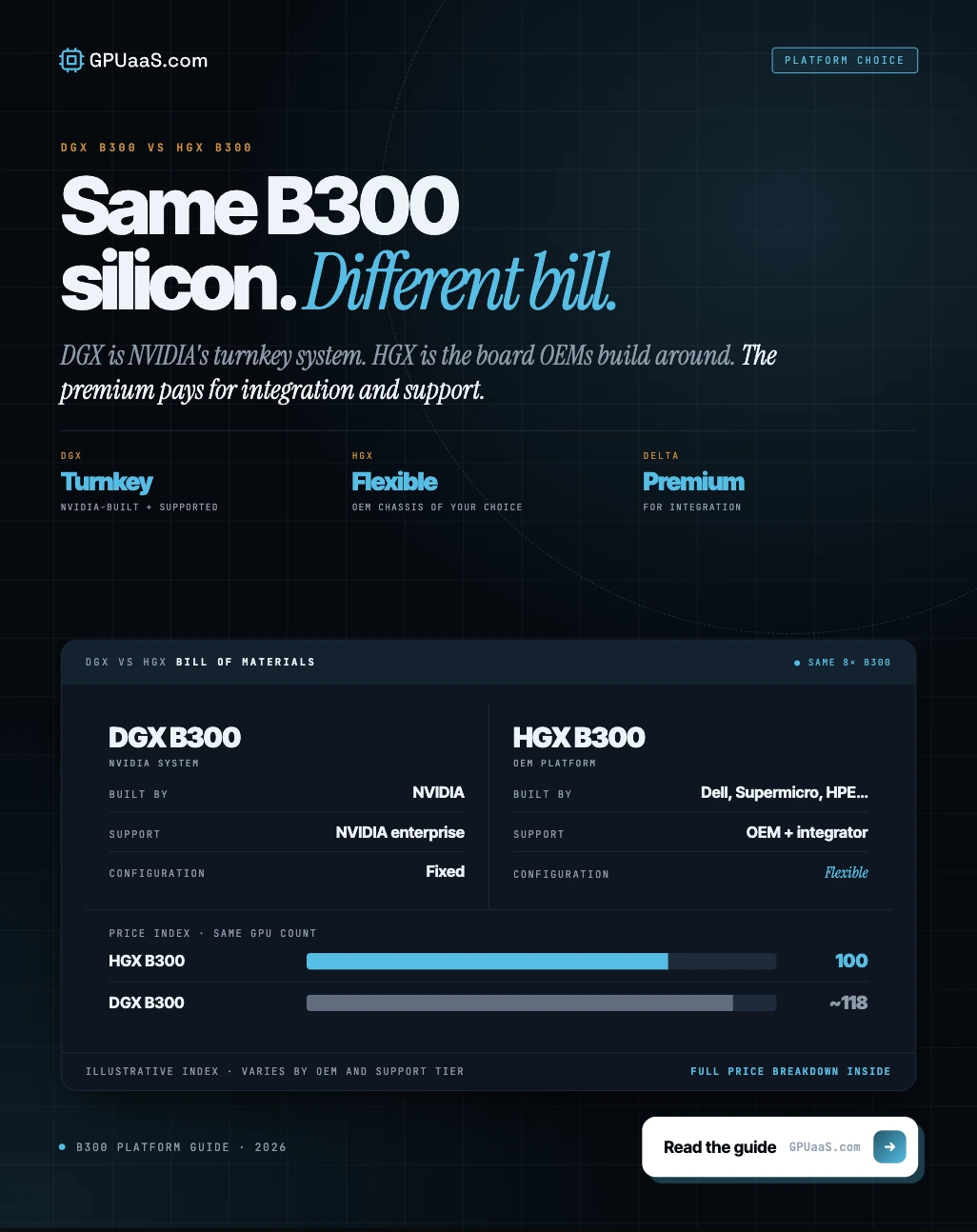
DGX is a brand, HGX is a board, and the invoice knows the difference. The surprise in the published numbers is which one costs more, and why neither matters to a rental buyer.
DGX B300 vs HGX B300: What the Price Difference Actually Buys
GPUaaS.com Team
GPU Infrastructure
October 7, 2026
No items found.
DGX B300 is NVIDIA's own fixed-configuration appliance with NVIDIA support, quoting around $400,000 to $500,000 fully configured in Q4 2026. HGX B300 is the baseboard that Supermicro, Dell, Lenovo and HPE build their own servers around, quoting anywhere from about $500,000 to $795,000 depending on what the OEM wraps around it.
The two get confused constantly, and the confusion costs money in both directions. Buyers budget for a DGX and get quoted an HGX build that is $200,000 higher, or assume HGX is the budget option and find that a liquid-cooled OEM configuration is the most expensive thing on the quote. This post sets out what each one is, what the invoice difference actually buys, and which one makes sense when the plan is to rent the capacity out rather than run it yourself.
Key takeaways
DGX is a brand and a product: a complete 10U NVIDIA-built system. HGX is a baseboard that OEMs integrate into their own chassis
Both carry the same eight B300 GPUs, 2.3TB of HBM3e and NVLink Switch. The silicon is identical
DGX B300 is air-cooled at 14.5 kW in one chassis. HGX B300 is available liquid-cooled and in denser configurations NVIDIA does not sell as DGX
NVIDIA publishes no list price for DGX B300. Reseller quotes run $400,000 to $500,000; an OEM HGX B300 build runs $500,000 to $795,000 in published listings
The DGX premium buys NVIDIA-validated integration, the DGX software stack and one support contract, not more silicon
For rental capacity, buyers quote the GPU and the interconnect, not the chassis brand. The committed B300 band is $5.00 to $6.50 per GPU-hour either way
◆ THE DISTINCTION
DGX is a product, HGX is a part
DGX B300 is a system NVIDIA designs, builds, ships and supports as one unit: eight B300 GPUs on the HGX baseboard, two Intel Xeon 6776P CPUs, 2TB of system memory, eight ConnectX-8 SuperNICs at up to 800 Gb/s each, two BlueField-3 DPUs, NVMe storage, all in a 10U air-cooled chassis with DGX OS, NVIDIA AI Enterprise, Base Command and Mission Control preinstalled. You cannot change the CPU, the memory, the NIC count or the cooling. That is the point of it.
HGX B300 is the baseboard inside that system: the eight GPUs, the NVLink Switch fabric and the PCIe connectivity, sold by NVIDIA to OEMs who put it in their own server. Supermicro, Dell, Lenovo, HPE and others each build an HGX B300 product line with their own choice of CPU, memory, storage, NICs, chassis and cooling. Some of those are air-cooled and look much like a DGX. Others are liquid-cooled, denser, or built for a specific rack standard.
So every DGX B300 contains an HGX B300. Not every HGX B300 is a DGX. When a search query says "DGX B300 price" the buyer usually means "8-GPU B300 server price," and the answer depends entirely on which of the two they end up buying.
◆ DGX B300 VS HGX B300, SIDE BY SIDE
Item
DGX B300
HGX B300 (OEM build)
Who builds it
NVIDIA
Supermicro, Dell, Lenovo, HPE, Aivres and others
GPUs and memory
8x B300, 2.3TB HBM3e
8x B300, 2.3TB HBM3e
CPU
2x Intel Xeon 6776P, fixed
OEM choice; Xeon 6 or EPYC, various SKUs
Compute NICs
8x ConnectX-8, 800 Gb/s each
Typically 8x ConnectX-8; configurable
Cooling
Air, 10U, 14.5 kW system max
Air or direct liquid; denser options exist
Software
DGX OS, AI Enterprise, Base Command, Mission Control
Bring your own; AI Enterprise licensed separately
Support
One NVIDIA Enterprise contract, whole system
OEM hardware support; NVIDIA for the GPUs
Published price range
$300,000 to $350,000 baseline; $400,000 to $500,000 configured
$496,728 integrator listing to $785,607 Lenovo and $795,000 high listing
Committed rental band
$5.00 - $6.50 / GPU-hr
$5.00 - $6.50 / GPU-hr
Specifications from NVIDIA DGX B300 documentation as compiled by GPUSmith and NADDOD. Prices from published reseller and OEM listings, June to October 2026, excluding VAT. NVIDIA publishes no DGX list price. Rental band from the GPUaaS.com October 2026 benchmark.
◆ WHAT THE INVOICE DIFFERENCE BUYS
Integration, software and one throat to choke
The surprising thing in the published numbers is that the DGX is not the expensive option. Reseller quotes for a configured DGX B300 cluster around $400,000 to $500,000, while OEM HGX B300 builds from Lenovo and others are listing above $785,000. That inverts the usual assumption, and the reason is what the OEM wraps around the baseboard: higher-core CPUs, more system memory, more NVMe, liquid cooling loops, and an OEM support contract priced for enterprise accounts. The HGX baseboard itself is the same.
What the DGX buys that an HGX does not is the validated stack. NVIDIA has tested that exact combination of firmware, drivers, NICs, OS and orchestration together, ships it that way, and supports all of it under one contract. For a team without infrastructure engineers who want to run NVIDIA's reference software, that is worth real money in time not spent. For a team with its own platform, its own orchestration and its own preferred CPU, it is money spent on things they will replace.
The B300 node price breakdown works through where the money goes inside an 8-GPU node and lands on the same conclusion: the GPUs are the smaller half of the bill on a high-end HGX build, and the spread between the cheapest and most expensive node with the same eight GPUs is 2.6x.
14.5 kW
system power on an air-cooled DGX B300, in a single 10U chassis. Air-cooled is not the same as easy to site
NVIDIA DGX B300 specifications, 2026
◆ COOLING AND FACILITY
The air-cooled DGX is a colocation problem, the liquid HGX is a facility problem
DGX B300 is air-cooled, which sounds like the easy option until the number is read. It draws up to 14.5 kW and moves around 1,500 CFM of air through one 10U chassis. Most legacy colocation racks are provisioned at 10 to 20 kW for the whole rack. One DGX B300 per rack is feasible in a lot of facilities; two is a conversation with the data center; four is a new contract. Hot-aisle containment stops being optional, and facilities running warm supply-air setpoints for efficiency need to re-check them before swapping a B300 into a slot that held a B200.
HGX B300 in a liquid-cooled OEM chassis solves the density problem and creates a different one: the facility needs a coolant distribution unit, manifolds and a liquid loop. Where that exists, four to eight B300 nodes per rack is routine. Where it does not, the capex to add it is counted in the hundreds of thousands and the lead time in months. This is why the HGX liquid-cooled build costs more and why it is the configuration most hyperscaler and neocloud operators actually deploy.
For a buyer who is renting rather than owning, none of this is their problem, which is the strongest argument in this post for renting B300 in 2026. The provider has already solved power and cooling, and the committed band prices the GPU-hour, not the chassis.
◆ FOR RENTAL
Buyers quote the GPU and the fabric, not the badge
Across requests through the GPUaaS.com network, almost nobody specifies DGX or HGX. They specify B300, a GPU count, a term, a region, and whether the inter-node fabric is InfiniBand or Ethernet. The committed band this month is $5.00 to $6.50 per GPU-hour on either chassis, and where a quote lands inside that band is set by term length, cluster size, interconnect and region. The October benchmark covers how to read the band.
That has an implication for anyone buying nodes with the intention of renting them out. The DGX premium for software and single-vendor support is invisible to a rental buyer, who brings their own stack and never calls NVIDIA. The HGX premium for liquid cooling and density is invisible too, except that it lets a provider put more GPUs in the same facility footprint, which shows up in their margin rather than in the quote. A provider buying for rental should optimise for cost per GPU-hour over three years, which the node price post puts between $3.06 and $8.05 depending on purchase price and facility cost.
The B300 vs B200 comparison covers whether B300 is the right part at all, and for teams who want a single B300 rather than an 8-GPU node, packet.ai handles self-serve access without the chassis question arising.
Skip the chassis decision. Get a B300 cluster quote.
Submit a spec and quotes come back within a few hours, sourced across 20+ vetted partners. No buyer fees. Power and cooling are the provider's problem.
DGX B300 is a complete NVIDIA-built system: eight B300 GPUs, fixed Xeon 6776P CPUs, ConnectX-8 NICs, the DGX software stack and one NVIDIA support contract in a 10U air-cooled chassis. HGX B300 is the GPU baseboard inside it, which OEMs such as Supermicro, Dell and Lenovo build their own servers around, including liquid-cooled variants.
NVIDIA publishes no list price. Reported baseline pricing was $300,000 to $350,000 in early 2026, with fully configured reseller quotes running $400,000 to $500,000 depending on support term and region. OEM HGX B300 builds list higher, from about $497,000 to $795,000, because of what the OEM adds around the baseboard.
Air-cooled, at up to 14.5 kW in a 10U chassis with roughly 1,500 CFM of airflow. That avoids a liquid loop but exceeds what most legacy colocation racks deliver to a single node, so density is limited to one or two per rack in many facilities. Liquid-cooled B300 is available as HGX from OEMs.
You can rent 8-GPU B300 nodes on committed terms through GPUaaS.com at $5.00 to $6.50 per GPU-hour this month. Whether the provider runs DGX or an OEM HGX chassis rarely matters to the workload, since the GPUs, memory and NVLink fabric are identical. Specify the GPU, count, term and interconnect rather than the chassis brand.
Usually HGX, because rental buyers bring their own software and never use the DGX stack or NVIDIA-direct support, while a liquid-cooled HGX build lets a provider fit more GPUs in the same facility. The exception is a provider in an air-cooled facility with no plan to add liquid, where an air-cooled DGX at a reseller quote can be the cheaper node.
Not on the GPU. Both use the same eight B300 GPUs, 2.3TB of HBM3e and NVLink Switch fabric. Differences in CPU, system memory, NIC configuration and cooling can change multi-node throughput and sustained clocks at the margin, which is why a liquid-cooled HGX build can hold boost clocks longer under full load than an air-cooled chassis.
Last reviewed: 8 October 2026. DGX B300 specifications and reseller pricing from GPUSmith and NADDOD, 2026. OEM HGX B300 pricing including the Lenovo SR680a V4 figure from gpuperhour.com, September 2026. Node cost breakdown from the GPUaaS.com B300 node price post. Committed cluster bands from the GPUaaS.com October 2026 benchmark. Hardware prices move frequently and should be confirmed before use in a model. Browse current B300 cluster availability on GPUaaS.com.