A data centre operator who has built a GPU hall has already solved power, cooling, financing and uptime. What is usually missing is a buyer pipeline.
The obvious answer is to hire a sales team. The arithmetic says that is rarely the right first move, and this post works through why, what a demand channel takes on instead, and what an operator should keep in house.
- Selling GPU capacity needs a pipeline, technical sales support, billing, contracts and ongoing marketing, which is a second business
- For illustration, a sales and solutions pair costing $400,000 a year needs about 2.3 fully committed 8-GPU nodes at $2.50 per GPU-hour just to cover itself
- An idle H100 costs roughly $30 a day, so empty capacity is a running cost rather than a neutral state
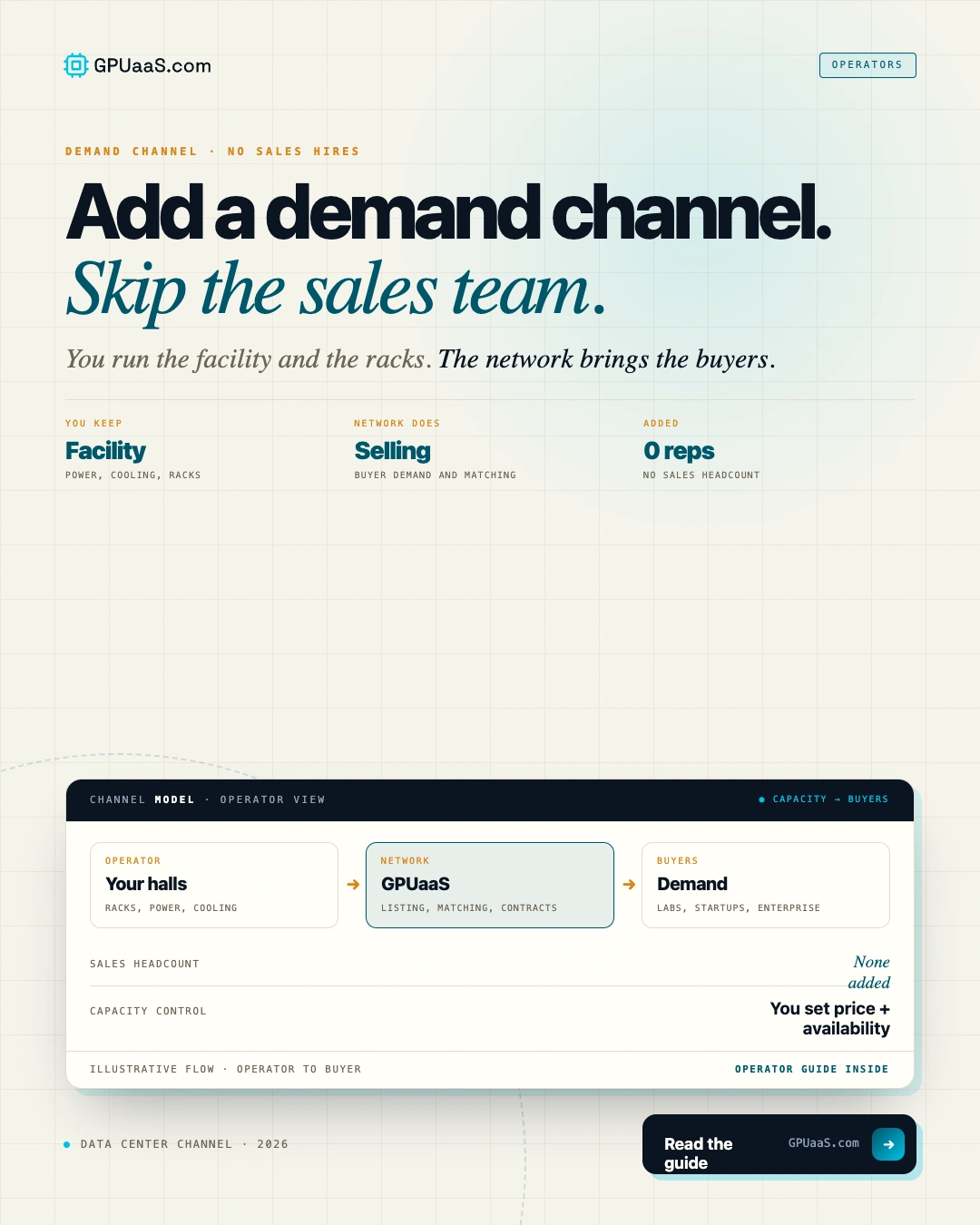
- A demand channel takes on buyer discovery, qualification and quoting. The operator keeps the facility, the hardware and the service
- Start with a single node to test whether demand exists for what you own
- Buyers ask facilities about power density, cooling, interconnect and support before they ask about price
The operator's actual problem
Facilities that were built for colocation, enterprise hosting or crypto have found themselves holding GPU capacity they cannot fill. The hardware is financed, the power is contracted and the racks are populated. Depreciation and contracted power run whether or not a customer is attached, and a single idle H100 costs about $30 a day.
Operators tend to diagnose this as a marketing problem and respond with a website and a rate card. A rate card gets found by buyers who already know the operator exists. Large committed buyers, who matter most, do not browse rate cards. They ask for quotes against a specification, and they ask several providers at once.
What a sales function really requires
An enterprise infrastructure sale is not a form submission. It needs someone to find and qualify buyers, someone technical enough to discuss interconnect tiers, cluster topology and checkpoint behaviour, and someone to produce a quote in a form a procurement team can sign. After the sale it needs billing that handles committed terms and overages, a contract template, an SLA that can be defended and support hours that match a buyer's expectations rather than the operator's.
On top of that sits marketing, because buyers must be able to find the operator at all, and the management overhead of running a team in a market that moves monthly. Median H100 on-demand rates rose 15% year over year to $3.42 per GPU-hour in late September, against widespread expectations of a fall. Pricing a committed cluster correctly means someone watching those movements continuously.
The break-even arithmetic
Take an illustrative fully loaded cost of $400,000 a year for one enterprise seller and one solutions engineer, before marketing, tooling or management. An eight-GPU node supplies 70,080 GPU-hours a year. Committed at $2.50 per GPU-hour and fully booked, it earns $175,200.
That means about 2.3 fully committed nodes simply to pay for the two people. At a more realistic 70% utilization the figure is closer to 3.3 nodes. An operator with 8 to 16 nodes would be spending a fifth to a third of gross capacity revenue on sales headcount before the first deal closes, and a sales hire takes months to produce a pipeline.
| Fleet size | Gross revenue at $2.50, fully booked | Sales pair as share |
|---|---|---|
| 4 nodes (32 GPUs) | $700,800 | 57% |
| 8 nodes (64 GPUs) | $1,401,600 | 29% |
| 16 nodes (128 GPUs) | $2,803,200 | 14% |
| 32 nodes (256 GPUs) | $5,606,400 | 7% |
The ratio only becomes comfortable above a few hundred GPUs. Below that, a sales team is a cost that exceeds what it is meant to protect, which is why so much capacity at small and mid-sized operators simply sits.
What a demand channel takes on
A demand channel supplies the part of the work that is hardest to do at small scale: buyer discovery, qualification of requests and getting a quote in front of someone with a real requirement. Requests arrive specified by GPU, cluster size, term and region, and listed capacity is matched against buyers already searching for something similar.
The operator keeps what it already does well: the facility, the hardware, the service quality and the day-to-day operation of the cluster. Nothing about the physical business changes. What changes is that requests start to arrive without a seller being hired to generate them.
What buyers will ask your facility
Power density comes first on current hardware. A B300 node draws about 14.5 kW, and Blackwell-class racks can reach 50 to 150 kW, while many existing halls were designed for 8 to 12 kW racks. Buyers will ask what density each rack supports, whether cooling is air or liquid and what the contracted power headroom is.
Interconnect follows. InfiniBand versus Ethernet changes multi-node training throughput, and it is the first technical question on anything beyond a single node. After that come uptime commitments, replacement policy, support hours and where the data physically sits. An operator who can answer those in writing shortens every quote that follows.
Start with one node
The usual objection is scale: a demand channel must only work for someone with a thousand GPUs. It does not. A single node is enough to list, and sixteen-GPU requests from teams fine-tuning on a deadline are ordinary. Small listings often fill faster than large ones because more requests fit them.
Listing one node answers the question that matters before any commitment: is there demand for what you own, at a rate you can live with? If requests arrive, list more. If they do not, the cost of finding out was close to nothing.
Capacity that has not arrived yet
Operators waiting on hardware deliveries can list capacity with a future available date. Lead times run 16 to 26 weeks on current-generation Blackwell, and buyers planning a training run commit ahead of delivery when the terms and date are clear. A rack that lands with contracts already attached skips the ramp that normally follows installation.
Where operators go wrong
The most common mistake is slow response. Buyers receive quotes in under 24 hours, and a provider who takes three days to answer a technical question loses the deal to one who answers in three hours. The second is overstating the specification, since an interconnect or a cooling claim that does not survive a buyer's due diligence ends the relationship permanently.
The third is pricing without a cost floor. A rate set by looking at competitors rather than at the cost to hold a GPU-hour will eventually land below what the capacity costs to run. The case for selling without building a cloud business covers the wider argument.
List your capacity and start getting quoted.
One node is enough to start. There is no cost to apply or list.
Apply as a providerFrequently asked questions
Do I need a sales team to sell GPU capacity?
Not necessarily. A sales and solutions pair costing an illustrative $400,000 a year needs roughly 2.3 fully committed 8-GPU nodes just to cover itself, so below a few hundred GPUs a demand channel is usually cheaper than building the function.
What does a demand channel handle?
Buyer discovery, qualification of requests and getting a quote in front of someone with a real requirement. The operator keeps the facility, the hardware and day-to-day operation of the cluster.
How many GPUs do I need to start?
One node is enough. Sixteen-GPU requests are ordinary, and small listings often fill faster than large ones because more requests fit them.
What will buyers ask about my facility?
Power density per rack, air or liquid cooling and contracted power headroom first, then interconnect tier, uptime commitment, replacement policy, support hours and data location.
Can I list capacity before the hardware arrives?
Yes. Capacity can be listed with a future available date, so a rack can arrive with contracts already attached.
Last reviewed: 23 October 2026. Headcount cost is an illustrative assumption and should be replaced with your own figures. Idle H100 cost and on-demand median from published utilization and market data, 2026. Node power draw and rack density ranges from Haink's AI infrastructure cost guide, 2026. Lead times from Presenc AI GPU supply research. Revenue arithmetic assumes $2.50 per GPU-hour across 70,080 GPU-hours per node-year. Apply to list GPU capacity on GPUaaS.com.