{"@context":"https://schema.org","@graph":[{"@type":"Service","@id":"https://gpuaas.com/gpu-cloud-usecase-pillars/llm-training#service","name":"GPU Cloud for LLM Training","provider":{"@type":"Organization","name":"GPUaaS.com","url":"https://gpuaas.com"},"serviceType":"GPU cloud infrastructure","description":"Wholesale multi-node GPU clusters for LLM training on InfiniBand from vetted partners, with node count and interconnect stated in the quote."},{"@type":"WebPage","@id":"https://gpuaas.com/gpu-cloud-usecase-pillars/llm-training#webpage","url":"https://gpuaas.com/gpu-cloud-usecase-pillars/llm-training","name":"GPU Cloud for LLM Training","isPartOf":{"@type":"WebSite","name":"GPUaaS.com","url":"https://gpuaas.com"}},{"@type":"BreadcrumbList","@id":"https://gpuaas.com/gpu-cloud-usecase-pillars/llm-training#breadcrumb","itemListElement":[{"@type":"ListItem","position":1,"name":"Home","item":"https://gpuaas.com"},{"@type":"ListItem","position":2,"name":"GPU Cloud","item":"https://gpuaas.com/cluster"},{"@type":"ListItem","position":3,"name":"GPU Cloud for LLM Training","item":"https://gpuaas.com/gpu-cloud-usecase-pillars/llm-training"}]},{"@type":"FAQPage","@id":"https://gpuaas.com/gpu-cloud-usecase-pillars/llm-training#faq","mainEntity":[{"@type":"Question","name":"How many GPUs do I need to train a model?","acceptedAnswer":{"@type":"Answer","text":"It depends on model size and deadline. Memory per GPU sets how much sharding you need, and sharding costs throughput, so H200 at 141 GB and B200 at 192 GB reduce the count needed against 80 GB cards."}},{"@type":"Question","name":"How should I think about training cost?","acceptedAnswer":{"@type":"Answer","text":"In time to convergence, not hourly rate. The median on-demand H100 rate was $3.33 per GPU-hour across 40 providers as of 31 August 2026, with B200 averaging $7.63. A dearer GPU that halves wall-clock time is cheaper overall."}},{"@type":"Question","name":"Does interconnect matter more than GPU choice?","acceptedAnswer":{"@type":"Answer","text":"Past a single node, yes. Gradient synchronisation happens every step, so interconnect bandwidth caps effective throughput regardless of how fast the GPUs are. Quotes state node count and interconnect."}},{"@type":"Question","name":"What commitment term suits a training run?","acceptedAnswer":{"@type":"Answer","text":"Training runs are long, so capacity standing ready for the duration is the usual structure, with a commitment term matched to the run. Terms vary by operator."}},{"@type":"Question","name":"Where should training capacity be placed?","acceptedAnswer":{"@type":"Answer","text":"Wherever power is cheapest, in most cases. A multi-week run at scale is dominated by electricity, and latency to users is irrelevant during training."}},{"@type":"Question","name":"Do data rules apply to training runs?","acceptedAnswer":{"@type":"Answer","text":"Generally to the training corpus rather than the weights. Processing a regulated corpus outside its jurisdiction needs a lawful transfer basis. Capacity is available in the jurisdiction you specify."}}]}]}
GPUAAS.COM · WHOLESALE GPU NETWORK / A HOSTED·AI SERVICE ◆ CAPACITY AVAILABLE · 20+ PARTNERSQUOTES < 24HREV 2026.09
+
+
GPU cloud for LLM training · cluster structure confirmed
◆ AVAILABLE

GPU cloud
for LLM training
, at

wholesale price.

H100, H200, B200, B300, GB300, Vera Rubin and more from vetted partners, with cluster structure confirmed before you commit, at
~30% less than hyperscale. Quotes in under 24 hours.

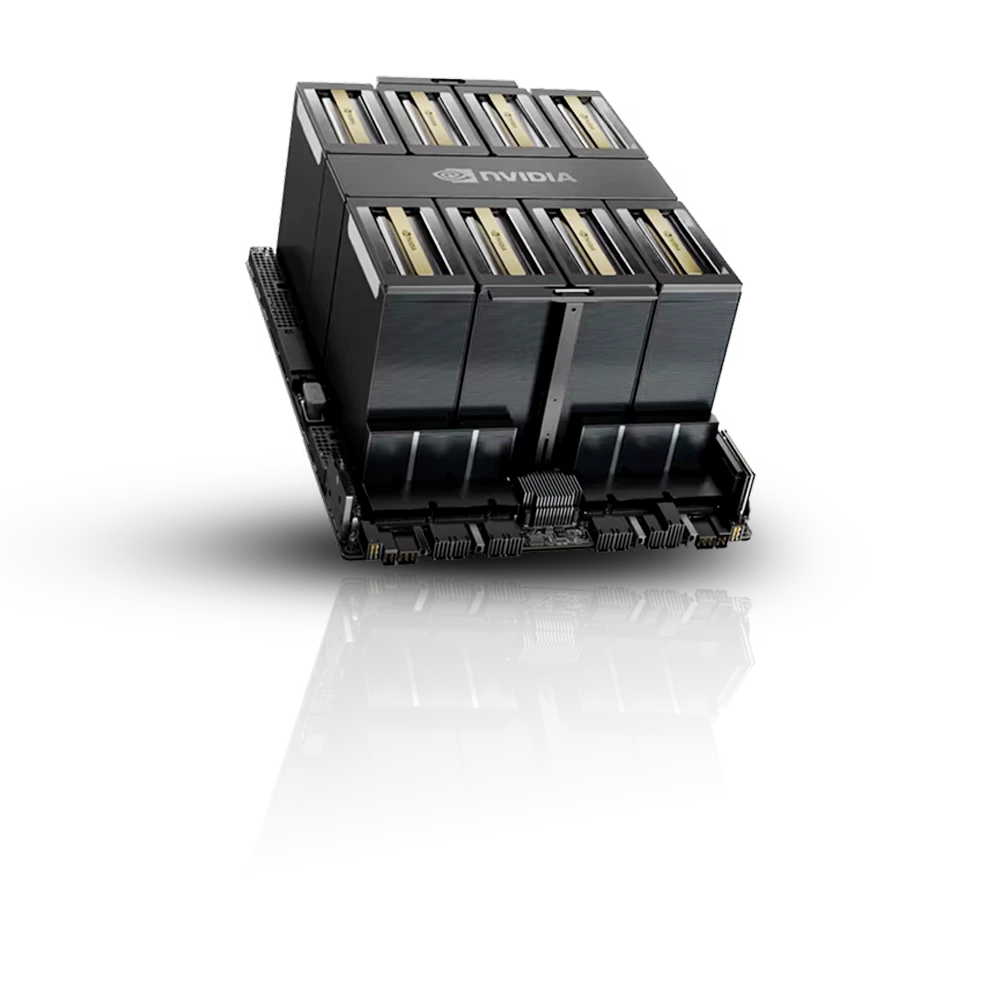
HGX GPU node
GPU generations
4
Architectures
Hopper + Blackwell
Vetted partners
20+
Quote turnaround
24 hrs
Commitment
Short / long
QUOTES IN UNDER 24 HOURS VETTED PARTNERS WORLDWIDE SHORT OR LONG TERM COMMITMENT DIRECT OPERATOR CONTRACTS CAPACITY AVAILABLE NOW PLACEMENT YOU SPECIFY
◆ THE SHORT ANSWER

Training is where the interconnect matters more than the GPU. A cluster of fast GPUs on slow networking trains more slowly than fewer GPUs on InfiniBand, because gradient synchronisation becomes the bottleneck. What decides your bill is time to convergence, not hourly rate, and that depends on cluster structure as much as on silicon. We have multi-node capacity on InfiniBand from vetted partners, with the structure stated up front.

+
01
◆ CLUSTER STRUCTURE

What interconnect does to throughput

Gradient synchronisation happens every step, so the fabric caps what your GPUs can deliver regardless of how fast they are.

8 nodes on standard ethernet
Sync becomes the bottleneck every step
scales poorly
4 nodes on InfiniBand
Fewer GPUs, but they are all working
beats 8 on ethernet
8 nodes on high-bandwidth RoCE
Workable, with tuning
scales adequately
8 nodes on InfiniBand
Gradient sync keeps pace with compute
scales well
+
02
Where training capacity earns its keep

What each training pattern demands of the cluster.

/01

Pretraining at scale

Distributed training from scratch across many nodes, where interconnect bandwidth and memory per GPU decide throughput far more than headline compute figures.
Distributed training · InfiniBand · FSDP
/02

Continued pretraining

Extend an existing base model on domain data, a shorter run than pretraining but with the same topology requirements and sharding constraints.
Continued pretraining · DeepSpeed
/03

Mixture-of-experts training

Train mixture-of-experts architectures where total parameters far exceed active parameters, so memory capacity and routing bandwidth set the ceiling.
MoE · expert parallel · 192 GB
/04

Research and ablations

Run architecture and hyperparameter sweeps at small scale before committing to a long run. Short, parallel and cheaper than the run they de-risk.
Sweeps · ablations · short runs
+
03
◆ LIVE NETWORK · 12 LOCATIONS

Vetted GPU partners worldwide, sized for multi-week runs.

Training is the workload least sensitive to latency and most sensitive to power cost. Tell us the GPU count and placement you want and you contract directly with the operator.

4
GPU GENERATIONS
20+
VETTED PARTNERS
12
PLACEMENT OPTIONS
24h
QUOTE TURNAROUND
USA CAN UK DEU FRA NLD UAE SAU IND SGP JPN AUS
+
04
◆ HOW IT WORKS

A matchmaker, not a marketplace.

We connect you to our vetted partners. You contract directly with the operator running your nodes.

STEP 01/4
01

Tell us the requirement

GPU model, count, placement and timeline. Add workload detail if you have it.

STEP 02/4
02

We match capacity

We find vetted partners with capacity that fits, in the jurisdiction you need.

STEP 03/4
03

Quotes in 24 hours

Real quotes from partners who hold the capacity, not listings that may not exist.

STEP 04/4
04

Contract and provision

You contract directly with the operator. We smooth the provisioning process.

below hyperscale list. Same silicon, wholesale rates.
stop overpaying for compute.
~30%
◆ RATES VARY BY GENERATION, TERM AND PLACEMENT
+
05
◆ FAQ

Frequently Asked Questions

Q1
How many GPUs do I need to train a model?

It depends on model size and deadline rather than on ambition. Memory per GPU sets how much sharding you need, and sharding costs throughput, so H200 at 141 GB and B200 at 192 GB reduce the count needed against 80 GB cards. Tell us the GPU count and generation you want and we return wholesale rates.

Q2
How should I think about training cost?

In time to convergence, not hourly rate. Market-wide the median on-demand H100 rate was $3.33 per GPU-hour across 40 providers as of 31 August 2026, with B200 averaging $7.63. A more expensive GPU that finishes in half the wall-clock time is cheaper overall, and that is usually the case at scale where interconnect and memory reduce sharding overhead.

Q3
Does interconnect matter more than GPU choice?

Past a single node, yes. Gradient synchronisation happens every step, so interconnect bandwidth caps your effective throughput regardless of how fast the GPUs are. Quotes state the cluster structure, including node count and interconnect, rather than leaving you to discover it after provisioning.

Q4
What commitment term suits a training run?

Training runs are long, so capacity standing ready for the duration is the usual structure, with a commitment term matched to the run. A mid-run interruption is expensive even with checkpointing, because you lose the work since the last checkpoint. Terms vary by operator.

Q5
Where should training capacity be placed?

Wherever power is cheapest, in most cases. A multi-week run at scale is dominated by electricity, so placement in a low-cost energy market can change the total materially. Latency to your users is irrelevant during training, which makes this the workload where placing capacity far from home costs you least.

Q6
Do data rules apply to training runs?

Generally the training corpus rather than the weights. Model weights derived from personal data are usually not themselves personal data, but processing that corpus outside its jurisdiction needs a lawful transfer basis. Tell us the jurisdiction you need and we return rates for capacity there.

◆ GET A QUOTE
Request wholesale rates

in under 24 hours.

Tell us the essentials. We'll line up real quotes from our vetted wholesale partners, and you contract directly with the operator.

Quotes in under 24 hours
Direct contact with operators
Vetted partners, matched to your requirement
20+ vetted providers · 10 regions
Contact
Full Name *
Business Email *
Organization *
Thank you! Your submission has been received!
Oops! Something went wrong while submitting the form.
GPU Requirements
GPU Model *
PRE-SELECTED
Number of GPUs *
Individual GPU count. 1 node = 8 GPUs.
Get the Best Deal
Thank you! Your submission has been received!
Oops! Something went wrong while submitting the form.